
NECO 2026 Government Question Paper
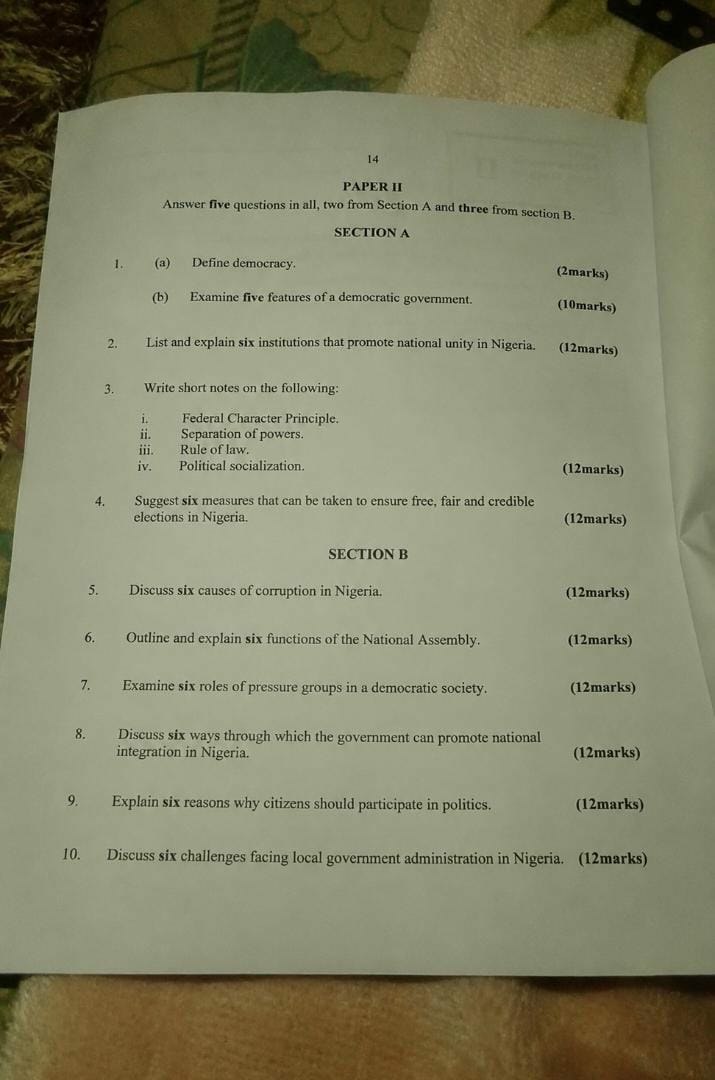
NECO 2026 Government Theory Answers
Below are the verified theory answers for NECO 2026 Government. Pick the required number of points as instructed in each question.
Question 1a: Definition of Government
Government is the institution of the state through which the will of the state is formulated, expressed and implemented. It is the machinery that makes and enforces laws, maintains order, and provides services to the people on behalf of the state.
Question 1b(i): Elements/Features of a State [Pick Any Five]
i. Population
A state must have people who occupy its territory. Without a population there can be no state, because the purpose of the state is to govern people. The population can be large or small.
ii. Territory
A state must have a definite geographical area with defined boundaries. This territory includes land, airspace and waters. The government exercises authority over everyone within this territory.
iii. Government
Every state must have a government. This is the institution that makes laws, enforces them, and administers the state. Without government there would be no authority to maintain order.
iv. Sovereignty
This is the supreme power of the state to make laws and act independently without external interference. A sovereign state is not under the control of any other state. It is the highest authority within its territory.
v. Recognition
For a state to function well in the international community, it must be recognized by other states. Recognition gives it the right to enter into treaties, join international organizations, and conduct foreign relations.
Question 2: Ways a Government Can Derive Legitimacy [Pick Any Six]
i. Free, Fair and Regular Elections
Legitimacy is derived when a government emerges through credible elections where citizens vote freely without intimidation, rigging or violence. Regular elections also allow the people to renew or reject the mandate of leaders. A government that conducts transparent elections is accepted both locally and internationally. Example: Nigeria’s 1999 general elections gave legitimacy to the Fourth Republic.
ii. Adherence to the Rule of Law
A legitimate government operates within the confines of the constitution. When both leaders and citizens are subject to the same laws, and the judiciary is independent, people develop trust in the system. Arbitrary rule, disobedience of court orders and lawlessness by government officials destroy legitimacy.
iii. Provision of Public Goods and Services
This is called performance legitimacy. When a government provides security of lives and property, good roads, electricity, quality education, healthcare and jobs, citizens willingly obey it. People support a government that improves their standard of living. Failure to deliver basic needs makes a government illegitimate.
iv. Respect for Fundamental Human Rights
A government that protects rights such as freedom of speech, freedom of religion, right to life and freedom of association is seen as legitimate. When a government engages in human rights abuses like extra-judicial killings, unlawful detention and censorship of press, it loses moral and legal authority to rule.
v. Accountability and Transparency
Citizens accept a government that is open about its activities and accountable to the people. Publishing budgets, fighting corruption, declaring assets and allowing public scrutiny of government spending builds confidence. A secretive and corrupt government is regarded as illegitimate because people feel their resources are being mismanaged.
vi. Ideological, Historical and Traditional Basis
Some governments gain legitimacy from history or tradition. A government that led the struggle for independence or liberation enjoys historical legitimacy. In traditional societies, kings and chiefs derive legitimacy from culture and customs. Also, governments that pursue popular ideologies like democracy, nationalism or social justice are accepted by the people.
Question 2b: Agencies/Institutions That Promote National Unity in Nigeria [Pick Any Six]
i. National Youth Service Corps (NYSC)
This scheme requires fresh graduates of tertiary institutions to serve in states other than their states of origin. It promotes national integration by exposing young Nigerians to different cultures, languages, and ethnic groups across the country.
ii. Federal Character Commission (FCC)
This body ensures the equitable distribution of public offices and socio-economic amenities among all states and ethnic groups. It helps prevent the domination of one region or ethnic group over others and promotes a sense of belonging.
iii. National Sports Festival
This biennial sporting event brings together athletes from all the states of the federation and the FCT. It encourages unity, friendship, and peaceful coexistence among Nigerians through healthy competition.
iv. Unity Schools (Federal Government Colleges)
These schools admit students from every state in Nigeria. By learning and living together, students develop mutual understanding, reduce ethnic prejudice, and strengthen national unity.
v. National Orientation Agency (NOA)
The agency educates citizens on government policies, promotes patriotism, and encourages national values. It also creates awareness on the importance of peace, unity, and national integration.
vi. The Judiciary
The judiciary interprets the constitution and settles disputes fairly. By ensuring justice and equality before the law, it strengthens national unity and promotes peaceful coexistence.
vii. The Nigerian Military and Paramilitary Agencies
The Armed Forces, Police, and other paramilitary agencies recruit personnel from all parts of the country. Their training and service together foster unity, discipline, and a shared commitment to national development.
Question 3: Reasons Why a Country May Adopt a Unitary System of Government [Pick Any Six]
i. Small Size and Homogenous Population
Countries that are small in landmass and have people of similar culture, language and religion do not need a complex federal structure. A unitary system is easier to manage and administer. Example: Togo, Ghana and Israel. Federalism would be a waste of resources for such states.
ii. To Promote National Unity and Integration
In a multi-ethnic state where there are tendencies of tribalism and separatism, a unitary system helps to centralize power and enforce national policies. This reduces regionalism and promotes a sense of oneness. The central government can ensure all groups are treated equally.
iii. For Efficient and Quick Decision Making
Because power is concentrated at the center, decisions can be made and implemented quickly without delays. There is no need for consultation between federal and state governments. This is very important during emergencies like war, flood, pandemic or economic crisis where swift action is needed.
iv. To Ensure Uniformity in Laws and Policies
A unitary system allows the central government to make laws that apply to the whole country. This prevents conflicts that arise when different states have different laws on education, health, or taxation. It also ensures balanced development across all regions.
v. To Reduce Cost of Governance
Federalism is expensive because it requires maintaining federal, state and local governments with separate executives, legislatures and civil service. A unitary system is cheaper because it operates only one central government and its agencies. This saves money for development, especially for poor countries.
vi. For Effective Control and Coordination of Resources
In a unitary system, the central government has full control over all resources in the country. This makes national planning, resource allocation and implementation of policies easier. It prevents duplication of functions and ensures that government programs are executed uniformly to achieve national goals.
Question 3b: Constitutional Principles of Nigerian Government [Pick Any Four]
i. Federal Character Principle
This is a constitutional provision designed to ensure equitable representation of all ethnic groups, states, and regions in the public service and government appointments. It aims to promote national unity and prevent the domination of any particular group in federal affairs.
ii. Separation of Powers
This is the division of government powers among the Executive, Legislature, and Judiciary. It prevents the concentration of power in one arm of government and ensures checks and balances.
iii. Rule of Law
This principle states that the law is supreme and applies equally to all citizens, including government officials. It guarantees equality before the law, protection of fundamental human rights, and fair administration of justice.
iv. Political Socialization
This is the process through which individuals acquire political values, beliefs, attitudes, and behaviours. It occurs through agents such as the family, school, peer groups, religious institutions, and the mass media.
v. Constitutionalism
This refers to the principle that government powers are limited and exercised according to the provisions of the constitution. It ensures that leaders govern within the law and protects the rights and freedoms of citizens.
Question 4: Differences Between Republicanism and Monarchy [Pick Any Six]
i. Method of Selecting the Head of State
In republicanism, the head of state is elected by the people either directly or indirectly for a fixed period of time. Leadership is based on popular sovereignty and the will of the people, while in monarchy, the head of state is hereditary. The position is passed down within a royal family through birth or succession and the person rules for life.
ii. Location of Sovereignty
In republicanism, sovereignty resides with the people. The government derives its authority from the constitution and the consent of the governed, while in monarchy, sovereignty resides in the monarch. The king or queen is regarded as the source of all authority and in some cases rules by divine right.
iii. Tenure of Office
Republican leaders have a limited tenure, usually four or five years, and can be re-elected or voted out, which ensures periodic accountability, while monarchs rule for life until death or abdication. The office is not subject to elections and there is no fixed term.
iv. Accountability
In republicanism, the head of state is accountable to the people and to other arms of government. He or she can be impeached, criticized by the press, or removed through elections if performance is poor, while in monarchy, the monarch is generally not accountable to the people. The position is ceremonial in constitutional monarchies and absolute in others, and removal is almost impossible.
v. Source of Authority
In republicanism, authority comes from the constitution, laws and democratic institutions. The powers of the president are defined and limited by law, while in monarchy, authority comes from tradition, custom, history and inheritance. In absolute monarchies the king makes laws by decree.
vi. Examples of States
Republican states include Nigeria, United States of America, France and Ghana. These countries have elected presidents as heads of state, while monarchies include United Kingdom, Saudi Arabia, Jordan and Morocco. In the United Kingdom the monarch is ceremonial, while in Saudi Arabia the king has absolute powers.
Question 4b: Ways to Improve the Electoral Process in Nigeria [Pick Any Six]
i. Ensuring Independence of the Electoral Body
The Independent National Electoral Commission (INEC) should be granted full financial and administrative autonomy to conduct elections without interference from the executive or any political party. This promotes credibility and fairness in the electoral process.
ii. Adoption of Electronic Transmission of Results
The use of biometric voter accreditation and electronic transmission of election results helps reduce electoral fraud, ballot box snatching, and manipulation of results during collation.
iii. Strict Enforcement of Electoral Laws and Penalties
Electoral offenders such as vote buyers, political thugs, and corrupt electoral officials should be promptly investigated and prosecuted. This serves as a deterrent to future electoral malpractice.
iv. Comprehensive Voter Education
Continuous civic education should be provided by agencies such as the National Orientation Agency (NOA) and civil society organizations to educate citizens on their voting rights, electoral procedures, and the dangers of vote buying.
v. Neutrality of Security Agencies
Security personnel deployed during elections must remain impartial and professional. They should protect voters and election officials without intimidating voters or supporting any political party.
vi. Timely Release of Election Funds
Adequate funds should be released early to the electoral commission to ensure proper planning, effective logistics, timely distribution of election materials, and adequate training of electoral officials.
vii. Open Access for Local and International Observers
Accredited election observers should be allowed to monitor all stages of the electoral process. Their presence promotes transparency, enhances public confidence, and helps ensure free and fair elections.
Question 5: Causes of Corruption in Nigeria [Pick Any Six]
i. Poverty and Economic Hardship
Low incomes, unemployment, and poor economic conditions encourage many people to engage in bribery, embezzlement, and other corrupt practices in order to survive or improve their standard of living.
ii. Weak Institutional Checks and Balances
Anti-corruption agencies and other government institutions often suffer from inadequate funding, political interference, and lack of independence, making it difficult to effectively fight corruption.
iii. Greed and Materialism
The excessive desire for wealth, luxury, and social status motivates many public officials to acquire money illegally through corrupt means.
iv. Ethnic and Tribal Sentiments
Tribalism and nepotism often lead to favoritism, where corrupt individuals are protected because they belong to the same ethnic group or region as those in authority.
v. Lack of Political Will
When political leaders fail to demonstrate genuine commitment to fighting corruption or refuse to punish offenders, corruption continues to thrive.
vi. Inadequate Judicial Enforcement and Delays
The slow judicial process allows corruption cases to remain in court for many years, enabling offenders to escape punishment or exploit legal loopholes.
vii. Cultural Pressures and Expectations
Some public office holders face pressure from family members, friends, and their communities to provide financial support or secure employment for relatives, which may encourage corrupt practices.
Question 6: Functions of the National Assembly [Pick Any Six]
i. Lawmaking Function
The National Assembly is responsible for debating, drafting, and passing bills into laws for the peace, order, and good governance of the country.
ii. Oversight Function
The National Assembly supervises the activities of ministries, departments, and agencies (MDAs) to ensure that government policies are properly implemented and that public funds are used responsibly.
iii. Appropriation and Budgeting Power
The legislature examines, amends, and approves the annual national budget presented by the President before government funds can be spent.
iv. Representative Function
Members of the National Assembly represent the interests of their constituents by presenting their needs, opinions, and grievances for government consideration.
v. Constitutional Amendment
The National Assembly has the power to amend the Constitution whenever necessary, following the procedures laid down by the Constitution and with the approval of the required number of State Houses of Assembly.
vi. Approval of Key Appointments
The Senate confirms important appointments made by the President, including ministers, ambassadors, heads of government agencies, and senior judicial officers.
vii. Investigative Function
The National Assembly has the authority to conduct investigations into the activities of government ministries, departments, agencies, and public officials to ensure accountability and expose corruption or mismanagement.
Question 7: Roles of Pressure Groups in a Democracy [Pick Any Six]
i. Interest Articulation
Pressure groups provide a channel through which citizens can express their needs, complaints, and demands to the government. They ensure that the interests of different groups in society are represented.
ii. Public Enlightenment and Education
Pressure groups educate the public on political, social, and economic issues through campaigns, seminars, workshops, and publications, thereby promoting political awareness.
iii. Influencing Legislation and Policy Formulation
They lobby lawmakers and government officials to enact laws or formulate policies that protect or promote the interests of their members.
iv. Promoting and Protecting Minority Rights
Pressure groups defend the rights of minority and vulnerable groups by ensuring they receive fair treatment and are not discriminated against in society.
v. Check on Government Excesses
They monitor government activities, expose corruption, challenge abuse of power, and demand accountability and transparency from public officials.
vi. Providing Technical Expertise to Government
Many pressure groups consist of professionals who provide expert advice, research findings, and recommendations to assist the government in making sound policies and decisions.
vii. Promoting Social and Economic Welfare
Pressure groups advocate for better working conditions, improved wages, social justice, and higher standards of living for their members and the general public.
Question 8: Ways the Government Can Promote National Unity [Pick Any Six]
i. Ensuring Equitable Distribution of Resources
The government should ensure that national resources, developmental projects, and public amenities are fairly distributed among all regions and states to reduce feelings of marginalization and promote national unity.
ii. Strict Enforcement of the Federal Character Principle
The government should ensure that appointments into public offices reflect the diversity of Nigeria’s ethnic and regional groups, giving every section of the country a sense of belonging.
iii. Strengthening Inter-State Cultural and Sports Exchange Programmes
The government should organize and support national cultural festivals and sporting events that bring people from different parts of the country together to promote unity, friendship, and mutual understanding.
iv. Enhancing Security and Conflict Resolution Mechanisms
The government should provide adequate security for all citizens and resolve ethnic, religious, and communal conflicts fairly and promptly to strengthen peace and national cohesion.
v. Sustaining and Upgrading the National Youth Service Corps (NYSC)
The government should continue to support and improve the NYSC scheme by providing adequate security, welfare, and opportunities for corps members to promote national integration.
vi. Expanding and Funding Federal Unity Schools
The government should establish and adequately fund more Unity Schools where students from different states and backgrounds can learn together and develop mutual understanding from an early age.
vii. Promoting Inclusive Civic Education and National Orientation
Through agencies such as the National Orientation Agency (NOA), the government should educate citizens on patriotism, tolerance, peaceful coexistence, and the importance of putting national interest above ethnic or religious differences.
Question 9: Factors That Influence Nigeria’s Foreign Policy [Pick Any Six]
i. National Interest
This is the most important factor. Nigeria’s foreign policy is designed to protect its territorial integrity, economic interest, and the welfare of Nigerians abroad. Any foreign policy decision must first consider how it benefits Nigeria. For example, Nigeria’s peacekeeping in ECOWAS is to protect its own security.
ii. Economic Factors
Nigeria needs foreign investment, loans, trade and technology to develop. This influences the countries Nigeria relates with. For example, Nigeria has strong ties with China, USA and UK because of trade, oil and investment. Economic recession or changes in oil prices can also force a change in foreign policy.
iii. Personality of the Leadership
The ideology, belief and diplomatic style of the President and Foreign Minister affect foreign policy. A pro-West president will align with Western countries, while a nationalist president may pursue non-alignment. For example, President Obasanjo’s focus on African leadership shaped Nigeria’s foreign policy.
iv. Public Opinion and Pressure Groups
The views of Nigerians, civil society, labour unions and the media influence government decisions on foreign affairs. When the public protests against an action, such as the execution of Ken Saro-Wiwa, the government is forced to respond in its foreign relations.
v. Membership of International Organizations
Nigeria’s membership of ECOWAS, AU, UN, OPEC and the Commonwealth commits her to certain principles. For example, ECOWAS protocol requires Nigeria to promote democracy and peace in West Africa. These organizations influence the direction of Nigeria’s foreign policy.
vi. Geopolitical Factors
Nigeria’s location in West Africa makes it a regional power. Events in neighbouring countries such as Chad, Cameroon, Niger and Benin directly affect Nigeria. Issues like terrorism, refugees and border disputes force Nigeria to be actively involved in regional politics.
Question 10: Limitations/Problems of the United Nations Organization [Pick Any Six]
i. Veto Power of the Permanent Members
The five permanent members of the Security Council—USA, UK, France, Russia and China—have veto power. Any one of them can block a resolution even if all other members support it. This has made it difficult for the UN to take decisive action on issues like Syria, Israel–Palestine and Ukraine.
ii. Lack of a Standing Army
The UN does not have its own army. It depends on member states to contribute troops for peacekeeping. This causes delay in intervention during crises and sometimes countries refuse to send troops. This weakens the UN’s ability to maintain international peace and security.
iii. Financial Problems
Many member states, especially the USA, fail to pay their annual dues regularly. This creates budget deficits and limits the UN’s ability to fund peacekeeping, humanitarian and development programmes. Lack of money has crippled many UN agencies.
iv. Principle of State Sovereignty and Non-Interference
The UN Charter respects the sovereignty of member states. The UN cannot force a sovereign country to obey its resolutions. Countries such as North Korea and Iran often ignore UN sanctions because the UN has no power to enforce them directly.
v. Political and Ideological Differences
During the Cold War, the rivalry between the USA and USSR led to deadlock. Today, differences between Western powers and Russia or China still cause division in the Security Council. These political differences prevent the UN from speaking with one voice.
vi. Limited Enforcement Power
The UN can only make recommendations and pass resolutions. It has no legal power to force member states to comply. Countries that violate UN resolutions often go unpunished, which makes the UN appear weak and ineffective.
 Examsmooth
Leave a comment