
NECO 2026 Physics Question Paper (Paper II)
Below are the official NECO 2026 Physics Paper II question pages. Theory answers will be added shortly
FOR LAGOS , OYO , ENUGU AND ABIA 👇👇👇
PHYSICS
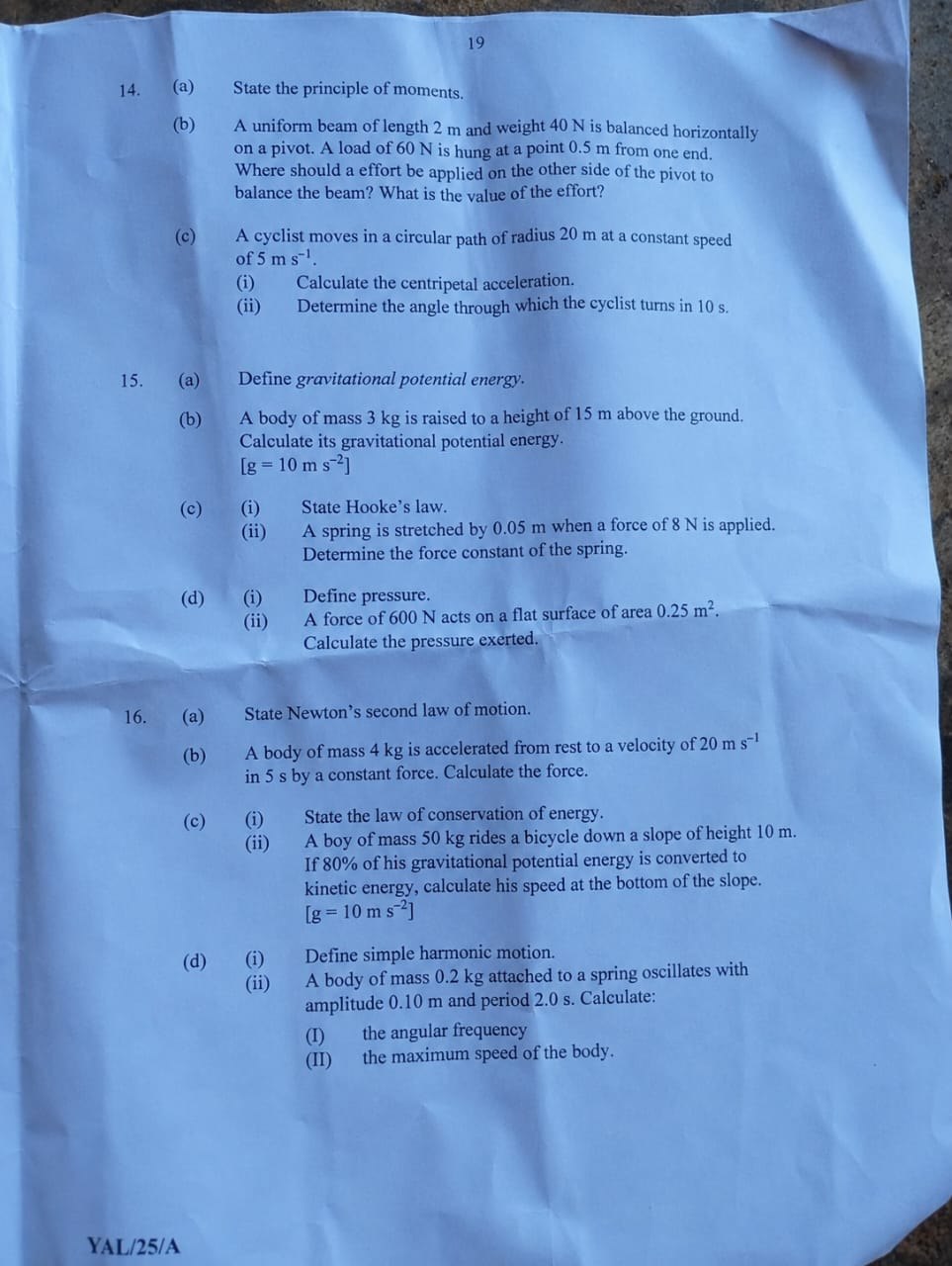
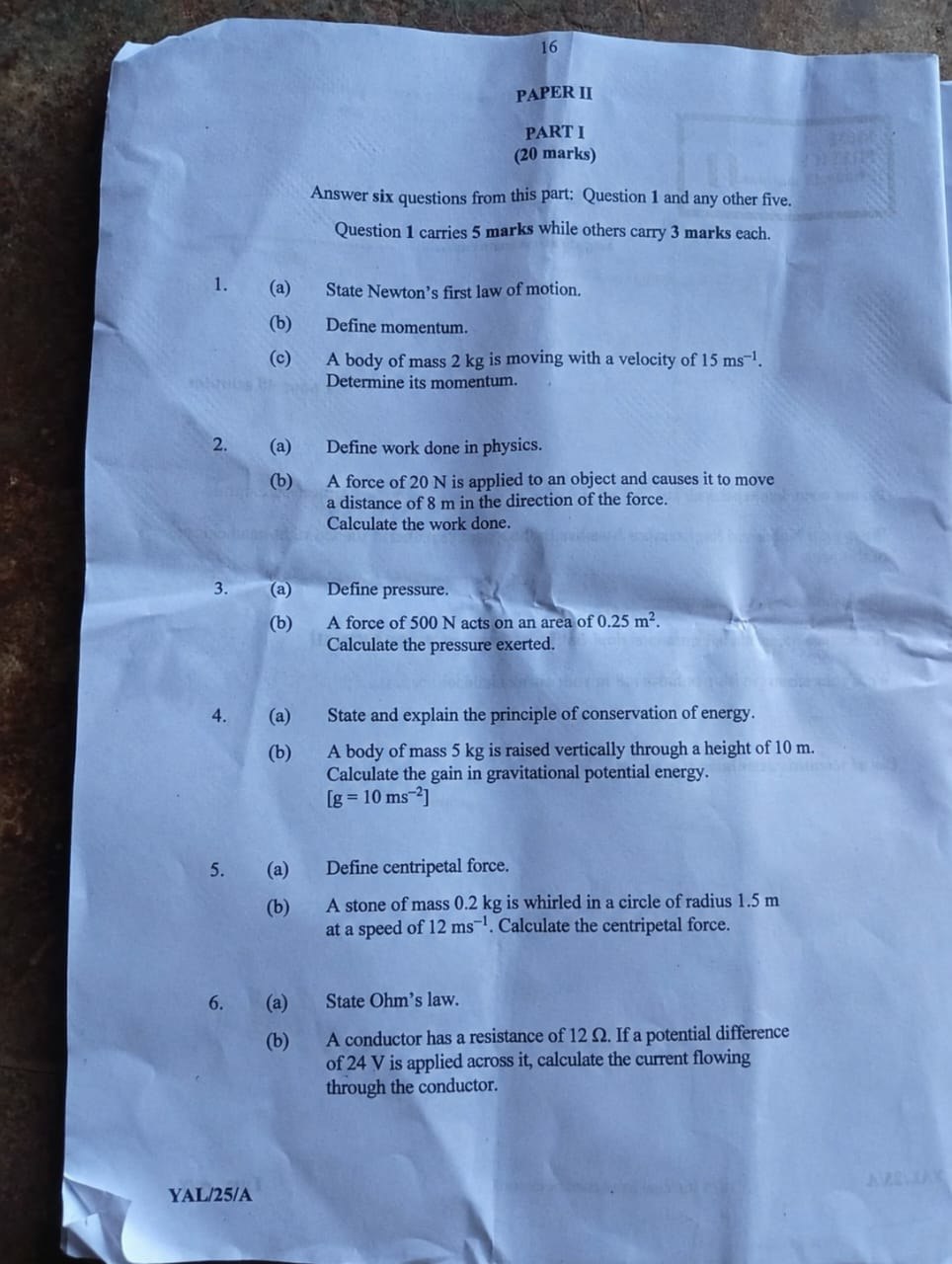
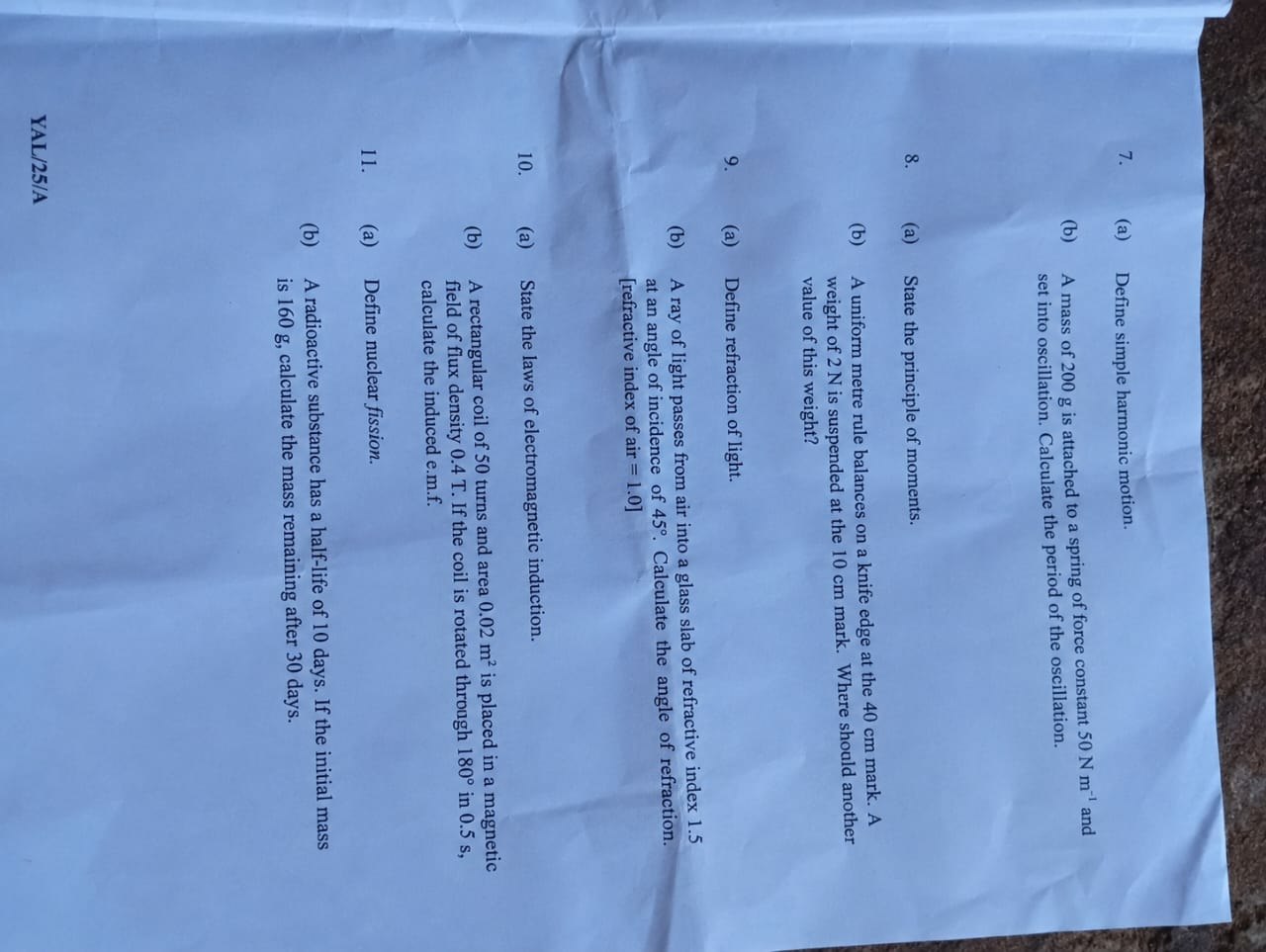
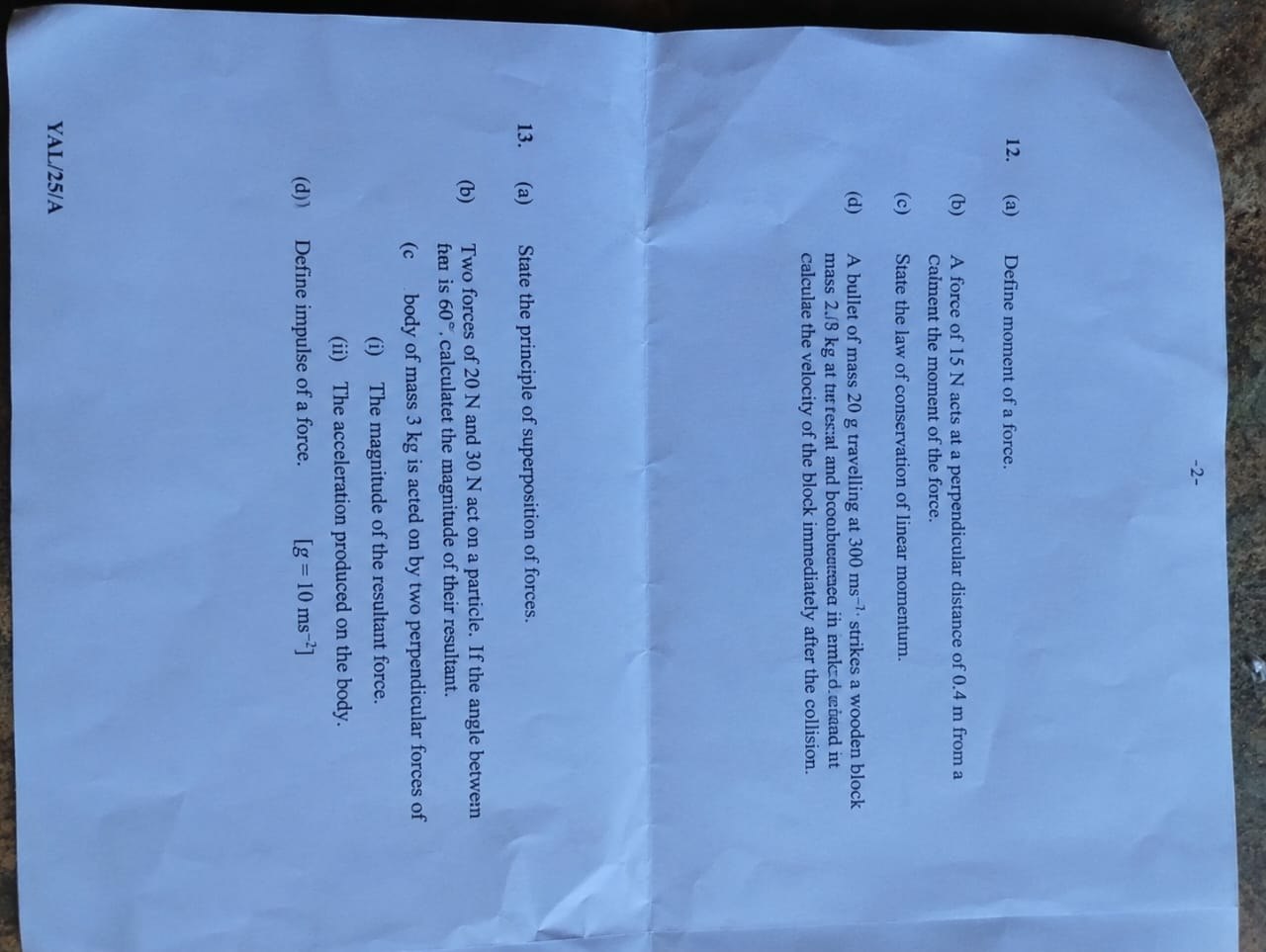
📌 OBJ INSTRUCTION: If your centre has a reshuffled paper, use the explained answers below to trace your equivalent question before answering.
NECO 2026 Physics OBJ Answers (Paper III)
| Questions | Answers |
|---|---|
| 1 – 10 | B, A, B, D, E, D, C, C, E, E |
| 11 – 20 | D, E, E, C, A, C, C, C, C, C |
| 21 – 30 | B, C, D, C, B, A, C, D, E, A |
| 31 – 40 | A, C, B, B, A, E, C, E, A, D |
| 41 – 50 | C, E, C, C, D, C, A, D, C, D |
| 51 – 60 | E, E, E, D, B, A, A, A, E, C |
NECO 2026 Physics Theory Answers (Paper II)
PART I — Answer 6 Questions (Q1 Compulsory)
QUESTION 1
1a. The armature of an electric motor is the rotating coil wound on a soft iron core. It rotates when current flows through it in a magnetic field, converting electrical energy to mechanical energy.
1b. A flat plate solar collector absorbs solar radiation on a flat surface and converts it to heat, but does not focus the rays. A focusing (parabolic) solar collector uses curved mirrors to concentrate sunlight onto a focal point, achieving higher temperatures suitable for generating electricity.
1c. Magnifying power (M) of a telescope = fo/fe, where fo = focal length of objective and fe = focal length of eyepiece.
1d(i). Speed is the rate of change of distance (scalar). Velocity is the rate of change of displacement (vector) — it has both magnitude and direction.
1d(ii). A body can have constant speed but changing velocity when it moves in a circle (e.g. uniform circular motion) — its speed is constant but the direction changes continuously, so velocity changes.
QUESTION 2
2a. The period T of a simple pendulum: T = 2π√(L/g), where L is the length of the pendulum and g is acceleration due to gravity. Period depends only on length and g — not on mass or amplitude (for small oscillations).
2b. Momentum = mass × velocity. The principle of conservation of momentum: in a closed system, total momentum before collision = total momentum after collision, provided no external forces act.
2c. Types of simple machines: Lever, Pulley, Inclined plane, Wheel and axle, Wedge, Screw.
2d. Potential energy is stored energy (energy due to position or condition). Kinetic energy is energy due to motion. Example: a raised object has PE; when it falls it converts PE to KE.
QUESTION 3
3a. Ultraviolet (UV) rays: used in sterilisation, detecting forged banknotes, causing fluorescence, treating skin conditions (phototherapy).
3b. Mechanical waves require a material medium for propagation (e.g. sound). Electromagnetic waves do not require a medium and can travel through a vacuum (e.g. light, radio waves).
BONUS QUESTIONS (Part I continued)
QUESTION 7
f = 50 Hz, v1 = 1.0 ms−1, v2 = 0.4 ms−1
λ = v/f
λ1 = 1.0/50 = 0.02 m
λ2 = 0.4/50 = 0.008 m
Difference: Δλ = λ1 − λ2 = 0.02 − 0.008 = 0.012 m
QUESTION 8
8a. Escape velocity: A body must be projected from the Earth’s surface with a minimum velocity of 11 km/s to completely overcome Earth’s gravitational pull and never return, without further propulsion.
8b. Lead-acid accumulator is a secondary cell — it can be recharged repeatedly. The wet Leclanché cell is a primary cell — it cannot be recharged once its chemicals are used up.
QUESTION 9
G = 5 Ω, Ig = 20 mA = 0.02 A, I = 10 A
Shunt current: I − Ig = 10 − 0.02 = 9.98 A
Since galvanometer and shunt are in parallel: Ig × G = (I − Ig) × S
0.02 × 5 = 9.98 × S
S = 0.1/9.98 ≈ 0.01 Ω
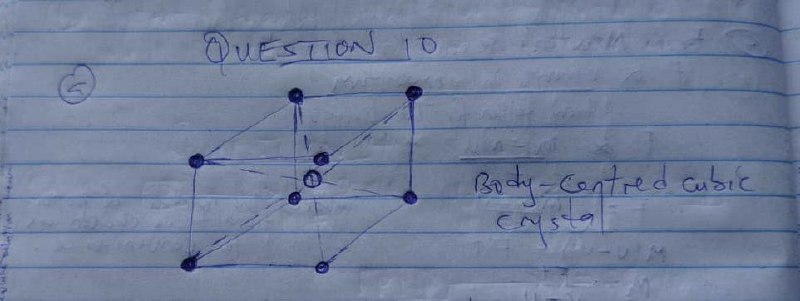
Question 10a — Crystal Structure Diagram
QUESTION 11
11a. Components of a photoelectric cell: (i) A photoemissive cathode (light-sensitive surface), (ii) An anode (collector electrode), both enclosed in an evacuated glass or quartz tube.
11b. Given Ve = h/(Meλe):
KE = ½MeVe2 = ½Me × [h/(Meλe)]2 = h2/(2Meλe2)
PART II — Answer 4 Questions
QUESTION 12
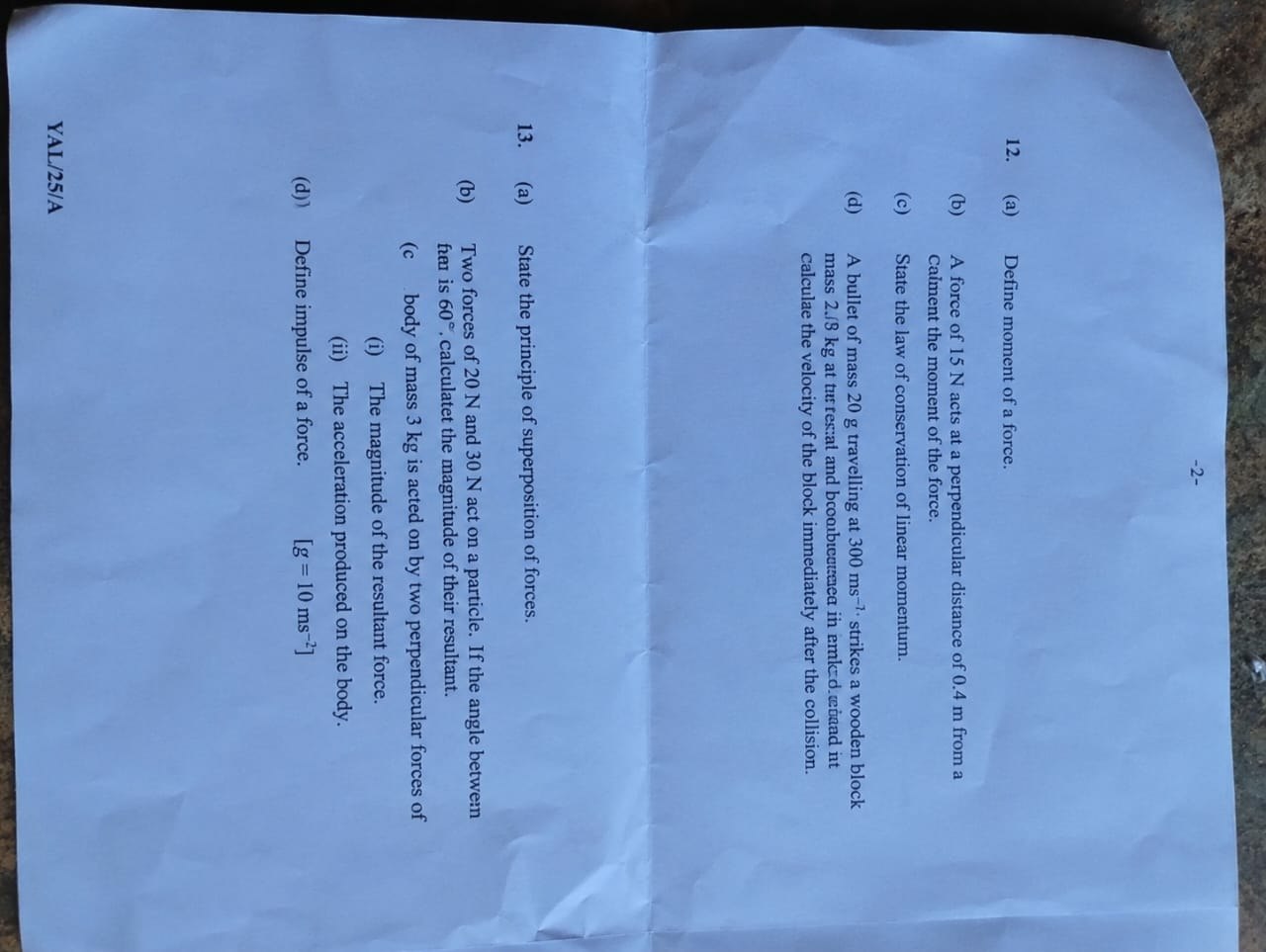
12a. Principle of floatation: A floating body displaces its own weight of the fluid in which it floats.
12b. A cone on its base has a large surface area of contact and low centre of gravity — stable. When tilted, it returns to original position. A cone on its apex has a very small contact area and high centre of gravity — unstable. When tilted, it topples over.
12c. F = ma = M(v − u)/t → M = Ft/(v − u)
12d(i). T = 2.0 s → f = 1/T = 1/2.0 = 0.5 Hz
12d(ii). m = 0.4 kg, T = 2.0 s
k = 4π2m/T2 = (4 × 9.8596 × 0.4)/4 = 15.775/4 ≈ 3.94 N/m
QUESTION 13
13a. A claw hammer is a first-class lever: the fulcrum (curved head against the wood) is between the effort (hand at handle end) and the load (nail). Arrangement: Load–Fulcrum–Effort.
13b(i). A clinical thermometer should not be sterilised in boiling water (100°C) because its range is only 35°C–43°C. The mercury would expand beyond calibration, causing the thermometer to crack or burst.
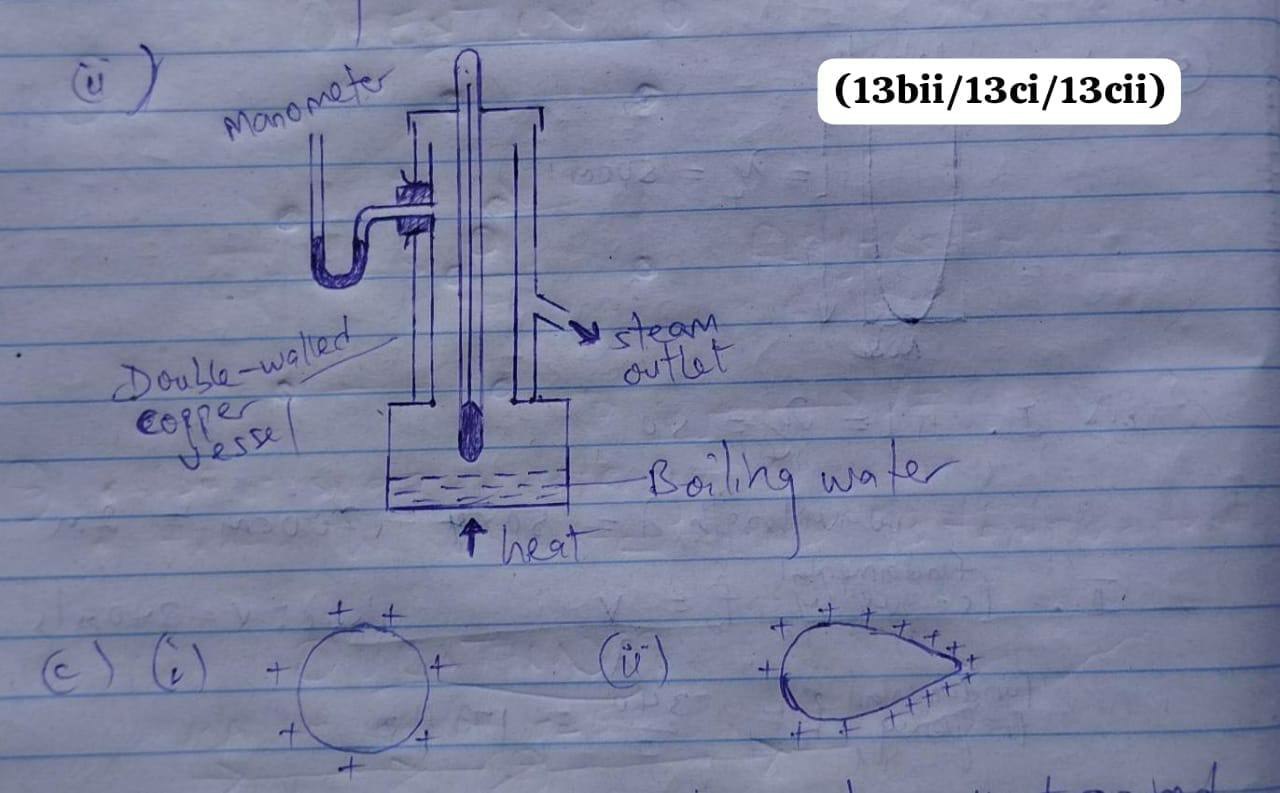
13d. Copper ball: mc = 0.05 kg, initial temp = 120°C; Water: mw = 0.1 kg; Calorimeter: mcal = 0.08 kg; Final temp = 30°C; c(water) = 4200 J/kgK; c(copper) = 400 J/kgK
Heat lost by copper = 0.05 × 400 × (120 − 30) = 1800 J
Heat gained = [0.1 × 4200 + 0.08 × 400] × (30 − Tw) = 452 × (30 − Tw)
1800 = 452(30 − Tw) → 30 − Tw = 3.98 → Tw ≈ 26.0°C
QUESTION 14
14a. A wavefront is an imaginary surface joining all points of a wave that are in the same phase of vibration at a given instant.
14b(i). Searchlight produces a parallel beam (rays travel straight and parallel). A bulb (point source) produces a divergent beam (rays spread outward from a single point).
14b(ii). Regular reflection: parallel rays on a smooth surface reflect as parallel rays in one definite direction. Diffuse reflection: parallel rays on a rough surface reflect in many scattered directions due to surface irregularities.
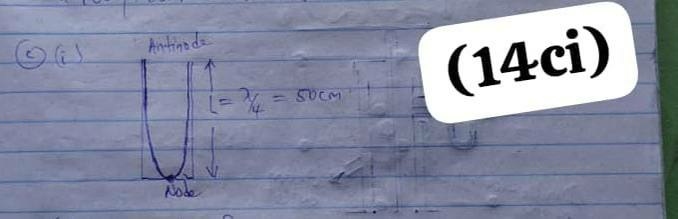
14c(ii) I. For a closed pipe at fundamental frequency: L = λ/4 → λ = 4L = 4 × 0.50 = 2.0 m
14c(ii) II. f1 = v/λ = 340/2.0 = 170 Hz. For a closed pipe, only odd harmonics exist. First overtone = 3rd harmonic = 3 × 170 = 510 Hz
QUESTION 15
15a(i). Electric current is the rate of flow of electric charge through a conductor, measured in amperes.
15a(ii). Factors affecting resistance: (i) Length of conductor — resistance increases with length. (ii) Cross-sectional area — resistance decreases as area increases.
Question 15b — Magnetic Field Diagrams
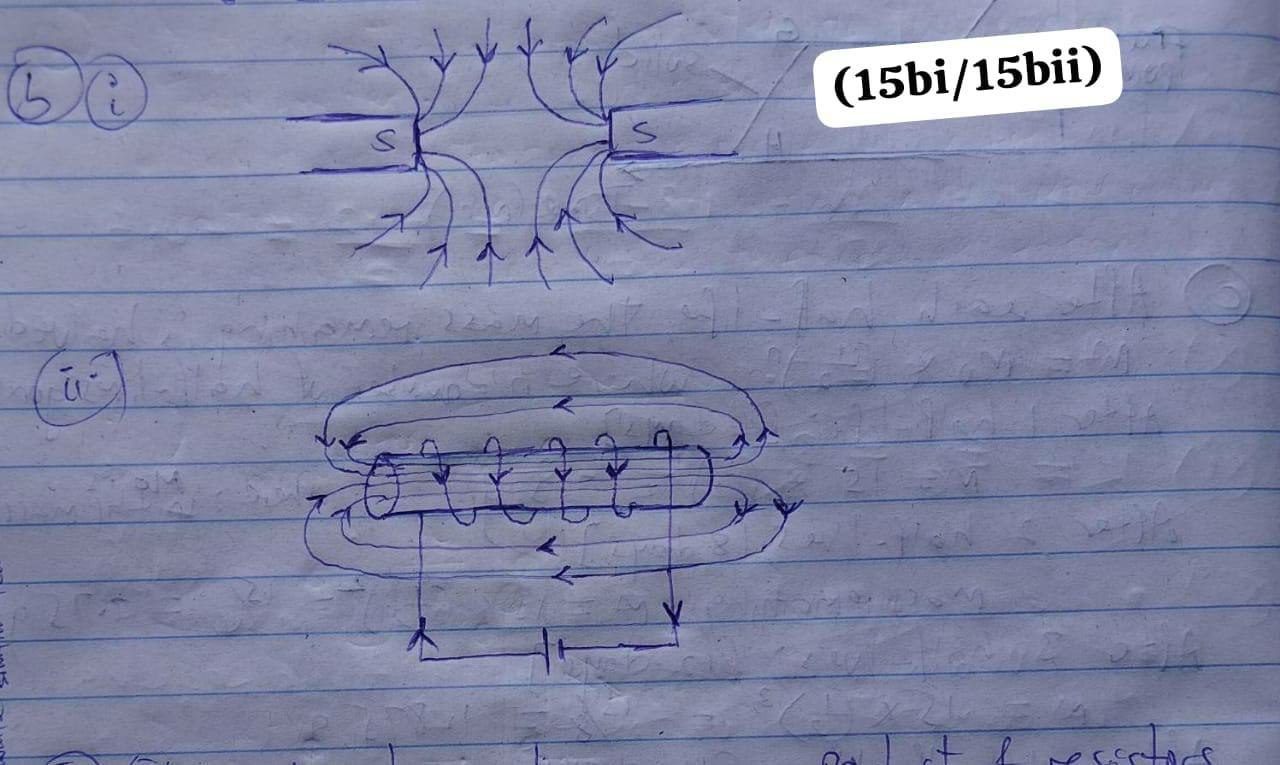
15c(i). Parallel resistors (2Ω and 5Ω): 1/R = 1/2 + 1/5 = 7/10 → R(parallel) = 10/7 ≈ 1.43 Ω
15c(ii). Total resistance = 0.5 + 4 + 1.43 = 5.93 Ω; I = E/R = 2/5.93 ≈ 0.34 A
QUESTION 17
17a. A continuity tester checks whether an electrical circuit, wire, or component is complete (unbroken) — it detects breaks, cuts, or faults in wiring, fuses, or switches.
17b. Examples of simple machines in daily use: (i) A wheelbarrow (lever) used to move goods on a construction site. (ii) An inclined plane (ramp) used to load heavy goods onto a truck.
17c. A prism uses total internal reflection — all light is reflected with no loss of intensity and no silvering to wear off, giving a brighter, clearer, single image. A mirror loses some light through absorption and can produce faint multiple (ghost) images.
17d. Cell comparison table:
| Cell | Positive Terminal | Negative Terminal | Electrolyte |
|---|---|---|---|
| Leclanché (Wet) | Carbon rod | Zinc rod | Ammonium chloride solution |
| Nickel-iron | Nickel plate | Iron plate | Potassium hydroxide solution |
17e(i). Magnification = Image size/Object size = 110/10 = 11
17e(ii). m = v/u → u = v/m = 100/11 ≈ 9.09 cm
Completed ✅❤️🔥
 Examsmooth
Leave a comment