
2026 WAEC Economics Questions and Answers
Live update hub for the 2026 WAEC Economics exam on Examsmooth. Answers are currently loading. Please bookmark this page and keep refreshing during and after your exam window for verified updates.
Note: Use this page for guidance and revision support. Always follow WAEC rules and your school’s examination policies.
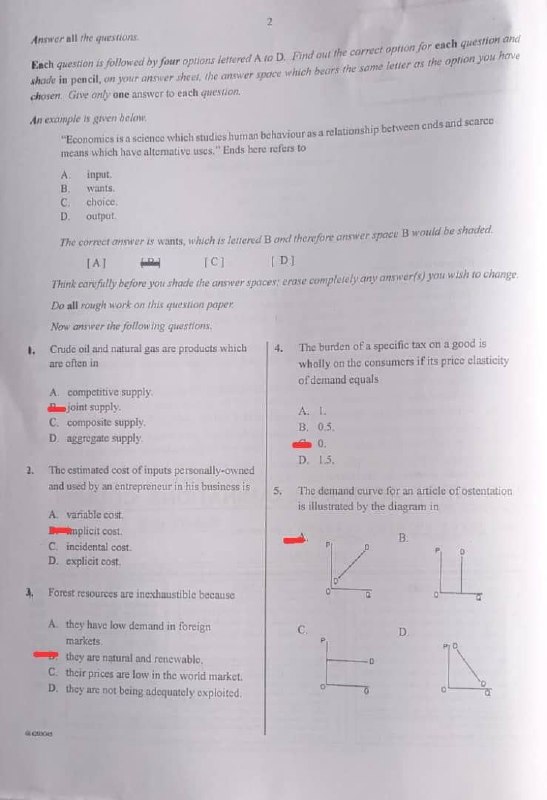
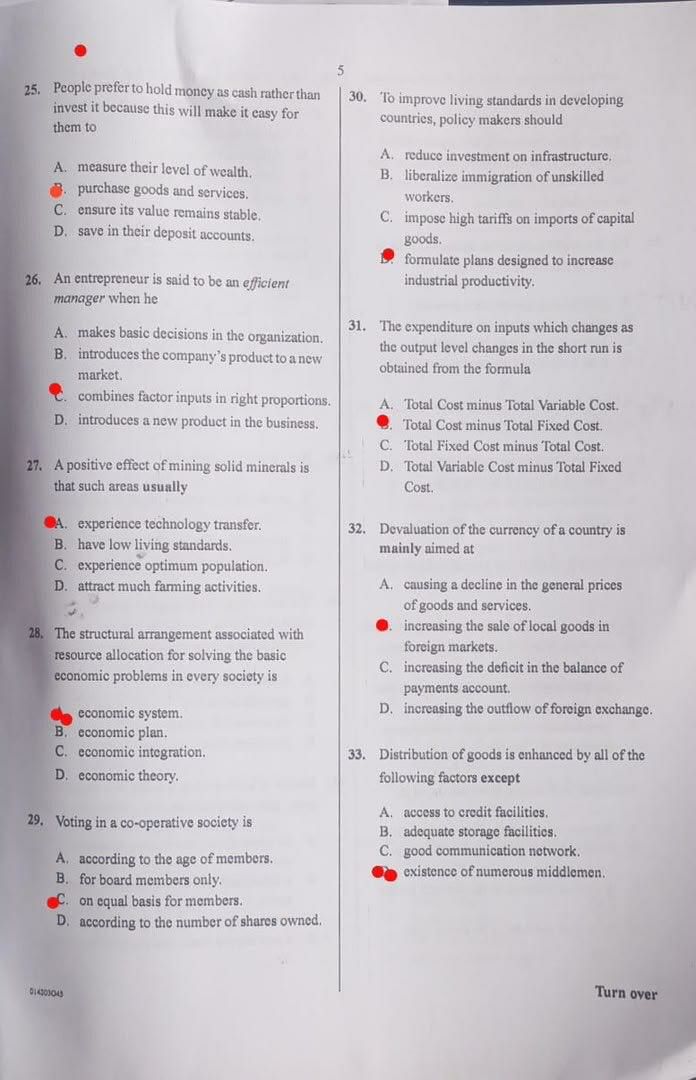
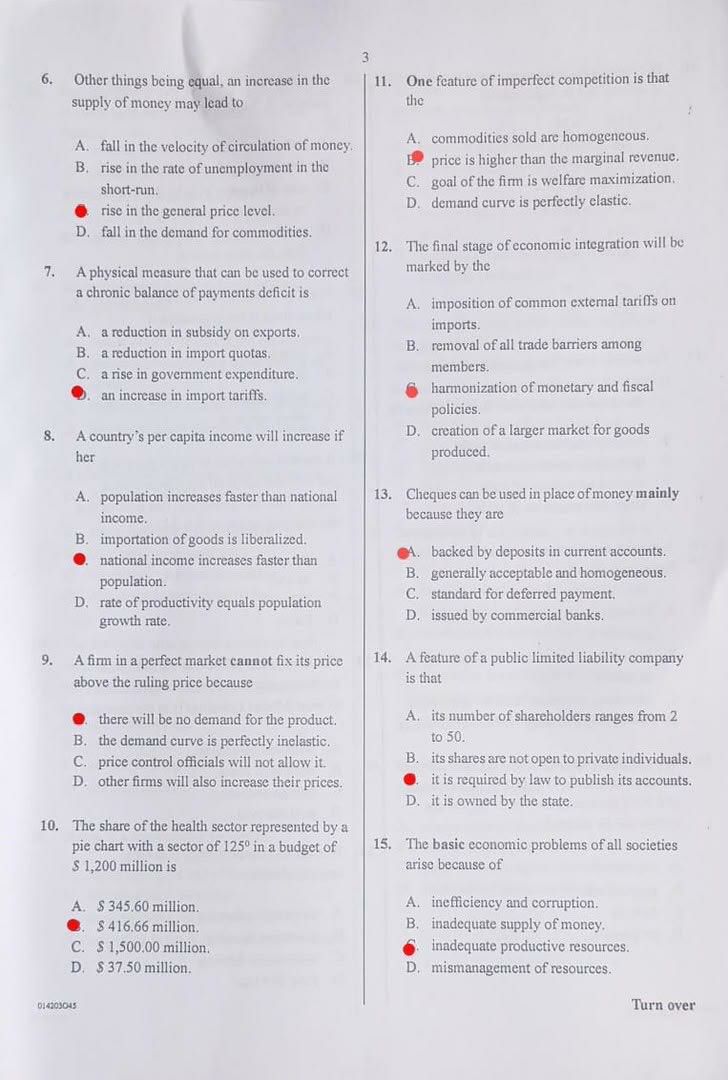
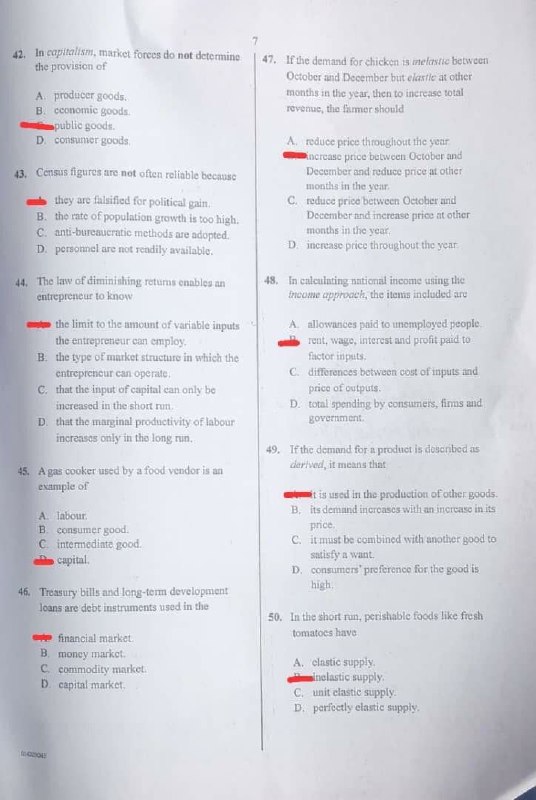
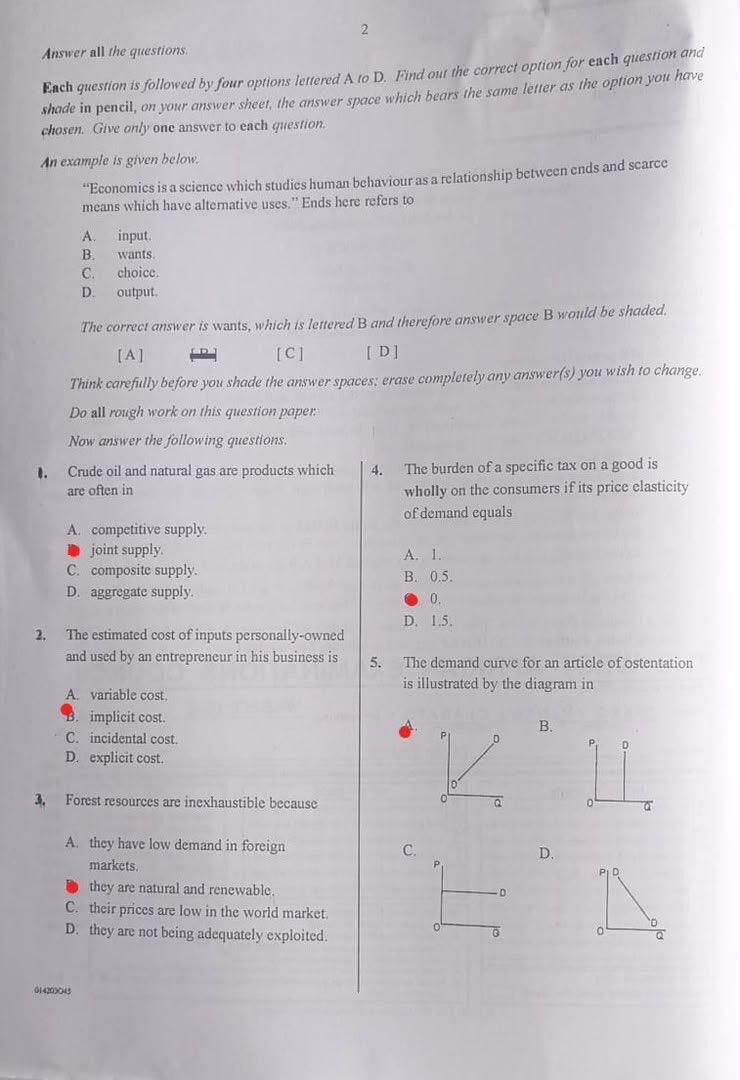
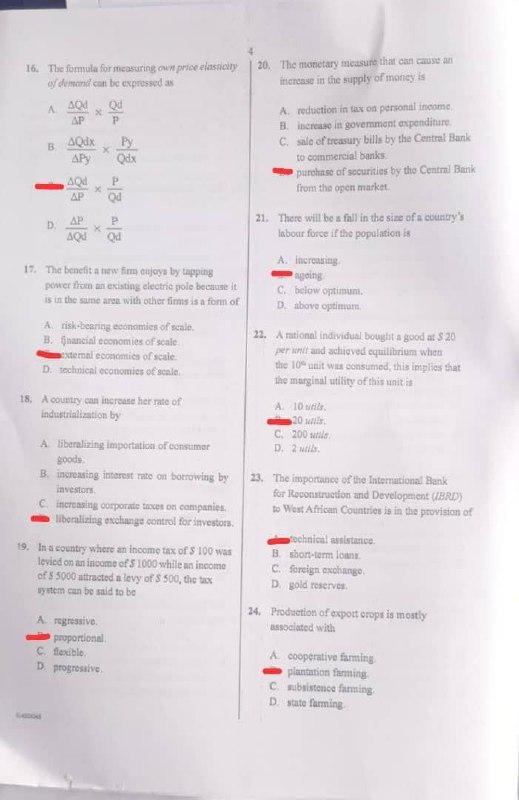
2026 WAEC Economics Question Paper
2026 WAEC Economics Essay / Theory Answers
Question 1
(1a)
- (i) Point of saturation (MU = 0): Qx = 6 units
- (ii) MU declining but positive (MU between 8 and 0): Qx = 1 to 5 units
- (iii) TU decreasing (when MU is negative): Qx = 7 units and beyond
- (iv) TU at maximum (when MU = 0): Qx = 6 units
(1b)
- (i) Law of Diminishing Marginal Utility
- (ii) Law of Consumer Equilibrium
(1ci) Consuming 1 unit of X: MU = 8 > Price ($4) → Consumer should increase consumption since they are getting more utility than they are paying for. They are not in equilibrium yet.
(1cii) Consuming 4 units of X: MU = 4 = Price ($4) → Consumer is in equilibrium. They should maintain this level of consumption as marginal utility equals the price paid.
Question 3
(3a) Importance of scale of preference to a consumer:
- Helps rank wants from most to least urgent.
- Guides rational decision-making with limited income.
- Helps avoid wasteful spending.
- Ensures maximum satisfaction from scarce resources.
(3b) Relevance of economic concepts to a producer:
- Scarcity – helps producer allocate limited resources efficiently.
- Supply and demand – helps determine optimal production levels and pricing.
- Opportunity cost – helps make better investment decisions.
- Elasticity – helps set prices to maximize revenue.
- Production costs – helps minimize costs and maximize profit.
- Market structures – helps understand competition and positioning.
- Marginal analysis – helps decide how much extra to produce.
- Consumer behavior – helps tailor products to meet demand.
(3c) Factors that can cause an increase in the supply of a commodity:
- Fall in cost of production – lower input costs allow more supply.
- Improvement in technology – increases productivity and output.
- Favourable government policies – subsidies reduce costs, boosting supply.
- Increase in number of producers – more firms enter the market.
Question 4
(4ai) Consumer goods and producer goods:
- Consumer goods: Products bought by individuals for direct consumption to satisfy personal wants. Examples: bread, clothes, television sets.
- Producer goods: Goods used by businesses to produce other goods and services rather than for final consumption. Examples: industrial machinery, raw cotton, delivery trucks.
(4aii) Primary production and tertiary production:
- Primary production: The extraction of raw materials directly from nature. Examples: mining, farming, fishing.
- Tertiary production: The provision of commercial, professional, or personal services to distribute goods and assist consumers. Examples: banking, teaching, transportation.
(4b)
- Fixed capital: Durable capital assets used repeatedly in production over a long period and which do not change form easily. Examples: factory buildings, heavy machinery.
- Working capital: Short-term assets used in daily business operations to cover running expenses. Examples: cash in hand, raw materials.
- Social capital: Assets provided by society or government that facilitate economic activities but are not owned by a single private entity. Examples: public roads, electricity grids, public schools.
Question 5
(5a)
- Firm: A single business unit or organization that produces goods or services under unified management.
- Industry: A collection of different firms producing identical, similar, or closely related goods and services.
(5b) Match each description to the correct type of business organisation:
- (i) Much red tape and legal expense in starting the firm → Public limited liability company.
- (ii) Owner(s) personal assets can be used to settle business debts → Sole proprietorship / Partnership.
- (iii) No specialized management → Sole proprietorship.
- (iv) Has a life independent of its owner(s) → Public limited liability company.
- (v) Permits some but not a great deal of specialization → Partnership.
- (vi) Greatest ability to acquire funds for expansion of the firm → Public limited liability company.
- (vii) Unresolved disagreements among members can end the business → Partnership.
- (viii) Distinct separation of ownership and control of the business → Public limited liability company.
(5c) The firm produces where marginal cost (MC) equals marginal revenue (MR), but the price (average revenue, AR) is below average total cost (ATC), so it makes a loss. It continues in operation in the short run but will exit the industry in the long run if conditions do not improve.
Question 6
(6a) Industrialization is the process by which an economy transforms from a primarily agricultural foundation into one based on the manufacturing of goods. It involves the extensive use of machinery, advanced technology, and factory systems to increase production output.
(6b)
- Location of industry: Refers to the specific geographic site or area where a single business enterprise or factory chooses to establish its operations.
- Localization of industry: Refers to the concentration or clustering of several independent firms or industries within the same specific geographic region.
(6ci) A sawmill:
- Siting location: Near the source of raw materials (heavily forested areas).
- Reason: Timber is bulky, heavy, and loses significant weight during processing. Siting nearby minimizes expensive transport costs for moving raw logs.
(6cii) A ceramic tile producing factory:
- Siting location: Near the source of raw materials (clay deposits) or near a reliable power/fuel source (natural gas pipelines).
- Reason: Clay is a heavy, weight-losing raw material. Additionally, ceramic production requires continuous, high-temperature kiln firing, making cheap fuel access critical.
(6ciii) An egg-producing poultry farm:
- Siting location: Near urban market centres.
- Reason: Eggs are highly fragile, perishable, and expensive to transport over long distances. Proximity to consumers ensures freshness and reduces breakage risks.
Join the Examsmooth WhatsApp Channel
Get instant alerts when we drop the 2026 WAEC Economics answers, plus updates for other subjects, exam tips, and corrections. Join our official Examsmooth WhatsApp Channel so you never miss any update.
Reminder: Our content is for learning support. Do not engage in any form of exam malpractice. Read, understand, and use these answers responsibly.

 Examsmooth
Leave a comment