
2026 WAEC Agricultural Science Questions and Answers
Complete OBJ and Essay Answers — Verified and Updated
This page contains the complete 2026 WAEC Agricultural Science questions and answers for Nigerian students. We cover both OBJ and theory/essay sections. Bookmark this page and share with your classmates.
2026 WAEC Agricultural Science OBJ Answers ✅
OBJ Answer Key for Questions 1–50
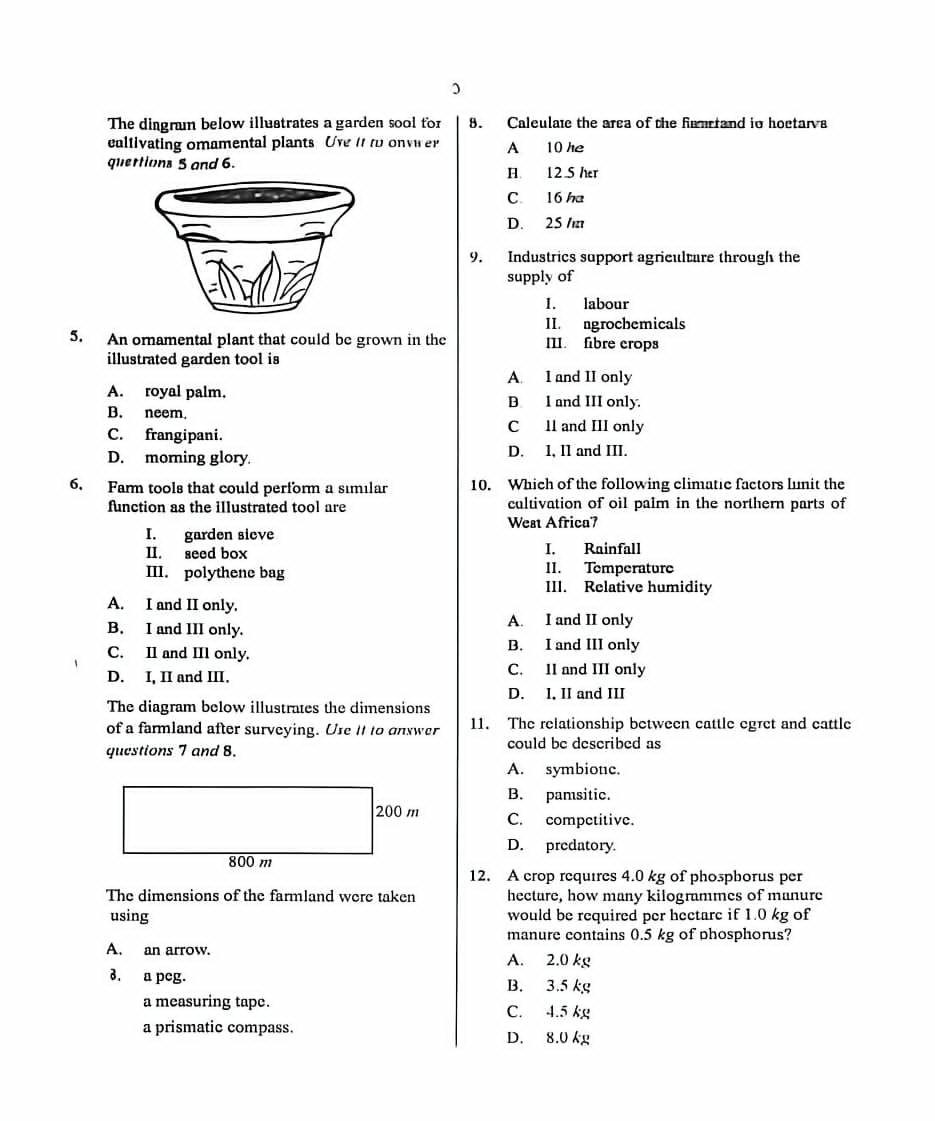
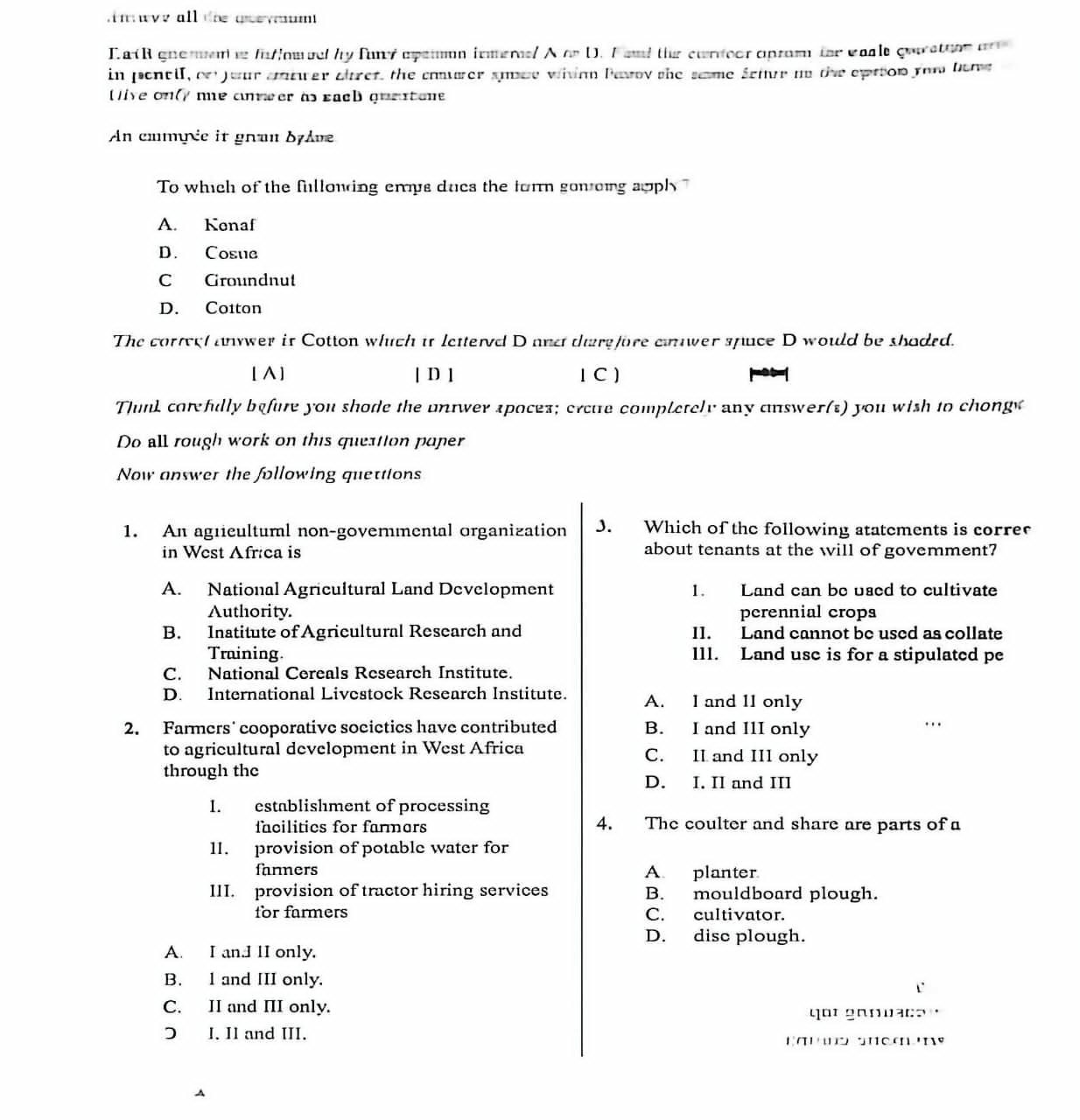
- 01. D
- 02. B
- 03. C
- 04. B
- 05. D
- 06. C
- 07. C
- 08. C
- 09. C
- 10. B
- 11. A
- 12. D
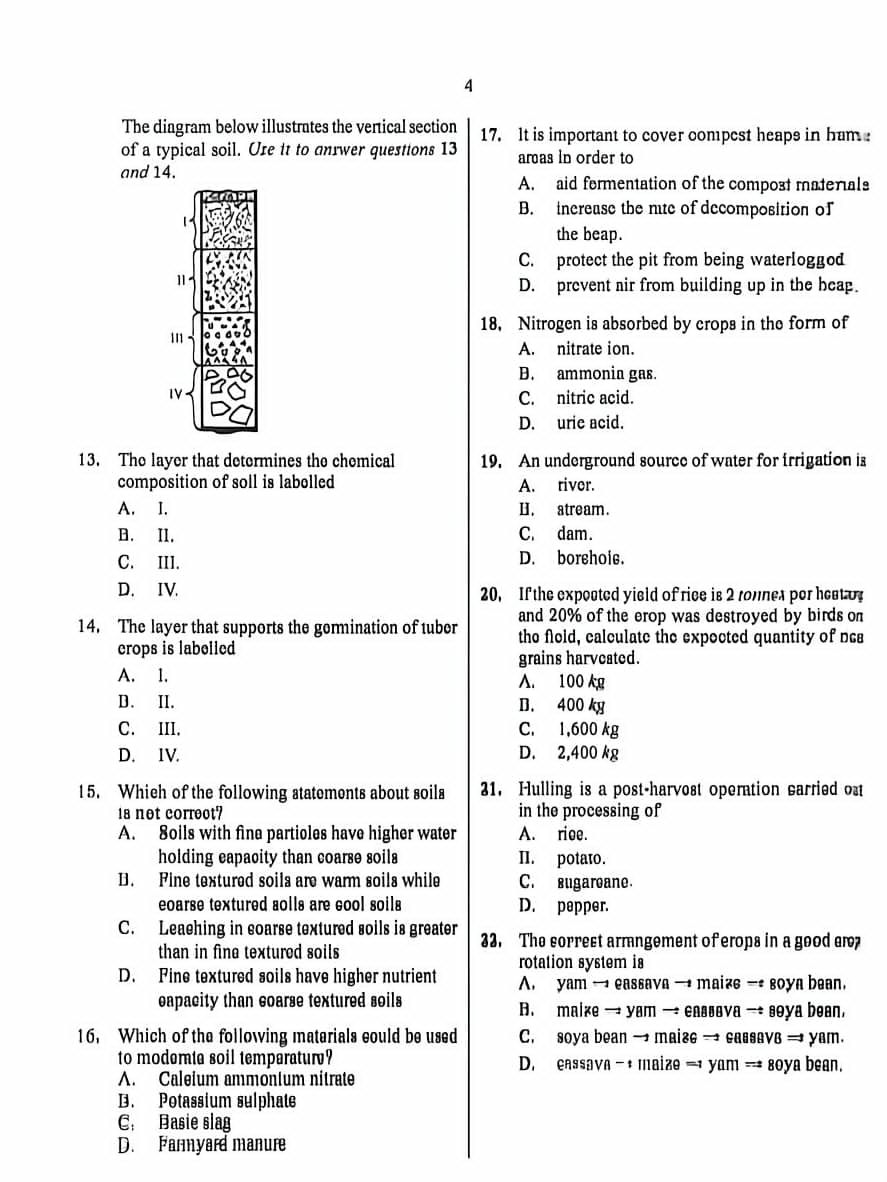
- 13. D
- 14. A
- 15. B
- 16. D
- 17. C
- 18. A
- 19. D
- 20. C
- 21. A
- 22. C
- 23. C
- 24. C
- 25. D
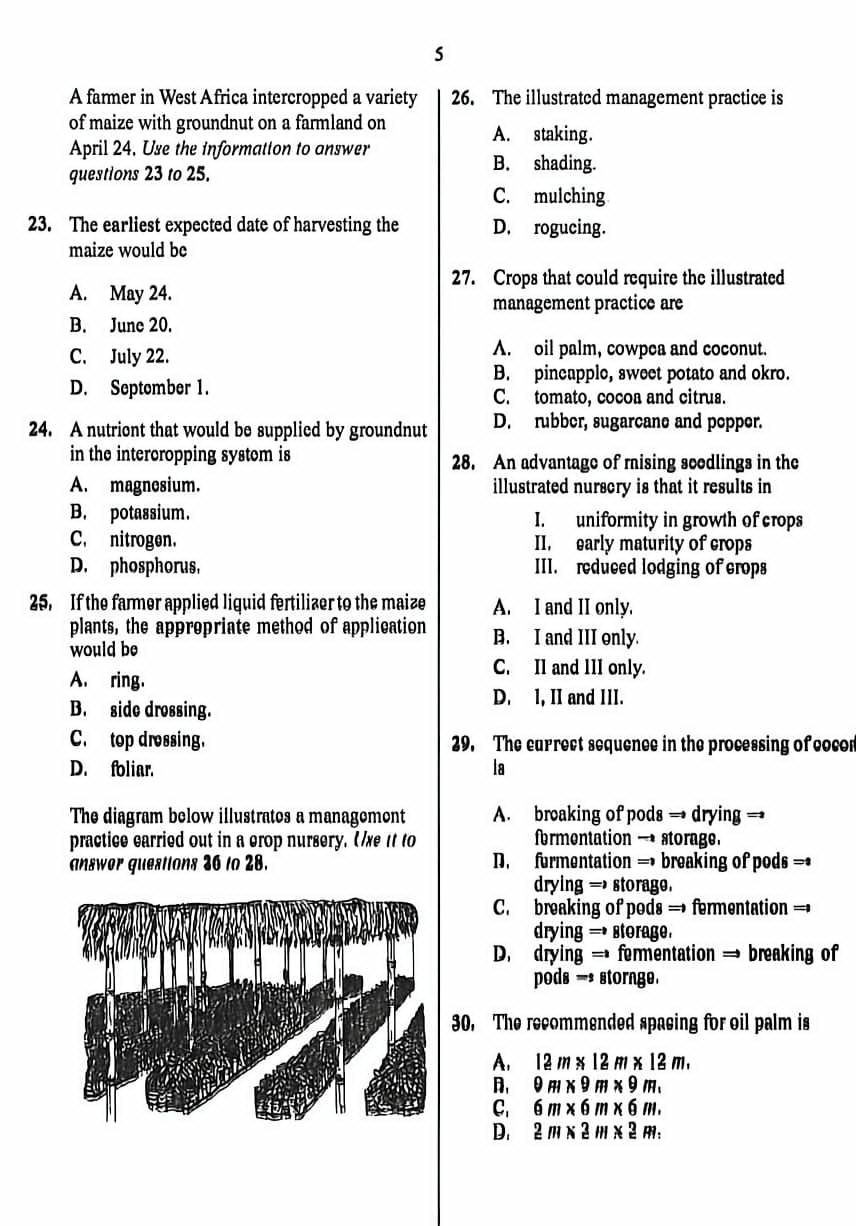
- 26. B
- 27. C
- 28. A
- 29. C
- 30. B
- 31. D
- 32. C
- 33. D
- 34. D
- 35. C
- 36. B
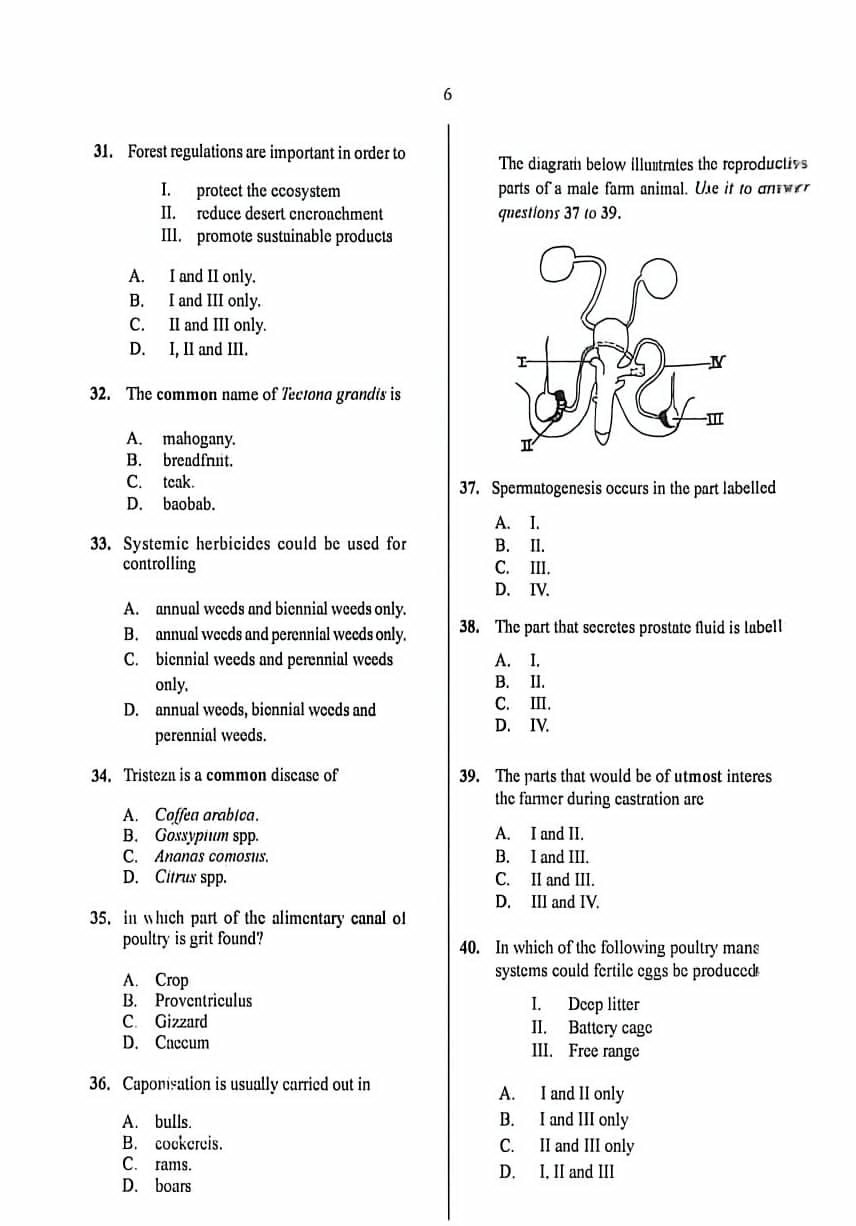
- 37. C
- 38. A
- 39. A
- 40. B
- 41. D
- 42. C
- 43. C
- 44. A
- 45. C
- 46. C
- 47. C
- 48. A
- 49. B
- 50. C
WAEC 2026 Agricultural Science Question Paper (Images)
2026 WAEC Agricultural Science Essay Answers
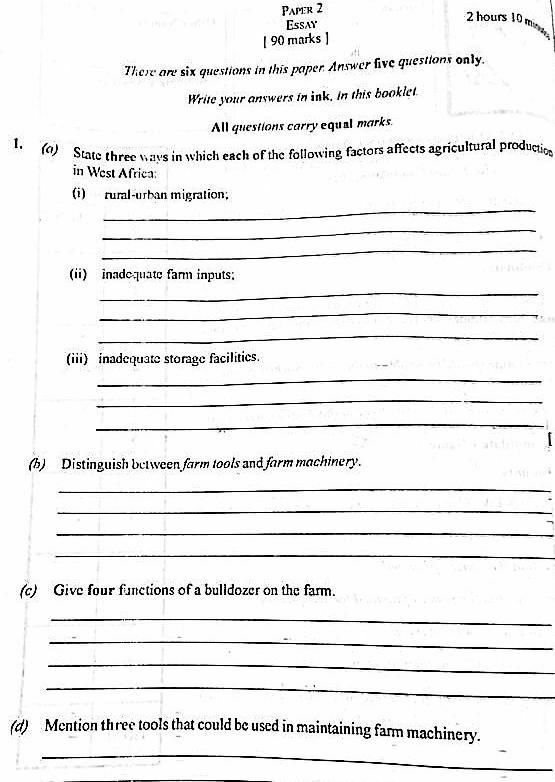
Question 1(a)(i) — Rural-Urban Migration
Effects on agriculture:
- It reduces the number of young farm workers.
- It increases the age of farmers since mostly old people are left behind.
- It leads to farmlands being abandoned.
Question 1(a)(ii) — Inadequate Farm Inputs (e.g., seeds, fertilizer)
Effects:
- Low crop yields.
- Poor soil fertility.
- Increased pest and disease damage.
Question 1(a)(iii) — Inadequate Storage Facilities
Effects:
- High post-harvest losses due to rot and pests.
- Forced selling at low prices immediately after harvest.
- Reduced food availability in the off-season.
Question 1(b) — Difference Between Farm Tools and Farm Machinery
Farm tools are simple hand-operated equipment such as cutlass and hoe, while farm machinery refers to complex, engine-powered equipment such as tractors and harvesters.
Question 1(c) — Uses of a Bulldozer on the Farm (Any Four)
- Used for clearing bushes and trees for new farmland.
- Used for levelling and grading land.
- Used for digging ponds or ditches.
- Used for removing stumps and rocks.
Question 1(d) — Farm Workshop Tools (Any Three)
- Spanners (wrenches).
- Grease gun.
- Screwdrivers.
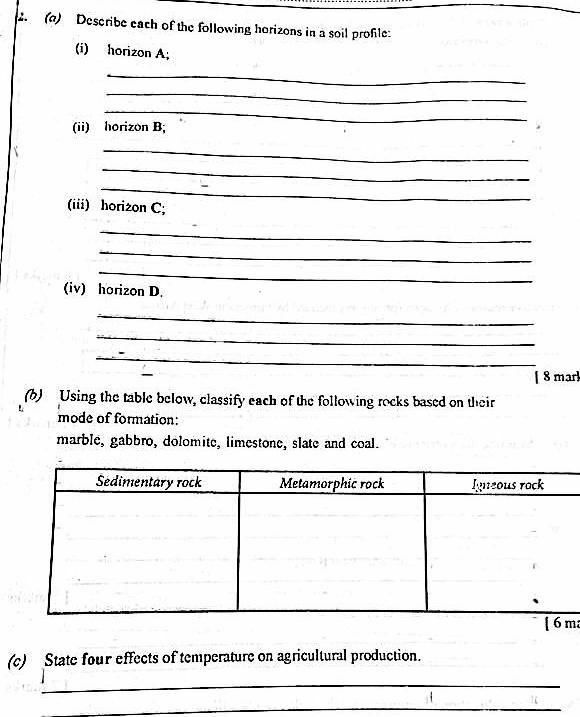
Question 2(a) — Soil Profile Horizons
Horizon A (Topsoil): Horizon A is the topsoil layer of the soil profile. It is dark in colour, rich in humus and plant nutrients, contains many microorganisms, and supports most plant roots.
Horizon B (Subsoil): Horizon B is the subsoil layer found below Horizon A. It contains less organic matter but is rich in minerals leached from the topsoil and is usually more compact.
Horizon C (Weathered Parent Material): Horizon C is the weathered parent material layer. It consists of partially broken rock fragments with little organic matter and few living organisms.
Horizon D (Bedrock): Horizon D is the bedrock or parent rock layer. It is the solid, unweathered rock from which the soil is formed.
Question 2(b) — Examples of Rock Types
Sedimentary Rocks: (i) Limestone (ii) Dolomite (iii) Coal
Metamorphic Rocks: (i) Marble (ii) Slate
Igneous Rocks: (i) Gabbro
Question 2(c) — Effects of Temperature on Agriculture (Pick Four)
- It affects the rate of seed germination.
- It influences the rate of plant growth and development.
- It affects flowering, fruiting, and crop yield.
- It influences the distribution and productivity of livestock.
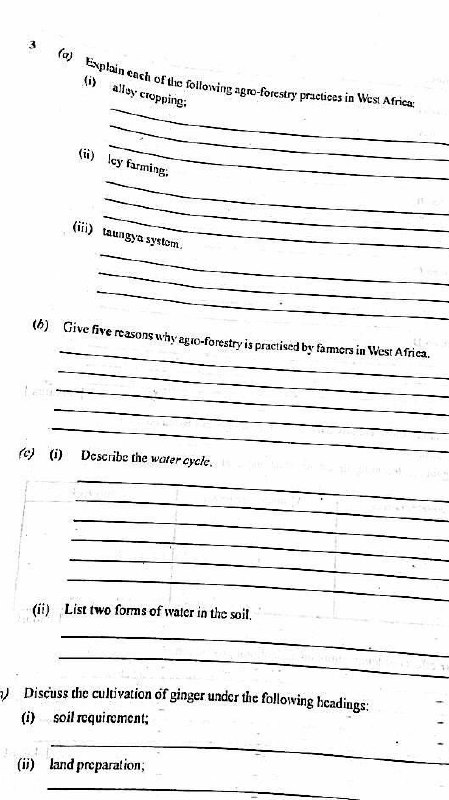
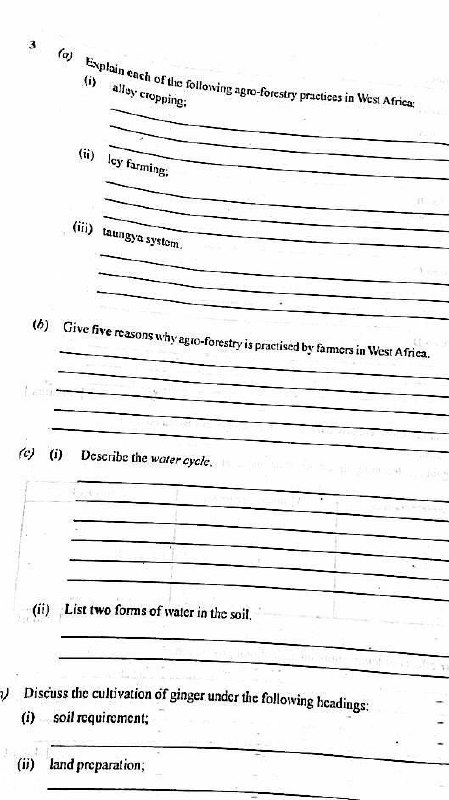
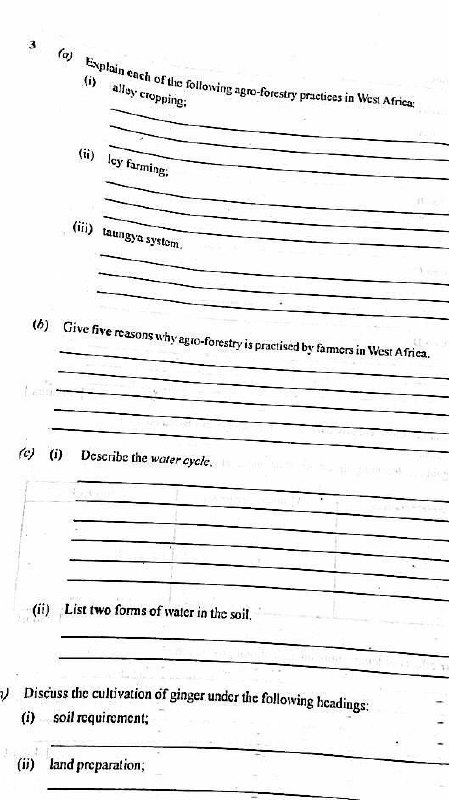
Question 3(a) — Examples of Agro-forestry Practices
- Alley cropping — Growing food crops in alleys or rows between planted hedgerow trees (e.g. Leucaena); the trees provide mulch and improve soil fertility.
- Ley farming — Alternating arable cropping with grass or legume pasture on the same land to restore soil fertility.
- Taungya system — Growing food crops between young forest or timber tree seedlings; farmers tend the trees while growing their crops.
Question 3(b) — Importance of Agro-forestry (Any Five)
- To improve and maintain soil fertility.
- To reduce soil erosion by tree cover.
- To provide shade for shade-loving crops.
- To provide additional income from timber and fruits.
- To conserve moisture in the soil.
Question 3(c)(i) — The Water Cycle
Water evaporates from oceans, rivers and lakes and rises as water vapour. It cools and condenses to form clouds, then falls as precipitation (rain or snow). The water runs off into rivers or infiltrates the soil and eventually returns to the oceans, where the cycle repeats.
Question 3(c)(ii) — Types of Soil Water
- Capillary water.
- Gravitational water.
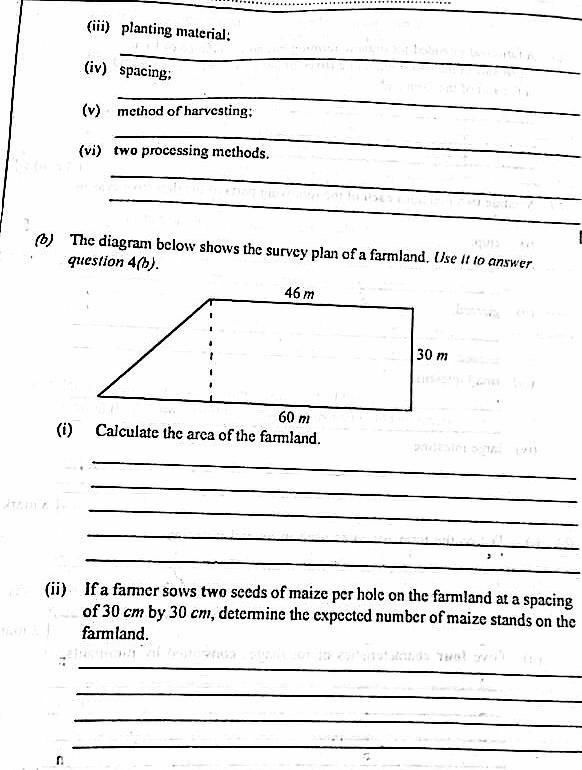
Question 4(b)(i) — Area of Farmland
Area of rectangle = 46 m × 30 m = 1,380 m²
Area of triangle = ½ × (60 − 46) × 30
= ½ × 14 × 30
= 210 m²
Total area = 1,380 m² + 210 m² = 1,590 m²
Question 4(b)(ii) — Number of Maize Stands
Spacing = 30 cm × 30 cm = 0.3 m × 0.3 m
Area occupied per stand = 0.3 × 0.3 = 0.09 m²
Number of maize stands = 1,590 ÷ 0.09
= 17,667 stands (approximately)
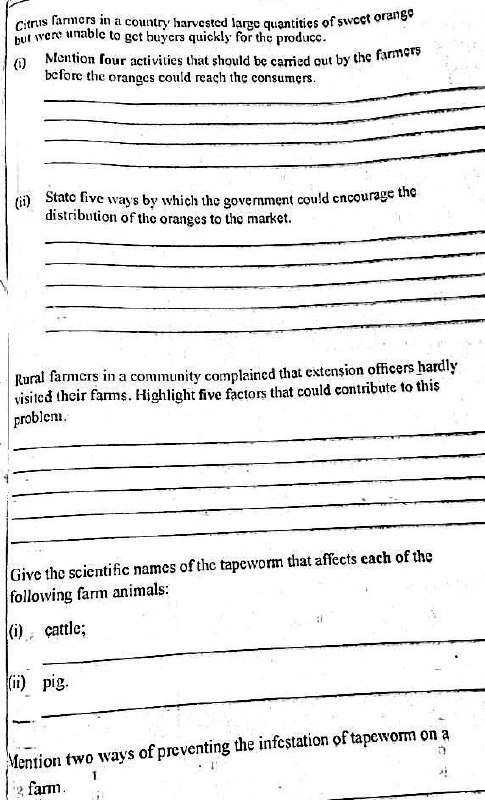
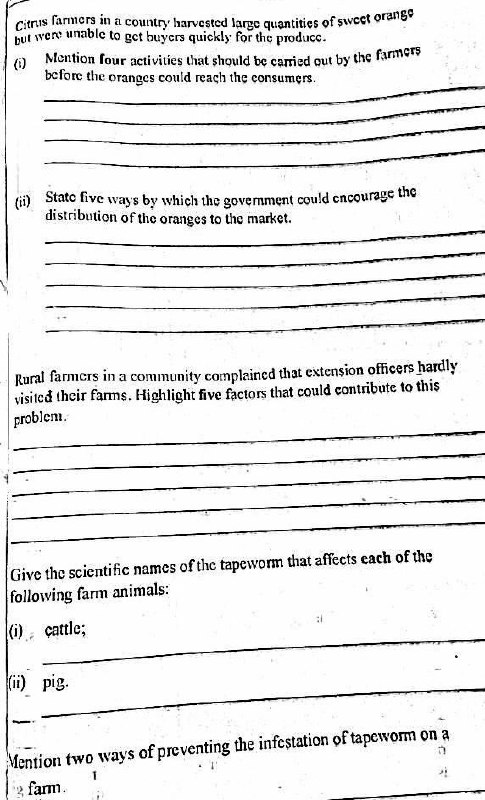
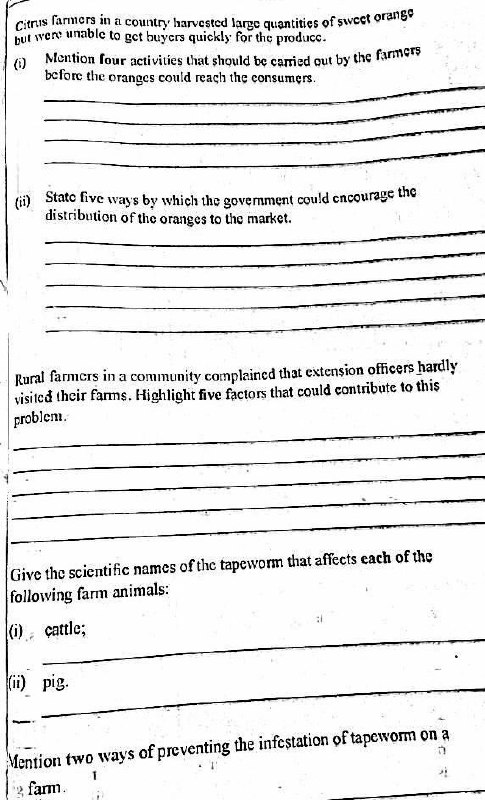
Question 5(a)(i) — Post-Harvest Handling of Oranges (Pick Four)
- Sorting the oranges.
- Grading according to size and quality.
- Packaging the oranges properly.
- Storing the oranges in suitable storage facilities.
- Processing the oranges into juice or concentrates.
- Transporting the oranges to distribution centres.
Question 5(a)(ii) — How Government Can Improve Orange Distribution (Pick Five)
- Provision of good road networks.
- Provision of storage and cold-room facilities.
- Granting loans to farmers and marketers.
- Establishment of marketing boards.
- Provision of transport facilities.
- Encouraging export of oranges.
- Providing market information services.
- Reducing taxes and levies on agricultural produce.
Question 5(b) — Problems Facing Agricultural Extension Officers (Pick Five)
- Inadequate number of extension officers.
- Poor road network to rural areas.
- Lack of transport facilities.
- Insufficient government funding.
- Large area of coverage assigned to extension officers.
- Poor communication facilities.
- Insecurity in some rural communities.
- Poor motivation and remuneration of extension officers.
Question 5(c)(i) — Tapeworm from Beef
Taenia saginata
Question 5(c)(ii) — Tapeworm from Pork
Taenia solium
Question 5(d) — Control of Tapeworm Infestation in Farm Animals (Pick Two)
- Regular deworming of farm animals.
- Proper disposal of animal and human faeces.
- Maintaining good farm sanitation.
- Provision of clean feed and water.
- Proper meat inspection before consumption.
✅ All answers have been posted!
See Also: Other 2026 WAEC Answers
Join Our WhatsApp Channel for Instant Answers
Get fast updates, verified answers and exam tips for WAEC Agricultural Science and other subjects. Join our WhatsApp channel so you never miss any update.
 Examsmooth
Leave a comment