
Question Paper Images
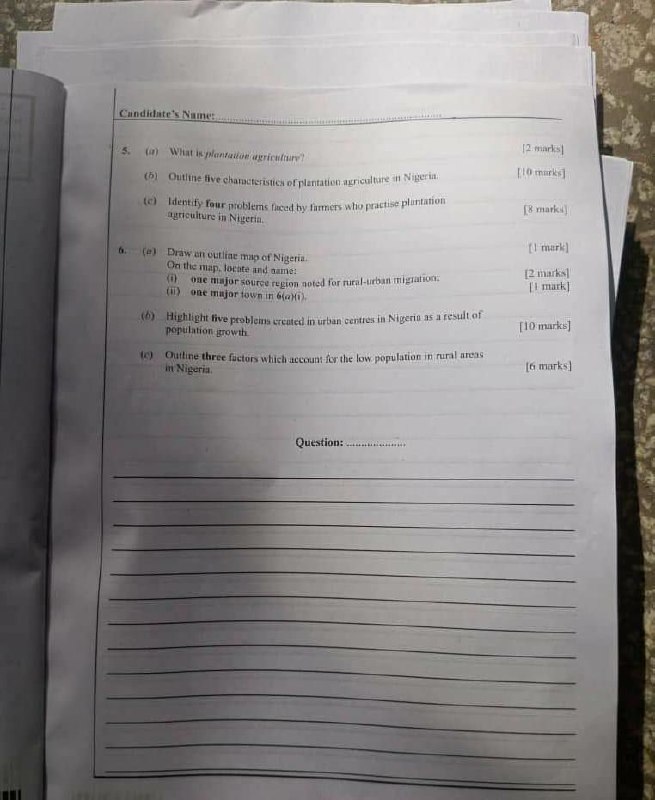
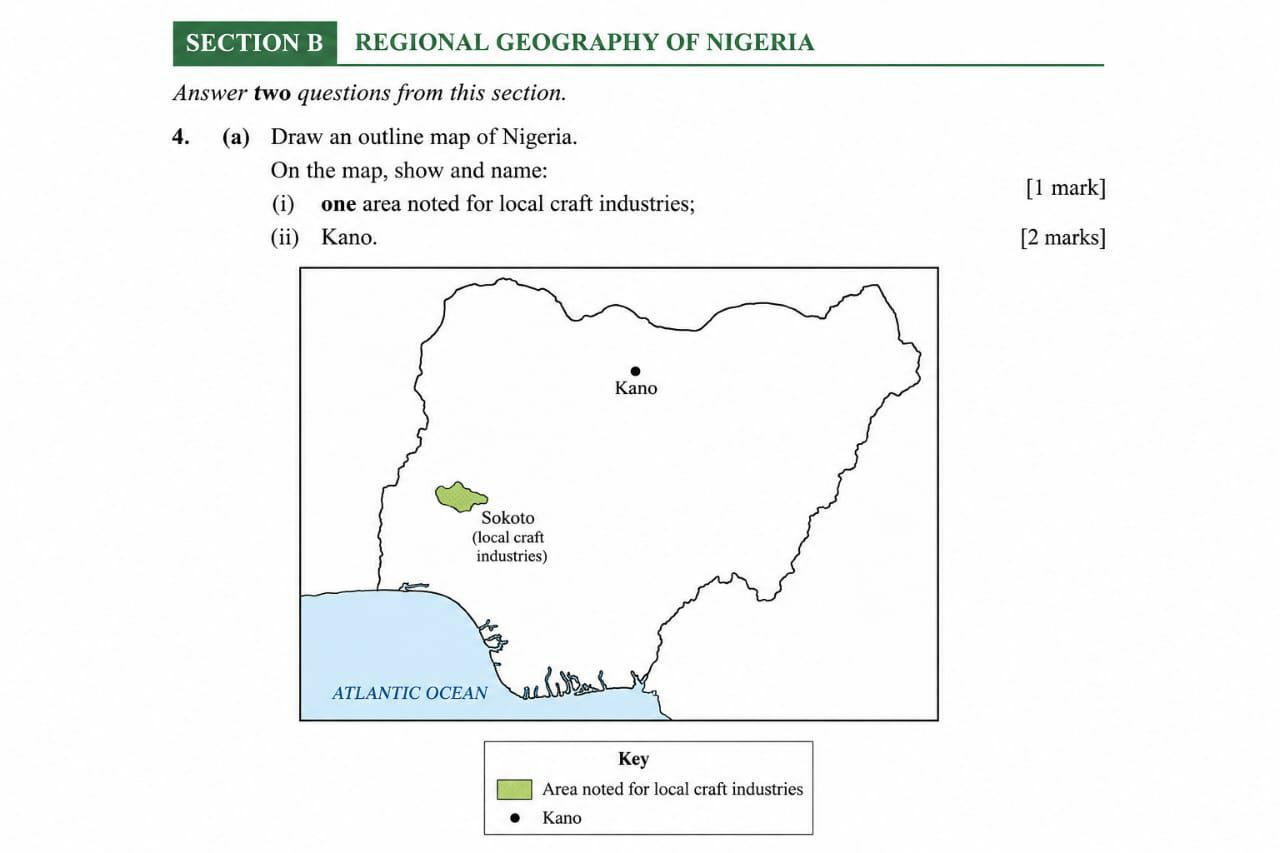
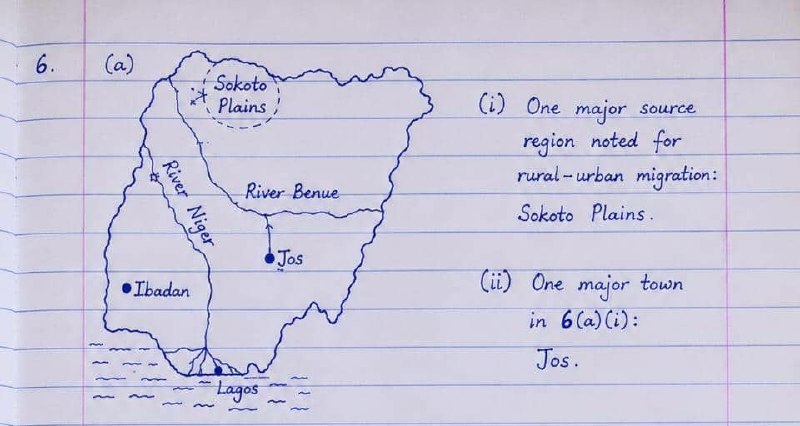
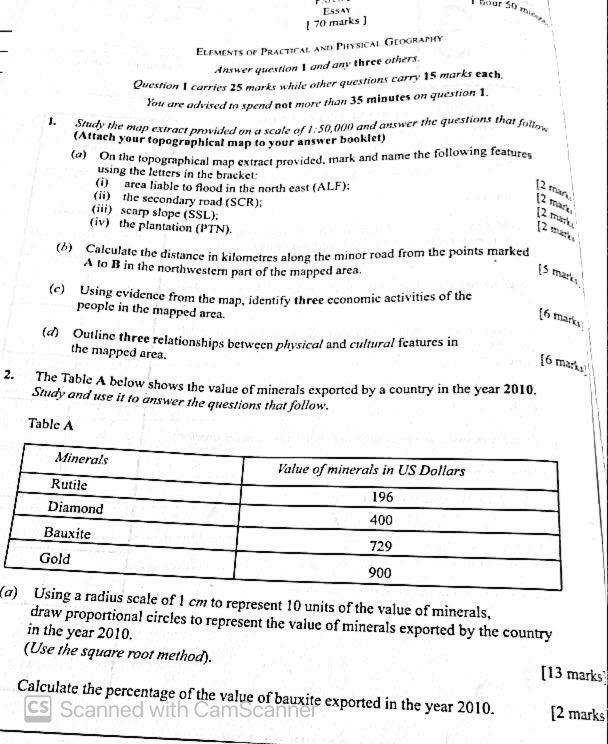
2026 WAEC Geography Questions and Answers (OBJ & Essay)
Live update: Answers are currently loading. Please bookmark this page now and keep refreshing before and during the exam for verified 2026 WAEC Geography answers.
Stay on this page, keep refreshing, and follow our WhatsApp channel for fast updates as the exam starts.
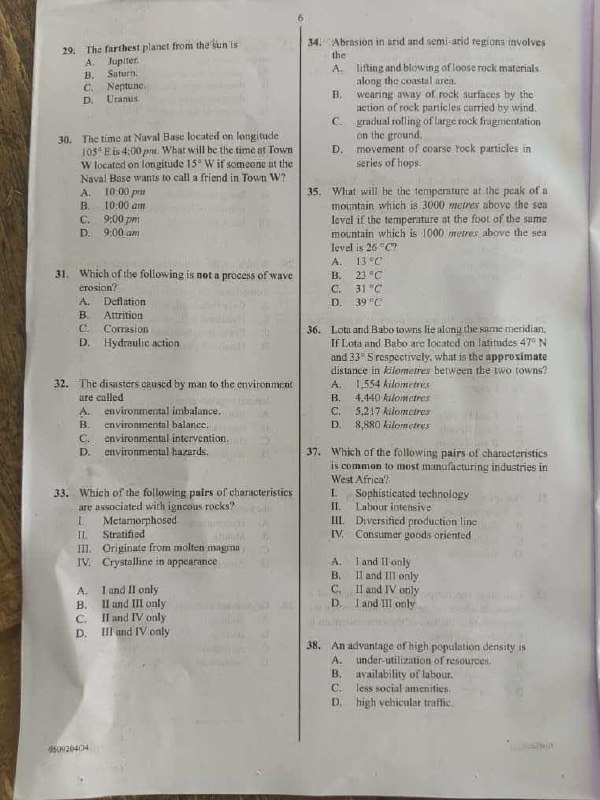
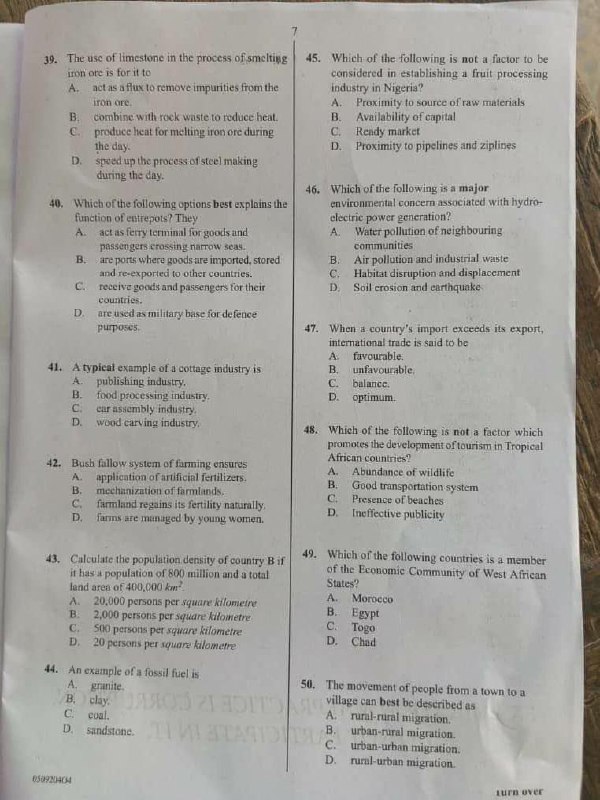
WAEC Geography 2026 OBJ Answers (Objective Section)
The full and verified WAEC Geography objective (OBJ) answers for 2026 will appear below once they are ready. Keep refreshing this page shortly before and during the exam.
WAEC Geography 2026 OBJ Answers
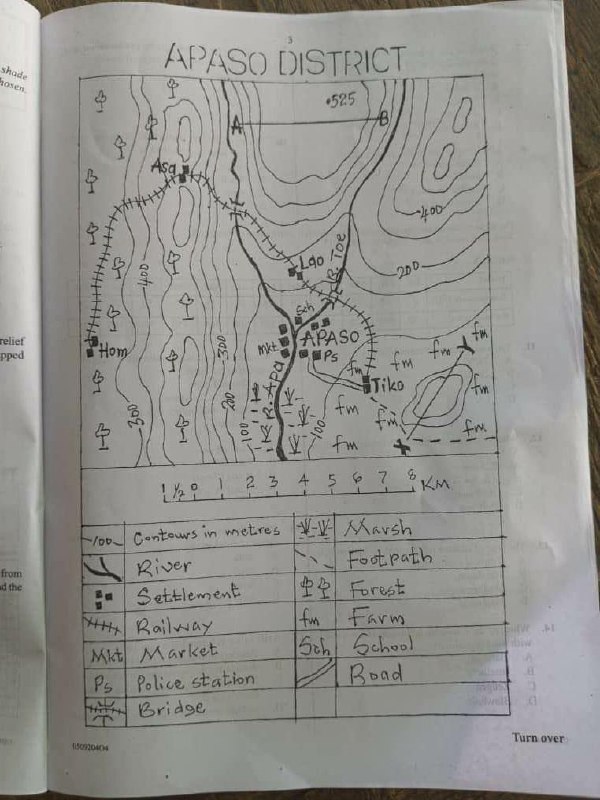
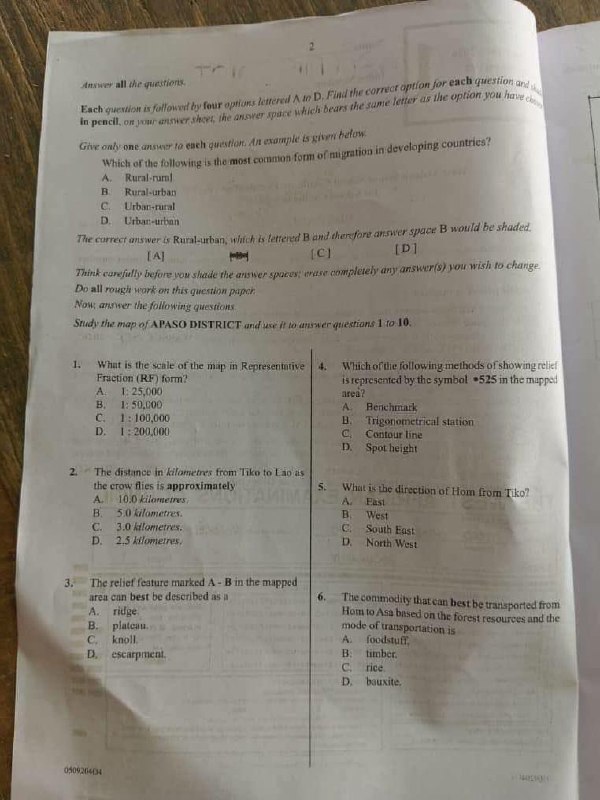
- 01–10: B B A D B B D D C C
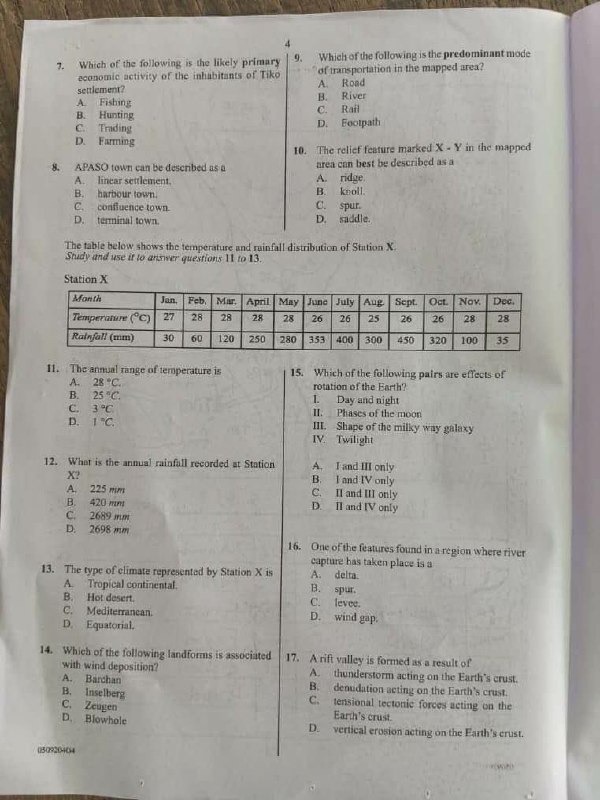
- 11–20: C C D A B B D C B C
- 21–30: D B B D A B B D C B
- 31–40: A D D B B A C B A B
- 41–50: D C C C D C B D C B
Once available, the OBJ answers will be clearly arranged number by number for easy filling on your answer sheet.
WAEC Geography 2026 Essay / Theory Answers
This section is for the theory/essay answers for WAEC Geography 2026. As soon as the questions are confirmed, we will upload well-structured, exam-ready solutions here.
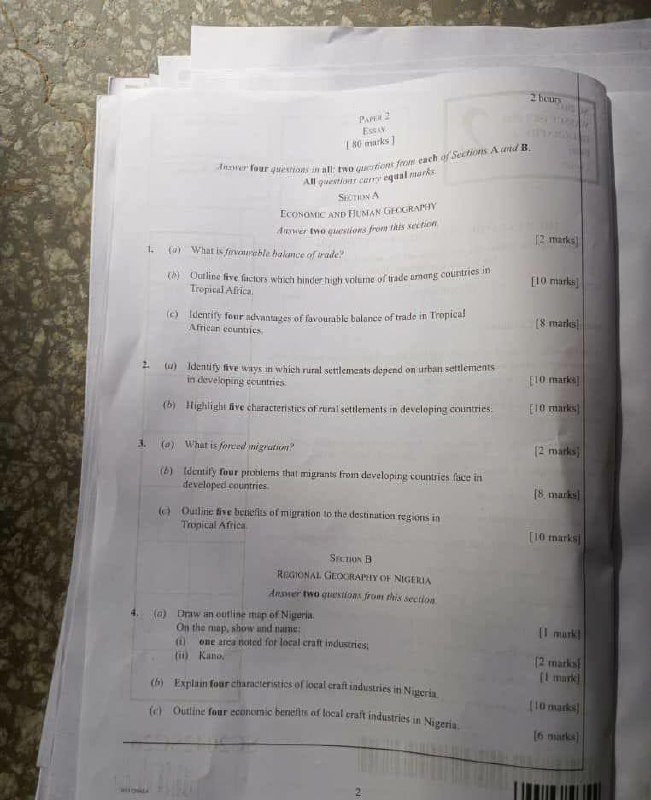
Question 1
(1a) Definition of Favourable Balance of Trade
Favourable balance of trade is a situation where the value of a country’s exports is greater than the value of its imports within a given period. It results in a trade surplus.
(1b) Problems Facing Trade in Africa (Pick Any Five)
- (i) Poor transportation network which makes movement of goods difficult and expensive.
- (ii) Inadequate communication facilities that slow down business transactions and exchange of information.
- (iii) Political instability and civil conflicts that disrupt commercial activities.
- (iv) Low level of industrial development leading to limited production of tradable goods.
- (v) Similarity in the products produced by many African countries, reducing the need for inter-country trade.
- (vi) Trade restrictions such as tariffs, quotas and customs barriers imposed by governments.
- (vii) Inadequate capital and investment needed for large-scale production and trade.
- (viii) Poor storage and warehousing facilities resulting in spoilage of goods, especially agricultural products.
- (ix) Currency instability and exchange rate fluctuations which discourage international transactions.
- (x) Corruption and bureaucratic bottlenecks that delay the movement of goods across borders.
(1c) Advantages of Favourable Balance of Trade (Pick Any Four)
- (i) Increases foreign exchange earnings.
- (ii) Improves the country’s balance of payments position.
- (iii) Promotes economic growth and development.
- (iv) Encourages expansion of local industries.
- (v) Creates employment opportunities for citizens.
- (vi) Increases government revenue through export-related taxes and activities.
- (vii) Strengthens the value and stability of the national currency.
- (viii) Enhances the country’s international creditworthiness and reputation.
- (ix) Increases national income and living standards.
- (x) Provides funds for infrastructural development and investment.
Question 2
(2a) Ways Rural Settlements Depend on Urban Centres (Pick Any Five)
- (i) Rural dwellers depend on urban centres for manufactured goods and consumer products.
- (ii) They rely on urban areas for higher educational institutions and specialized training.
- (iii) Rural communities depend on urban hospitals and healthcare facilities for advanced medical services.
- (iv) They obtain banking, insurance and other financial services from urban centres.
- (v) Urban areas provide markets for the sale of agricultural products produced in rural areas.
- (vi) Rural settlements depend on urban centres for administrative and government services.
- (vii) They rely on urban industries for employment opportunities and income generation.
- (viii) Urban centres supply farm machinery, fertilizers, pesticides and improved seeds to rural farmers.
- (ix) Rural dwellers depend on urban centres for specialized technical and professional services.
- (x) They obtain information, communication and media services from urban areas.
(2b) Characteristics of Rural Settlements (Pick Any Five)
- (i) Low population density with relatively few people living in a large area.
- (ii) Most inhabitants are engaged in primary activities such as farming, fishing, hunting and forestry.
- (iii) Settlements are usually small and widely dispersed.
- (iv) Social amenities such as electricity, pipe-borne water and healthcare facilities are often inadequate.
- (v) Transportation and communication networks are generally poorly developed.
- (vi) Housing is commonly built with local materials such as mud, thatch, bamboo and wood.
- (vii) The standard of living is generally lower than that of urban areas.
- (viii) There is a strong sense of community and close social relationships among residents.
- (ix) Educational facilities are limited and often poorly equipped.
- (x) The environment is dominated by natural vegetation and agricultural land use.
[ESSAY ANSWERS LOADING ⏳]
Refresh this page regularly and follow our WhatsApp channel so you don't miss when the full Geography essay answers drop.
WAEC 2026 Geography Paper 3 \u2014 Physical & Practical Geography Answers
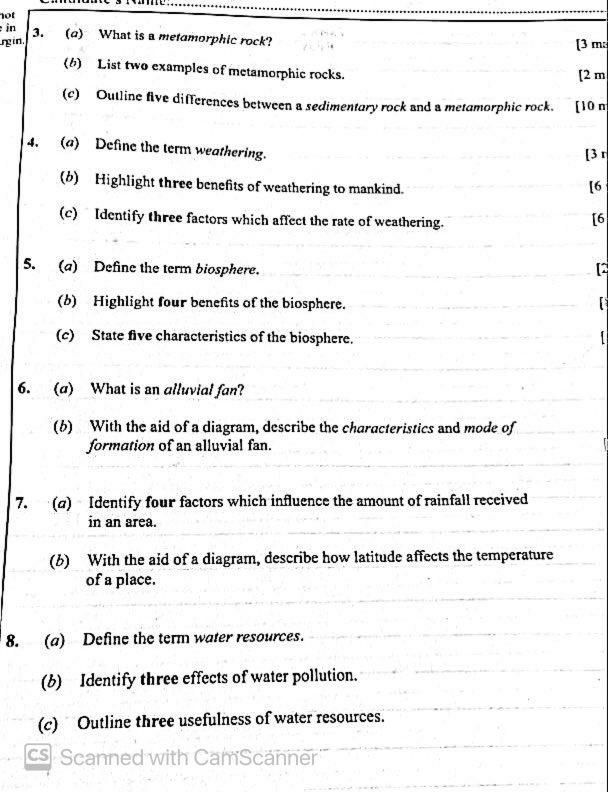
Question 3
(3a) Definition of Metamorphic Rock
A metamorphic rock is a rock that has been changed from its original form by intense heat, pressure, or chemical action within the Earth's crust without melting completely.
(3b) Examples of Metamorphic Rocks
(i) Marble
(ii) Slate
(3c) Differences Between Sedimentary and Metamorphic Rocks (Pick Any Five)
- (i) Sedimentary rocks are formed by deposition, compaction, and cementation of sediments, while metamorphic rocks are formed when existing rocks are altered by heat and pressure.
- (ii) Sedimentary rocks usually contain fossils, while metamorphic rocks rarely contain fossils because the fossils are destroyed during metamorphism.
- (iii) Sedimentary rocks have distinct layers or strata, while metamorphic rocks have foliated bands or crystalline structures.
- (iv) Sedimentary rocks are generally softer, while metamorphic rocks are generally harder.
- (v) Sedimentary rocks are formed at or near the Earth's surface, while metamorphic rocks are formed deep within the Earth's crust.
- (vi) Sedimentary rocks are less compact, while metamorphic rocks are more compact and dense.
- (vii) Sedimentary rocks include sandstone and limestone, while metamorphic rocks include marble and slate.
- (viii) Sedimentary rocks are less resistant to heat and pressure, while metamorphic rocks are more resistant to heat and pressure.
Question 4
(4a) Definition of Weathering
Weathering is the gradual breakdown, disintegration, and decomposition of rocks at or near the Earth's surface by physical, chemical, or biological processes.
(4b) Importance of Weathering (Pick Any Three)
- (i) It helps in the formation of soil.
- (ii) It releases minerals needed for plant growth.
- (iii) It provides materials for construction such as sand and clay.
- (iv) It exposes valuable mineral deposits for mining.
- (v) It aids agricultural activities through fertile soil formation.
- (vi) It contributes to the formation of landforms and scenic landscapes.
- (vii) It improves water infiltration and groundwater storage.
- (viii) It supplies raw materials for industries such as ceramics and brick making.
(4c) Factors Affecting Weathering (Pick Any Three)
- (i) Climate.
- (ii) Temperature changes.
- (iii) Rainfall amount.
- (iv) Nature and composition of rocks.
- (v) Rock structure and degree of jointing.
- (vi) Vegetation cover.
- (vii) Relief or slope of the land.
- (viii) Human activities.
Question 5
(5a) Definition of the Biosphere
The biosphere is the zone of the Earth where living organisms exist and interact with one another and with their physical environment, including the atmosphere, hydrosphere, and lithosphere.
(5b) Importance of the Biosphere (Pick Any Four)
- (i) It provides habitat for living organisms.
- (ii) It supplies food for humans and animals.
- (iii) It provides raw materials for industries.
- (iv) It helps in maintaining ecological balance.
- (v) It produces oxygen necessary for life.
- (vi) It regulates the carbon cycle and climate.
- (vii) It serves as a source of medicinal plants and drugs.
- (viii) It supports agriculture, forestry, and fishing activities.
(5c) Characteristics of the Biosphere (Pick Any Five)
- (i) It is the zone where life exists on Earth: includes all parts where living organisms can survive, including land, water, and the lower atmosphere.
- (ii) It contains a great variety of living organisms: made up of numerous species of plants, animals, and microorganisms occupying different habitats.
- (iii) It interacts with the atmosphere, hydrosphere, and lithosphere: living organisms depend on air, water, and soil, making the biosphere closely linked to other Earth spheres.
- (iv) It is dynamic in nature: constantly changing as a result of natural processes such as evolution, climate change, and human activities.
- (v) It depends mainly on solar energy: energy from the sun drives photosynthesis, which supports food chains and sustains life.
- (vi) It is characterized by interdependence among organisms: plants, animals, and microorganisms rely on one another for food, shelter, and survival.
- (vii) It has continuous nutrient cycling: essential elements such as carbon, nitrogen, oxygen, and water are recycled through natural processes.
- (viii) It contains diverse ecosystems: forests, grasslands, deserts, wetlands, rivers, and oceans, each supporting distinct forms of life.
Question 6
(6a) Definition of Alluvial Fan
An alluvial fan is a fan-shaped deposit of sediments such as sand, gravel, and silt formed when a river or stream flows from a steep slope onto a flat plain and loses its velocity, causing it to deposit its load.
(6b) Diagram
[Candidates are required to draw a labelled diagram of an alluvial fan as instructed in the question paper.]
Characteristics of an Alluvial Fan
- (i) It is fan-shaped or cone-shaped in appearance.
- (ii) It is formed at the foot of a mountain or steep slope.
- (iii) It consists of deposited materials such as sand, gravel, pebbles, and silt.
- (iv) It has a gentle outward slope from the apex to the edges.
- (v) The sediments are thickest near the apex and thinner towards the margins.
- (vi) It is usually crossed by several distributary channels.
Mode of Formation of an Alluvial Fan
- (i) A river or stream flows down a steep mountain slope carrying large quantities of sediments.
- (ii) On reaching a flat plain or valley floor, the gradient suddenly decreases.
- (iii) The river loses velocity and transporting power.
- (iv) Coarse materials such as gravel and pebbles are deposited first near the mouth of the slope.
- (v) Finer materials such as sand and silt are carried farther and deposited towards the outer edges.
- (vi) Repeated deposition over time causes the sediments to spread outward in a fan-like pattern, resulting in the formation of an alluvial fan.
How to Use Examsmooth for Your 2026 WAEC Geography Exam
Examsmooth is created to help Nigerian students prepare smarter and stay updated during major exams like WAEC, NECO and JAMB. For this 2026 WAEC Geography paper, keep this page open, bookmark it, and check back often as the exam time approaches. Always combine any help you get here with serious personal reading and past questions practice.
- Bookmark this page on your browser right now.
- Join our official WAEC WhatsApp channel using the button above.
- Return to this page at least 30 minutes before the exam starts.
- Keep refreshing the page so you can see when the answers are updated.
- Use the answers as a guide and still think carefully before writing.
 Examsmooth
Leave a comment