
TYPE A
SECTION A — CONTINUOUS WRITING
Question 1 — Formal Letter
27, Olanrewaju Street,
Ogba, Lagos.
12th March, 2026.
The Principal,
Government Secondary School,
Ogba, Lagos State.
Dear Sir/Ma,
POOR CONDITION OF THE SCHOOL LIBRARY
I write as a concerned student of this great institution to draw your kind attention to the deplorable condition of our school library and to humbly suggest ways in which it can be improved for the benefit of all students.
At present, the library is in a very poor state. The roof leaks whenever it rains, causing water to drip onto the shelves and soak many of the books. A large number of the available books are outdated and no longer relevant to the current curriculum. The lighting in the library is also very poor; many of the bulbs are dim or completely dead, making it difficult for students to read comfortably. In addition, the seating arrangement is grossly inadequate. During break time and after school, students struggle to find chairs and tables, and some are forced to sit on the floor or stand while reading.
These conditions have had a negative impact on students’ learning. Because the books are old and sometimes damaged by water, many students no longer see the library as a reliable place to obtain current information for assignments and examinations. The poor lighting strains our eyes and discourages prolonged reading, while the lack of adequate seating makes the environment uncomfortable and noisy as students quarrel over the few available chairs. As a result, the library, which is supposed to be the intellectual heart of the school, is grossly underutilized, and students’ academic performance is indirectly affected.
In view of the above, I wish to suggest some practical steps that can be taken to revive the library. First, the leaking roof should be repaired without delay and the ceiling replaced where necessary. Secondly, the school, with the support of the Parents-Teachers Association and old students, should purchase new and up-to-date textbooks, reference materials and past question booklets that reflect the current syllabus. Thirdly, the lighting system should be improved by replacing faulty bulbs and providing fans to make the reading environment more comfortable. Furthermore, the school should provide more chairs and tables and arrange them properly to accommodate more students. It would also be helpful to employ or assign a qualified librarian who will organize the books, maintain order and guide students in the use of the library. Finally, a clear reading timetable can be created for each class to encourage regular use of the library for private study and group research.
Sir/Ma, I sincerely believe that if these suggestions are implemented, our school library will become a vibrant centre of learning once again and will contribute greatly to better academic performance in the school. I therefore appeal for your prompt intervention on this matter.
Yours faithfully,
____________________
Adesuwa Okafor
Question 2 — Article
THE MENACE OF FLOODS AND HOW WE CAN PREVENT THEM
In recent years, many communities across Nigeria have experienced devastating floods. From the coastal areas of Bayelsa and Rivers States to inland towns along the River Niger and Benue, homes, roads and farmlands have repeatedly been submerged by rising waters. Climate change, poor urban planning and human carelessness have all contributed to this growing threat. Flooding, which occurs when water overflows onto normally dry land, has become one of the most destructive natural disasters facing our nation today.
The effects of floods on people and the environment are far-reaching. First, floods displace thousands of people from their homes. Families are forced to move into overcrowded camps or stay with relatives, losing their privacy and comfort. Secondly, floods destroy properties such as houses, vehicles, furniture and electrical appliances, leaving victims with huge financial losses. Thirdly, stagnant floodwater often becomes contaminated with sewage and refuse, leading to the spread of waterborne diseases like cholera, typhoid and diarrhoea. Hospitals and clinics in affected areas are usually overwhelmed with patients after every major flood.
Furthermore, floods wreak havoc on agriculture. Farmlands are washed away, and crops such as rice, maize, cassava and vegetables are destroyed. This leads to food shortages and increase in the prices of available food items, thereby worsening hunger and poverty, especially among rural dwellers. In some cases, livestock such as goats, sheep and poultry are swept away by the fierce currents. Floods also lead to loss of human lives when people are trapped in their homes, attempt to cross flooded roads or are bitten by snakes and other dangerous creatures driven out of their natural habitats by the rising water. In addition, schools and businesses are frequently shut down when roads are cut off and buildings are flooded, disrupting education and economic activities.
Despite these frightening effects, floods can be prevented or at least greatly reduced if we take the right measures. The first step is to construct and maintain proper drainage systems in our cities, towns and villages. Drains and gutters should be well designed, regularly cleared of silt and refuse, and not allowed to be blocked by illegal structures. Secondly, people must stop building houses on floodplains, river banks and natural waterways. Government agencies should strictly enforce building regulations and demolish structures that obstruct the free flow of water. Thirdly, government at all levels should develop effective early warning systems to alert citizens about expected heavy rainfall and possible flooding so that they can evacuate on time.
Moreover, proper waste disposal is essential in the fight against flooding. When people dump refuse in gutters, rivers and canals, they block the flow of water and increase the likelihood of floods. Public enlightenment campaigns should therefore emphasize the need for citizens to use waste bins and designated dump sites. Afforestation, that is, planting of trees, should also be encouraged because tree roots help to hold the soil together and reduce erosion and surface runoff. In areas that are especially prone to flooding, government can construct dams, embankments and levees to control the movement of water and protect surrounding communities.
In conclusion, flooding is a serious menace that destroys lives, property and the environment in Nigeria. However, if government, communities and individuals work together to improve drainage, obey town planning regulations, manage waste properly, plant trees and build protective structures, the impact of floods can be greatly reduced. It is our collective responsibility to protect our nation from this yearly disaster.
Question 3 — Narrative Essay
The first time Amaka saw her father return home with tears in his eyes, she knew that life had become even harder. His small mechanic workshop had been demolished during a government road expansion exercise. For weeks, he moved from house to house, looking for any menial job that would put food on the family’s table. Her mother’s petty trading in tomatoes and pepper barely sustained them. As the first of four children, Amaka felt the heavy weight of responsibility pressing on her young shoulders.
At school, things were not much better. Her classmates often mocked her for wearing the same faded uniform and using an old, torn school bag. Sometimes she came to school on an empty stomach because there was no money for breakfast. Her performance began to drop. She failed Mathematics twice in a term and barely managed to pass English. One afternoon, after receiving yet another poor test result, she sat alone under the mango tree beside the school field, fighting back tears.
“Maybe I am not meant to succeed,” she whispered to herself.
As she sat there, her class teacher, Mr. Ibrahim, approached quietly. “Amaka, why are you not in class?” he asked gently.
She hesitated, then burst into tears. “Sir, everything is hard. There is no money at home. I cannot concentrate. I keep failing. I think I should just drop out and learn a trade.”
Mr. Ibrahim listened patiently, his face full of concern. When she finished, he placed a comforting hand on her shoulder. “My daughter,” he said softly, “I know things are difficult now, but there is light at the end of the tunnel. Many great people passed through hardship before they succeeded. What matters is that you do not give up. If you are ready to work hard, I will help you.”
True to his word, Mr. Ibrahim began to give Amaka extra lessons after school. He explained difficult topics in Mathematics and English patiently, using simple examples from everyday life. He also spoke with the school principal, who arranged for Amaka to benefit from a small scholarship that covered her textbooks and examination fees. Her church youth group contributed a new school bag and a pair of sandals. Little by little, hope returned to her heart.
However, the road to success was still not easy. At home, Amaka had to help her mother in the market before and after school. She fetched water, cooked and assisted her younger siblings with their homework. Many nights she read by the dim light of a kerosene lantern because there was no electricity. Sometimes sleep tempted her, but she remembered Mr. Ibrahim’s words and forced herself to continue.
When the time for WAEC drew nearer, fear once again tried to overwhelm her. The syllabus looked huge, and some of her friends spent their evenings at viewing centres instead of reading. One day, her friend Ngozi tried to persuade her to join them.
“Amaka, this life is too short to be serious all the time,” Ngozi said with a laugh. “Let us go and watch the match. After all, people who read still fail.”
Amaka smiled sadly. “Ngozi, I do not have that luxury. My family is counting on me. I must pass this WAEC. Maybe later I will join you, but not today.”
She returned home, closed the door of their small room and opened her books. Night after night, she studied past questions, summarised textbooks and practised essay writing. On weekends, she attended free tutorial classes organized by a youth association in the community. Sometimes hunger gnawed at her stomach, but determination fed her soul.
Eventually, the WAEC examinations began. Amaka entered the hall each day with a mixture of fear and faith. She prayed quietly before turning each question paper, and to her surprise, most of the questions were on topics she had studied thoroughly. When the last paper ended, she felt both relieved and anxious about the future.
Months later, the long-awaited results were released. On the morning the results came out, Amaka accompanied her father to a neighbour’s shop where they usually checked information online. Her hands trembled as the shop owner typed in her examination number. For a few seconds, the internet connection froze. Then the page loaded.
“Amaka, come and see!” the man exclaimed.
She moved closer, her heart pounding. There on the screen, in bold letters, were her grades: English—B3, Mathematics—B2, Biology—A1, Chemistry—B3, Physics—B2, and good passes in all her other subjects. She stared in disbelief, then screamed with joy. Her father hugged her tightly, tears of happiness rolling down his cheeks.
“My daughter, you have made us proud,” he said, his voice shaking. “God has answered our prayers.”
With her excellent result, Amaka applied to the University of Lagos to study Nursing Science. Once again, the waiting period was stressful, but she did not lose hope. She continued to assist her mother in the market and volunteered at a small clinic in their area, where she learnt basic first aid. One sunny afternoon, while she was washing plates in the backyard, her younger brother ran in excitedly, waving a brown envelope.
“Sister Amaka, letter from the university!” he shouted.
With trembling hands, she opened the envelope and unfolded the letter. It was an admission letter from the University of Lagos, offering her a place to study Nursing Science. She let out a loud cry of joy and knelt down in gratitude.
Years passed, and Amaka worked just as hard in the university as she had in secondary school. She won a scholarship from a non-governmental organisation that supported brilliant but needy students. During holidays, she returned home to tutor younger students in her community for free. Finally, on her graduation day, dressed in her academic gown and cap, she looked into the crowd and saw her parents sitting proudly in the front row.
As her name was called and she walked across the stage to receive her degree, memories of the hunger, tears and late-night reading flooded her mind. She smiled to herself and whispered, “Truly, there is light at the end of the tunnel.” Her story became an inspiration to many others, proving that with perseverance, faith and hard work, even the darkest night will one day give way to the bright light of success.
Question 4 — Debate
Good day, Mr Chairman, panel of judges, accurate timekeeper, my fellow co-debaters, distinguished ladies and gentlemen. I am (Name), and I am here to speak against the motion which states that “Social Media has done more harm than good to students’ academic performance.” I strongly believe that social media, when used wisely, has done far more good than harm to students’ academic performance.
To begin with, social media provides students with easy access to educational content. Platforms like YouTube, Khan Academy, Coursera and many educational channels on Facebook and Instagram offer free lessons on almost every subject imaginable. A student who is confused about a topic in Mathematics or Chemistry can simply search online and watch step-by-step explanations. In the past, students depended solely on their classroom teachers, but now social media has opened a world of additional teachers and resources, thereby improving understanding and performance.
Furthermore, social media promotes collaboration and group study among students. Through WhatsApp and Telegram groups, classmates can share notes, discuss difficult questions and remind one another about assignments and tests. During examination periods, many schools create online platforms where teachers and students interact, revise past questions and clarify doubts in real time. Instead of struggling alone, students now enjoy a virtual classroom that extends beyond the four walls of the school.
In addition, social media grants students access to past questions, study materials and global knowledge. Many educational pages and websites upload WAEC, NECO and JAMB past questions with worked solutions. Students also read scientific articles, watch documentaries and follow educational influencers who share tips on effective reading, time management and career choice. This broad exposure helps students to think critically, stay updated with current affairs and perform better in examinations.
My opponents may argue that social media distracts students, encourages laziness and wastes precious study time. While it is true that some students misuse social media, the problem is not the platforms themselves but how individuals choose to use them. Even textbooks, if not read, cannot improve anyone’s performance. A disciplined student can set clear boundaries by turning off notifications during study time and following mainly educational pages. Therefore, instead of condemning social media, we should teach students digital discipline and responsible usage.
Another point my opponents may raise is that social media exposes students to immoral content and cyberbullying. I agree that these dangers exist, but again, the solution is not to deny the many academic benefits of social media. Rather, parents, teachers and government should provide guidance, enforce age restrictions, promote cyber safety education and report offensive accounts. Just as we do not ban roads because accidents happen, we should not condemn social media because some people use it wrongly.
In conclusion, social media has become an essential educational tool in our modern world. It gives students access to countless learning resources, encourages collaboration, exposes them to global knowledge and helps them prepare effectively for examinations. The real issue is discipline and guidance, not the existence of social media. I therefore urge this honourable house to reject the motion and to recognise that social media has done more good than harm to students’ academic performance when used responsibly. Thank you.
SECTION B — COMPREHENSION
Question 5 — Comprehension (Service Dogs Passage)
(a) What is a service dog?
A service dog is a specially trained dog that assists people with disabilities or special needs in carrying out daily activities and living more independently.
(b) How did Max help his owner?
Max helped his owner by alerting him to important sounds, guiding him safely through crowded or dangerous places, and providing emotional support and comfort when he felt anxious or lonely.
(c) What qualities make a good service dog?
The qualities that make a good service dog include patience, intelligence, obedience, loyalty and the ability to remain calm and focused under pressure or in noisy environments.
(d) Explain in your own words “Max was more than a pet.”
This means that Max was not just an ordinary domestic animal kept for pleasure or companionship; he was a trained helper and constant companion who performed important tasks that made life safer and easier for his owner.
(e) What is the writer’s purpose in this passage?
The writer’s purpose is to educate readers about the important role that service dogs play in improving the quality of life of people with disabilities and to create appreciation for these specially trained animals.
(f) Suggest a suitable title for the passage.
Any one of the following is acceptable:
• “Service Dogs: Man’s Most Faithful Helpers”
• “Beyond Companionship: The Life of Service Dogs.”
SECTION C — SUMMARY
Question 6 — Summary (Benefits of Walking)
Regular walking offers numerous health benefits. It strengthens the heart, improves cardiovascular health and reduces the risk of heart disease. Walking helps to control weight by burning calories and boosting metabolism. It also strengthens muscles and bones, lowering the risk of osteoporosis. In addition, walking improves mental health by reducing stress, anxiety and depression through the release of feel-good chemicals. It enhances blood circulation, lowers blood pressure and improves lung function. Because it is cheap, simple and suitable for all ages, regular walking is a powerful habit that promotes overall well-being.
TYPE B
SECTION A — CONTINUOUS WRITING
Question 1 — Article
THE MENACE OF FLOODS AND HOW WE CAN PREVENT THEM
In recent times, flooding has become a recurring nightmare for many communities in Nigeria. From Lagos and Ibadan to Lokoja and Makurdi, heavy rainfall and overflowing rivers have repeatedly submerged homes, roads and farmlands. Flooding occurs when water escapes from its normal channel and covers dry land, and it has become one of the most destructive disasters we face as a nation.
Floods have several serious effects on individuals and society. First, they displace thousands of people from their homes, forcing them to stay in temporary camps, schools or with relatives. Living in such crowded conditions often leads to discomfort and lack of privacy. Secondly, floods destroy properties such as houses, vehicles, furniture and electrical appliances. Many families lose everything they have laboured for over the years in a single flood incident.
Moreover, floods contribute to the spread of waterborne diseases. When water from rivers and drains mixes with refuse and human waste, it becomes contaminated and dangerous. People who drink or bathe with such water are at risk of cholera, typhoid fever and diarrhoea. Hospitals in affected areas usually record a sharp increase in the number of patients after floods. In addition, farmlands and crops are destroyed when they are submerged for several days. This leads to reduced food supply, increase in food prices and greater hunger among poor families.
Floods also cause loss of lives. Some people drown when trying to cross flooded roads or when they are trapped inside their homes. Others are bitten by snakes and other dangerous animals that are displaced by the rising water. Educational and economic activities equally suffer. Schools are closed, bridges collapse and markets are shut down when flood water cuts off major roads. This slows down development and increases poverty.
Despite these terrible effects, flooding can be prevented or reduced if we take the right steps. Firstly, government must construct proper drainage systems and ensure that existing gutters and canals are regularly cleared. When drains are blocked by refuse or illegal structures, rainwater has nowhere to go and so spreads across roads and into houses. Secondly, people should avoid building houses on floodplains, river banks and natural waterways. Town planning authorities must strictly enforce building regulations and demolish structures that obstruct the free flow of water.
Another important preventive measure is the establishment of effective early warning systems. Meteorological agencies should monitor rainfall patterns and quickly inform the public when heavy rainfall and possible flooding are expected. This will enable people to move to safer areas before the situation becomes dangerous. Proper waste management is also crucial. Citizens must learn to dispose of refuse in designated dumps instead of throwing it into gutters, rivers and streams. Public enlightenment campaigns on radio, television and social media can help change people’s attitudes.
Furthermore, afforestation should be encouraged. Planting trees helps to hold the soil together and slow down the flow of water, thereby reducing erosion and surface runoff. In flood-prone areas, government can build dams, embankments and levees to control the flow of rivers and prevent them from overflowing. When all these measures are combined with proper urban planning and strict enforcement of environmental laws, the damage caused by floods will be greatly reduced.
In conclusion, flooding is a dangerous menace that displaces people, destroys property, spreads disease, damages farmlands and sometimes claims lives. However, if government and citizens work together to improve drainage, obey building regulations, dispose of waste properly, plant trees and construct protective structures, we can protect our communities from this recurring disaster. Flood prevention is therefore a collective responsibility we must all take seriously.
Question 2 — Narrative Essay
From the moment Chidi could remember, his parents’ favourite saying was, “We do not have much, but we have our hands and our brains.” They lived in a tiny, one-room apartment in the outskirts of Enugu, where his father worked as a commercial driver and his mother sold akara by the roadside. There was hardly enough money to feed the family of six, but they never missed evening prayers or morning chores. Chidi grew up knowing that if he wanted a better life, he would have to work for it.
At school, Chidi’s classmates laughed at his worn-out sandals and patched uniform, but he ignored them. He sat in the front row and listened attentively to every lesson. After school, while some boys rushed to the viewing centre to watch football, Chidi hurried to his mother’s stall to help her fry akara. When business slowed down in the afternoon, he would bring out his books and read beside the hot, smoky frying pan.
One afternoon, his friend Uche tapped him playfully on the shoulder. “Chidi, you are always reading,” Uche complained. “Let us go and play football. Life is not all about books.”
Chidi smiled. “I know, but my parents cannot afford to send me to university unless I get a scholarship. If I waste this opportunity, I may remain in this poverty forever. I have to work hard now so that my future will be different.”
As the years passed, Chidi’s commitment to his studies deepened. He woke up at 4:30 a.m. every day to read before preparing for school. At night, he revised his notes by lantern light, often fighting sleep. When his classmates were buying expensive textbooks and past questions, Chidi could only afford second-hand books from a roadside vendor. Yet he made the best use of what he had, copying extra notes from friends and borrowing textbooks from the school library.
When he entered SS2, his Mathematics teacher, Mrs. Okafor, noticed his seriousness. One day after class, she called him aside.
“Chidi, your test scores are impressive,” she said warmly. “Have you considered applying for scholarships after WAEC?”
“Yes, ma,” he replied shyly. “But I am afraid I may not be good enough. My parents are poor and I do not attend special lessons like others.”
She smiled. “Hard work is more important than where you come from. If you continue like this, you will go far. I will give you extra exercises and guide you through past questions. Do your part and leave the rest to God.”
From that day, Chidi spent his break time solving Mathematics problems in the staffroom under her supervision. On Saturdays, he attended free tutorial classes organised by a youth group in his church. While many of his friends complained that WAEC was too difficult, Chidi saw it as a mountain he could climb if he prepared well.
Finally, the WAEC examinations arrived. For several weeks, Chidi wrote one paper after another, pouring all his energy and knowledge onto the answer sheets. Some nights he could barely sleep, worrying about whether his answers were correct. When the last paper ended, he felt both relief and fear. The results would determine his future.
Months later, the results were released online. Chidi’s father took him to a nearby cybercafé to check his grades. The cafe attendant entered his examination number and waited. As the page loaded, Chidi silently prayed. Then the attendant’s face lit up.
“Young man, you have done excellently!” he exclaimed. “Look at all these A’s and B’s!”
Chidi looked at the screen and saw: English—B3, Mathematics—A1, Physics—A1, Chemistry—B2, Further Mathematics—B2 and high grades in all his other subjects. He could hardly believe his eyes. His father hugged him in the middle of the café, ignoring the surprised looks of other customers.
“My son, I knew your hard work would not be in vain,” he said, his voice breaking with emotion.
Encouraged by his result, Chidi applied for a scholarship offered by an oil company for brilliant science students from poor backgrounds. The application required his WAEC result, a recommendation letter from his principal and a personal essay on why he deserved the award. Chidi poured out his heart in the essay, describing his humble beginnings, his determination and his dream of becoming an engineer who would design roads and bridges across Nigeria.
Several weeks after submitting the application, he received an email inviting him for an interview in Lagos. Travelling to Lagos was expensive, but his church members and neighbours contributed transport money when they heard about his opportunity. At the interview, he met many other brilliant students from different states. Some wore expensive suits and spoke polished English. For a moment, Chidi felt intimidated, but he quickly reminded himself of how far he had come through hard work.
The panel of interviewers asked him questions about his background, his study habits and his plans for the future. He answered honestly and confidently, giving credit to his parents and teachers. Weeks later, while helping his mother at the akara stall, his phone vibrated. It was an email notification. With trembling hands, he opened it and read the first line: “Dear Chidi, we are pleased to inform you that you have been awarded the 2026 Engineering Scholarship…”
He shouted for joy and hugged his mother, who danced in the middle of the street, her apron covered in oil. The scholarship covered his tuition, accommodation and living expenses for his chosen course of Civil Engineering at the University of Nigeria, Nsukka.
At the university, Chidi continued to work hard. While some of his mates wasted time at parties and clubs, he spent hours in the library and engineering laboratory. His dedication paid off. He graduated with first-class honours and was immediately offered a job with a reputable construction company. Years later, he became a renowned engineer known for supervising major road and bridge projects across the country.
Whenever he visited his old secondary school to speak to students, he shared his story and ended with the same message: “I am living proof that hard work pays. Your background may be poor, but if you are diligent and persistent, your future can be rich.” His life became a shining example that hard work truly rewards those who refuse to give up.
Question 3 — Debate
Mr Chairman, honourable panel of judges, accurate timekeeper, co-debaters, distinguished ladies and gentlemen, good day. I am (Name), and I stand here to speak for the motion which states that “Social Media has done more harm than good to students’ academic performance.”
Social media refers to online platforms such as Facebook, WhatsApp, Instagram, TikTok, X and Snapchat that allow people to create, share and exchange information and messages. Although these platforms have some advantages, their negative impact on students’ academic performance is far greater and more evident in our society today.
Firstly, social media has become a major source of distraction and addiction among students. Many students spend several hours each day chatting, watching skits and scrolling through endless posts instead of reading their books. They check their phones even during lessons and prep time, paying more attention to likes and comments than to their teachers. This addiction reduces the time and concentration needed for serious study, leading to poor performance in tests and examinations.
Secondly, social media exposes students to immoral content and cyberbullying. With just one click, a student can watch pornography, violent videos and other morally corrupt materials that pollute the mind and distract from academic goals. Some students are also bullied online through insults, threats and the sharing of embarrassing pictures or rumours. Victims of cyberbullying often become depressed, lose interest in school and perform poorly in their studies.
Another harmful effect is that social media encourages poor language use. Many students have replaced correct spelling and grammar with slang and abbreviations such as “l8r,” “u,” and “k.” They become so used to this informal language that they make the same mistakes in their essays and examinations. This leads to low scores, especially in English Language, where correct spelling, punctuation and grammar are very important.
Furthermore, social media contributes to sleep deprivation. Instead of going to bed early, many students stay awake late into the night, chatting or watching videos. They wake up tired, doze in class and are unable to concentrate. Their memory becomes weak and they forget what they have been taught. No wonder many students cannot answer simple questions during lessons or perform well in examinations.
Social media also promotes unhealthy competition, peer pressure and materialism. Students see pictures of their mates flaunting expensive phones, clothes and lifestyles online. In an attempt to imitate them, some become involved in examination malpractice, internet fraud and other vices just to get money for a “soft life.” Their focus shifts from education to showing off, and their academic performance suffers greatly.
My opponents may argue that social media provides educational materials and helps students to communicate. However, what is happening in reality? Only a few disciplined students use social media mainly for academic purposes. The majority use it for entertainment and gossip. If social media were truly more helpful than harmful, we would not see the alarming decline in reading habits, concentration and moral values among students today.
In conclusion, social media has caused more harm than good to students’ academic performance by encouraging addiction, distraction, immoral behaviour, poor language use, lack of sleep and misplaced priorities. I therefore strongly support the motion and urge parents, teachers and government to regulate students’ use of social media and to promote face-to-face learning and reading instead. Thank you.
Question 4 — Formal Letter
27, Olanrewaju Street,
Ogba, Lagos.
12th March, 2026.
The Principal,
Government Secondary School,
Ogba, Lagos State.
Dear Sir/Ma,
POOR CONDITION OF THE SCHOOL LIBRARY
I am a senior student of this noble institution, and I write to express my deep concern about the present condition of our school library and to suggest ways in which it can be improved.
Presently, the library is in a very poor state. The roof leaks badly whenever it rains, allowing water to drip onto the shelves and damage books. Many of the textbooks, reference materials and journals are old, torn and outdated, and do not reflect the current syllabus. The lighting in the library is also insufficient, as several bulbs are either dim or not working at all, making it difficult to read. In addition, there are too few chairs and tables for the large number of students who wish to use the library, so some students have to stand or sit on the floor when reading.
These problems have negatively affected students’ learning. Because the books are outdated and sometimes damaged, many students prefer to rely only on their class notes and do not see the need to visit the library. The poor lighting strains our eyes and discourages long periods of reading, while the inadequate seating creates an uncomfortable and noisy environment. The library, which should be a quiet and attractive place for research and private study, has therefore lost its importance in the academic life of the school.
To address these challenges, I wish to humbly suggest some measures. First, the leaking roof should be repaired and the affected ceiling boards replaced as soon as possible. Secondly, the school, in collaboration with the Parents-Teachers Association and old students, should purchase new and relevant textbooks, past questions and reference materials in all subjects. Thirdly, all faulty bulbs should be replaced and additional lighting provided to make the library bright and conducive for study. More chairs and tables should also be provided and neatly arranged to accommodate more students. Furthermore, a qualified librarian should be employed or assigned to organise the books, maintain discipline and assist students in locating materials. Finally, the school may consider drawing up a reading timetable for each class to encourage regular use of the library.
I am confident that if these suggestions are implemented, our library will once again become a centre of serious academic work and will contribute greatly to improved performance in internal and external examinations. I therefore appeal for your kind and prompt attention to this matter.
Yours faithfully,
____________________
Adesuwa Okafor
SECTION B — COMPREHENSION
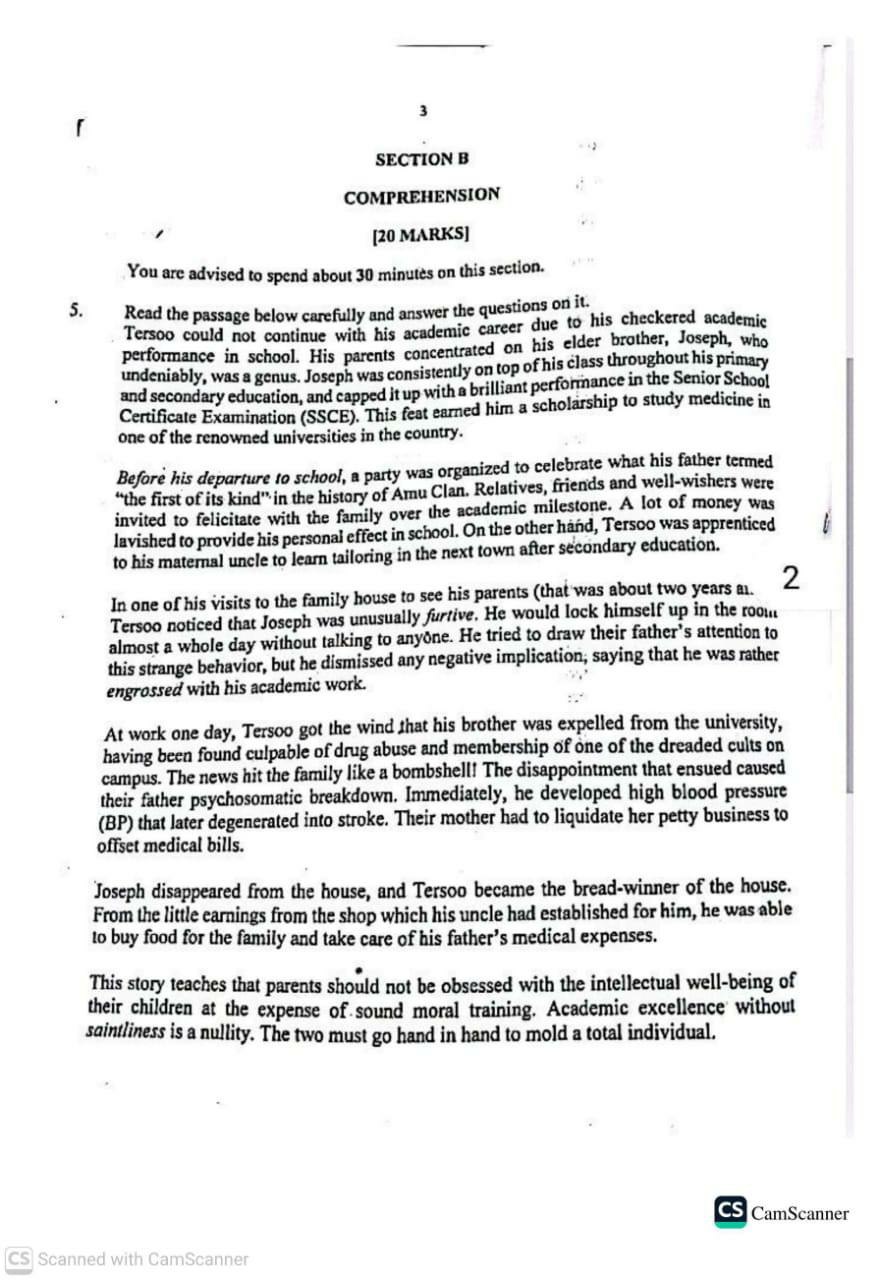
Question 5 — Comprehension (Tersoo & Joseph Passage)
(a) Why did Tersoo visit the school counsellor?
Tersoo visited the school counsellor because he was deeply worried about his brother Joseph’s behaviour. Although Joseph was performing excellently in his studies, his moral character was declining, and Tersoo needed guidance on how to handle the situation.
(b) What was Joseph’s problem according to the passage?
Joseph’s problem was that, despite being academically brilliant, he had developed bad habits such as truancy, dishonesty and disrespect for elders and authority figures. His conduct did not match his academic success.
(c) What advice did the counsellor give?
The counsellor advised that academic excellence alone is not enough; good character, discipline and sound moral values are equally important for true success. He encouraged that Joseph should be helped to understand that his behaviour must match his intelligence if he wants to have a meaningful life.
(d) Explain “a brilliant mind in a corrupt vessel.”
This expression means that a person may be very intelligent and academically gifted, but if his character is bad and he is morally weak, his intelligence is wasted and becomes dangerous instead of useful.
(e) What is the main message of the passage?
The main message is that true success is not measured by academic excellence alone, but by a combination of good results and good character. Intelligence without discipline and morals is incomplete and harmful.
(f) Give a suitable title for the passage.
Any one of the following is acceptable:
• “Brains Without Character: The Story of Two Brothers”
• “When Excellence Is Not Enough.”
SECTION C — SUMMARY
Question 6 — Summary (Poor Reading Culture in Nigeria)
The passage explains that Nigeria’s poor reading culture is caused by several factors. Many families are too poor to buy books and educational materials. Overcrowded and noisy homes make reading difficult, while high adult illiteracy means parents cannot serve as reading models for their children. Materialism has shifted people’s attention from education to the pursuit of quick wealth. In addition, government and institutions do not invest enough in libraries, reading centres and literacy programmes. Together, these factors have produced a society where reading is neither valued nor regularly practised.
TYPE C

SECTION A — CONTINUOUS WRITING
Question 1 — Narrative Essay
Emeka grew up in a small village in Imo State where most families depended on farming for survival. His father was a poor palm wine tapper and his mother sold garri at the local market. Emeka’s dream was to become an engineer, but every time he looked at their leaking mud house and his parents’ rough, calloused hands, his dream seemed far away.
In primary school, Emeka was often sent home for not paying fees on time. Sometimes he missed classes because he had to follow his father to the farm to help with manual labour. When he gained admission into secondary school, the challenges increased. He had to trek several kilometres to school each day, and he owned only one uniform, which his mother washed every Saturday and dried carefully in the sun.
As he entered SS1, the subjects became more difficult. Mathematics, Physics and Chemistry seemed like strange languages. After failing a major Mathematics test, Emeka sat alone behind the classroom, staring at his script.
“Maybe I am not meant for school,” he thought sadly.
Just then, his Mathematics teacher, Mr. Danladi, approached him. “Emeka, why are you sitting here alone?” he asked.
Emeka sighed. “Sir, no matter how I try, I still fail Mathematics. My parents are poor, and I do not have money for extra lessons. I think I should just drop out and learn a trade.”
Mr. Danladi looked at him kindly. “My boy, I have watched you in class. You are intelligent and hardworking. You only need guidance and more practice. There is a saying that there is light at the end of the tunnel. Your present struggle is the dark part of the tunnel, but if you keep moving and refuse to give up, you will get to the light.”
Those words touched Emeka deeply. From that day, he decided to fight for his dream. He began to stay back after school to solve extra questions under Mr. Danladi’s supervision. He also formed a small study group with two classmates who were good in science subjects. In the evenings, after helping his mother at the market, he read his notes by lantern light until his eyes grew heavy.
When the time for WAEC approached, fear tried to overwhelm him again. Many of his classmates were paying for “special centres” where they hoped to cheat in the examination. Emeka was tempted, but he remembered his teacher’s words and his parents’ honest lifestyle.
“I will pass on my own,” he told himself. “My success must be clean.”
During the examination, Emeka prayed silently before each paper. The questions were challenging, but he discovered that many of them were similar to the past questions he had practised. He did his best and left the rest to God. After the last paper, he returned to the farm to assist his father, trying not to worry too much about the results.
Months later, the WAEC results were released. Since there was no internet in the village, the principal sent a teacher to the nearest town to print out the results. Students gathered anxiously in front of the staffroom notice board as the teacher pinned the sheets up. Emeka’s heart was beating fast as he searched for his name.
When he finally found it, he rubbed his eyes to be sure he was seeing clearly: English—B3, Mathematics—B2, Physics—B3, Chemistry—B3, Further Mathematics—C4 and good passes in all other subjects. He shouted with joy and jumped up, attracting the attention of everyone around.
“Emeka, you have made it!” his friends cried, patting him on the back.
News of his success spread quickly through the village. The youth leader in their church introduced him to an organisation that offered scholarships to brilliant but needy students. Emeka applied and was invited for an interview in Owerri. He had never travelled that far alone, but his parents encouraged him and contributed their last savings for transport.
At the interview, Emeka spoke honestly about his background, his struggles and his dream of becoming an engineer who would build strong roads and bridges for his country. The panel was impressed by his humility, confidence and excellent WAEC result. A few weeks later, he received a letter informing him that he had been awarded a full scholarship to study Civil Engineering at the Federal University of Technology, Owerri.
His parents could not hold back their tears when he shared the news. His father, who had never been to university, hugged him tightly.
“My son, the tunnel has indeed ended in light,” he said in a trembling voice.
At the university, Emeka continued to work hard. The lectures were tough and the workload heavy, but he remembered how far he had come. He spent long hours in the library and joined study groups. He also used his small allowance wisely, never forgetting the sacrifices his parents had made.
In his final year, Emeka designed an innovative bridge model for his project, which won first prize at the faculty exhibition. After graduation, he was offered a job with a reputable construction company in Lagos. With his first few salaries, he renovated his parents’ house, replacing the leaking roof and mud walls with a modern structure.
Standing in front of the new house one evening, watching his parents relax on the veranda, Emeka remembered the days of trekking to school hungry and reading by lantern light. The journey had been long and difficult, but he had refused to give up. Truly, there was light at the end of the tunnel, and his story became an encouragement to many young people in his village.
Question 2 — Article
ELECTORAL MALPRACTICE: A THREAT TO NIGERIA’S DEMOCRACY
Democracy is a system of government in which the people choose their leaders through free and fair elections. In Nigeria, elections are supposed to give citizens the opportunity to express their will and decide who governs them. Unfortunately, this noble process is often destroyed by electoral malpractice. Electoral malpractice refers to all illegal and dishonest activities that take place before, during and after elections, such as vote-buying, ballot-box snatching, stuffing of ballot papers, manipulation of results and intimidation of voters.
One major effect of electoral malpractice is that it undermines the will of the people. When politicians buy votes with money, food items or clothes, many poor voters are tempted to sell their conscience. Ballot boxes may be stuffed with fake votes or genuine results may be altered at collation centres. In such situations, the candidates who truly won the hearts of the people may lose, while unpopular or corrupt politicians are declared winners. This destroys the basic principle of democracy, which is government of the people, by the people and for the people.
Secondly, electoral malpractice often produces incompetent and irresponsible leaders. Leaders who come to power through fraud feel they do not owe their positions to the people but to the godfathers who sponsored them. As a result, they focus on paying back their sponsors through contracts and appointments instead of serving the masses. Because they did not win through performance or good ideas, they have little motivation to govern well. This leads to bad policies, mismanagement of public funds and slow development.
Furthermore, electoral malpractice breeds political violence. During elections, rival groups engage thugs to snatch ballot boxes, attack opponents or scare voters away from polling units. Such violence sometimes leads to injuries, destruction of property and even loss of lives. Many people are afraid to come out and vote because they fear clashes at polling stations. When elections are associated with bloodshed, democracy loses its peaceful nature and becomes a dangerous game.
Another serious effect is the erosion of public trust in government and democratic institutions. When citizens repeatedly see that their votes do not count, they lose faith in the electoral system, in the Independent National Electoral Commission (INEC) and in the judiciary. They begin to believe that elections are mere formalities and that powerful people will always find a way to rig the process. This cynicism weakens democracy and can push people towards protests, apathy or even undemocratic alternatives.
Electoral malpractice also discourages voter participation, especially among youths. Many young people feel that there is no point in registering or standing in long queues under the sun when the final results may be manipulated. Low voter turnout means that a small group of people end up deciding the future of the whole country, which is unhealthy for democracy. Over time, this lack of participation weakens the bond between leaders and the citizens they are supposed to serve.
To tackle this menace, several steps must be taken. First, INEC needs to be strengthened and made truly independent, free from political interference and financial pressure. The commission should be adequately funded and staffed with credible officers who cannot be easily bribed or intimidated. Secondly, there should be stiff penalties for electoral offenders. Anyone caught buying votes, snatching ballot boxes or falsifying results should be quickly prosecuted and jailed to serve as a warning to others.
Civic education is also essential. Citizens must be taught, through schools, religious institutions and the media, the importance of free and fair elections and the dangers of selling their votes. Young people should be encouraged to register, collect their Permanent Voter Cards and participate actively in the electoral process. In addition, political parties should conduct transparent primaries and present credible candidates with good records.
Another important solution is the proper use of technology in elections. Electronic voter registration, smart card readers, biometric verification and electronic transmission of results can reduce human interference and make it harder to manipulate figures. However, these technologies must be well tested, secure and trusted by the public.
In conclusion, electoral malpractice is a serious threat to Nigeria’s democracy. It deprives the people of their true choice, puts incompetent leaders in power, breeds violence, destroys public trust and discourages voter participation. Nigerians must therefore rise and defend their votes by rejecting vote-buying, obeying electoral laws and demanding transparency from those who conduct elections. Only then can our democracy grow strong and truly reflect the will of the people.
Question 3 — Formal Letter
15, Unity Crescent,
Garki, Abuja.
20th April, 2026.
The Honourable Minister of Defence,
Ministry of Defence,
Ship House, Area 10,
Garki, Abuja.
Dear Sir,
THE URGENT NEED TO ADDRESS SECURITY CHALLENGES IN NIGERIA
I am a concerned Nigerian citizen and senior secondary school student, and I write to draw your attention to the increasing security challenges facing our dear country and to humbly suggest some ways of addressing them.
In recent years, Nigeria has been confronted with various forms of insecurity. In the North-East, Boko Haram insurgents continue to attack communities, schools and worship centres, kidnapping and killing innocent people. In several northern states, bandits raid villages, rustle cattle and abduct travellers on highways. Kidnapping for ransom has spread to different parts of the country, making ordinary citizens live in constant fear. There are also cases of communal clashes between farmers and herders, as well as ethnic and religious conflicts that claim lives and destroy property. In the Niger Delta, oil theft, pipeline vandalism and sea piracy have remained serious concerns.
These security problems have had devastating effects on our nation. Many lives have been lost and thousands of people have been displaced from their homes, living as refugees in their own country. Farmers are afraid to go to their farms, leading to food shortages and higher prices of food items. Businesses are closing down or relocating because of fear of attacks, resulting in loss of jobs and increased poverty. Foreign and local investors are also discouraged from investing in Nigeria, which slows down economic growth and development. Many children, especially in the North-East, cannot go to school because of the fear of abduction, thereby endangering the future of our youth.
Sir, I acknowledge and appreciate the efforts that the Federal Government and the security agencies have already made to tackle these challenges. However, it is clear that more needs to be done and that the strategies must be improved. In this regard, I humbly offer a few suggestions. Firstly, the military, police and other security agencies should be adequately funded and provided with modern equipment, including drones, communication gadgets, armoured vehicles and surveillance systems, to enable them to respond swiftly and effectively to threats.
Secondly, the welfare of security personnel should be improved. They risk their lives daily to protect citizens, and they deserve good salaries, timely payment of allowances, proper training and decent accommodation. When their welfare is taken seriously, they will be more motivated and less likely to be corrupt or compromise operations.
Thirdly, community policing should be adopted and strengthened. Local communities know their environment better and can easily identify strange faces and suspicious movements. By working closely with traditional rulers, youth groups and vigilante associations, the police will receive timely information that can help to prevent attacks before they occur.
In addition, modern technology and intelligence gathering must be given priority. Security agencies should improve the collection and sharing of intelligence among themselves to track the movement and communication of criminals. It is also important to address the root causes of insecurity, such as poverty, unemployment, injustice and poor education. When young people are engaged in meaningful jobs and feel that their voices are heard, they will be less likely to join criminal groups.
In conclusion, I respectfully urge you, Honourable Minister, to intensify efforts to restore peace and security across our nation. A safe and secure Nigeria will encourage investment, promote education and allow citizens to go about their daily activities without fear. I am hopeful that with strong political will, proper planning and cooperation among all stakeholders, Nigeria will overcome her present security challenges.
Yours faithfully,
____________________
Adekunle James
Question 4 — Debate
Mr Chairman, honourable panel of judges, accurate timekeeper, co-debaters, ladies and gentlemen, good day. I am (Name), and I stand to speak for the motion which states that “Globalisation is a Threat to Cultural Preservation.”
Globalisation refers to the process by which countries of the world become more connected through trade, travel, communication and the media. Cultural preservation means protecting and maintaining the beliefs, languages, customs, dress, food and values that make a people unique. While globalisation has some benefits, it is clear that it poses a serious threat to the preservation of our local cultures.
Firstly, globalisation leads to the erosion of indigenous languages. English and other foreign languages now dominate our schools, offices and media. Many young people cannot speak their mother tongues fluently, and some are even ashamed to do so in public. Parents proudly boast that their children speak only English, forgetting that a language that is not spoken will soon die. When a language disappears, the wisdom, proverbs and stories stored in that language also vanish.
Secondly, globalisation encourages the adoption of foreign dressing styles at the expense of our traditional attire. In many Nigerian cities, young people prefer to wear jeans, T-shirts and suits, while traditional outfits like agbada, iro and buba, isi agu and wrapper are reserved only for special occasions. Fashion trends from Europe and America are copied blindly, and modesty is often thrown away. Our traditional sense of decency and identity is gradually being replaced by what we see on foreign television channels.
Furthermore, globalisation is gradually replacing local festivals and customs with Western celebrations. Valentine’s Day, Halloween and other foreign events now receive more attention among youths than important cultural festivals such as new yam festivals, argungu fishing festival and traditional marriage rites. Instead of learning folk dances, moonlight tales and local games, children spend their time watching foreign cartoons and playing video games.
Our food culture is not left out. Fast foods like burgers, pizza and fried chicken are now seen as more attractive than our healthy local meals such as tuwo, amala, eba and okra soup. Many urban youths would rather eat at foreign-style restaurants than sit with elders to enjoy traditional dishes. As a result, knowledge of how to prepare indigenous meals is gradually fading away.
In addition, globalisation creates what some scholars call “media colonialism.” Through foreign films, music, social media and advertisements, Western values are constantly promoted as superior. Our youths admire foreign celebrities and copy their speech, hairstyles and lifestyles. They begin to see their own culture as backward and primitive. This leads to loss of self-confidence and cultural pride.
My opponents may argue that globalisation brings development, technology and access to information. While this is true, we must not allow these benefits to destroy our cultural roots. It is possible to enjoy the advantages of globalisation while still preserving our language, dress, festivals and values. The real danger lies in accepting everything foreign without question and rejecting our own identity.
In conclusion, globalisation is indeed a threat to cultural preservation because it encourages the abandonment of our indigenous languages, traditional dress, festivals, food and values. I therefore urge this honourable house to support the motion and to call on parents, schools, religious bodies and government to consciously promote Nigerian cultures even as we interact with the rest of the world. Thank you.
SECTION B — COMPREHENSION
Question 5 — Comprehension (Tersoo & Joseph Passage)
(a) Why did Tersoo visit the school counsellor?
He visited the school counsellor because he was disturbed by his brother Joseph’s worsening behaviour despite his academic brilliance and he needed advice on what to do.
(b) What was Joseph’s problem according to the passage?
Joseph’s problem was that, although he was very intelligent and excelled academically, he had become truant, dishonest and disrespectful to elders and school authorities.
(c) What advice did the counsellor give?
The counsellor advised that academic success must go hand in hand with good character, discipline and moral values, and that Joseph needed guidance to change his attitude if he wanted to achieve true success in life.
(d) Explain “a brilliant mind in a corrupt vessel.”
This phrase means that a person may have great intelligence and academic ability, but if the person’s character is bad and morally corrupt, that intelligence becomes wasted and dangerous.
(e) What is the main message of the passage?
The main message is that real success is measured not only by academic excellence but also by good moral character and discipline; both must go together.
(f) Give a suitable title for the passage.
Possible titles include:
• “Brains Without Character: The Story of Two Brothers”
• “When Excellence Is Not Enough.”
SECTION C — SUMMARY
Question 6 — Summary (Benefits of Walking)
The passage highlights the following key benefits of walking:
- Walking regulates the sleep-wake cycle and cures insomnia.
- Walking aids weight management by burning calories.
- Walking improves mental health by reducing anxiety and depression.
- Walking boosts energy levels and prevents sluggishness.
- Walking strengthens the immune system and reduces susceptibility to illness.
- Walking promotes heart health by lowering cholesterol and blood pressure.
TYPE D

SECTION A — CONTINUOUS WRITING
Question 1 — Debate
Mr Chairman, honourable panel of judges, accurate timekeeper, co-debaters, distinguished ladies and gentlemen, good day. I am (Name), and I stand to speak for the motion which states that “Globalisation is a Threat to Cultural Preservation.”
Globalisation is the process by which countries of the world become more connected through trade, technology, travel and the media. Cultural preservation means protecting and maintaining the languages, customs, values, dress and traditions that identify a particular people. Although globalisation has brought some benefits, it poses a serious danger to the survival of our local cultures.
Firstly, globalisation is causing the gradual disappearance of indigenous languages. Because of the influence of foreign media and the need to communicate in international business, English has become the dominant language in many Nigerian homes. Children grow up speaking only English and cannot greet or converse properly in their mother tongues. Some parents even punish their children for speaking local languages. As a result, many Nigerian languages are at risk of extinction, and with them we lose our proverbs, folktales and traditional wisdom.
Secondly, globalisation encourages the blind copying of foreign fashion and lifestyle. Young people now prefer jeans, mini-skirts and designer labels to traditional outfits like Ankara, aso-oke and isi agu. They style their hair and dress exactly like foreign musicians and actors they see on television and social media. Our traditional sense of modesty and respect in dressing is being pushed aside, and cultural identity is gradually being replaced by Western trends.
Thirdly, globalisation is replacing local festivals and customs with foreign celebrations. Valentine’s Day, Christmas in the Western style and Halloween parties are now popular among Nigerian youths, while many do not know the meaning of their own traditional festivals. Cultural dances, moonlight stories and initiation rites that taught morals and community values are disappearing because everyone is busy watching foreign films and playing online games.
Our traditional foods are also under threat. Fast-food restaurants selling burgers, pizza, fried chicken and sugary drinks are spreading across our cities. Many families prefer instant noodles and foreign snacks to nutritious local meals like tuwo shinkafa, pounded yam, fufu and afang soup. As a result, knowledge of how to cook indigenous dishes is fading, and our health is affected because we consume more processed food.
In addition, globalisation creates a form of media domination, where foreign films, music and advertisements present Western culture as modern and desirable, while African culture is portrayed as backward. Our youths admire foreign celebrities and try to talk, dress and behave like them. They begin to look down on their own culture and see it as inferior. This destroys cultural pride and self-confidence.
My opponents may argue that globalisation brings economic opportunities, technology and exposure. While this is true, it does not cancel the fact that without conscious effort, our culture will be swallowed up. We can enjoy the benefits of globalisation while still respecting and promoting our languages, dress, festivals and values. The real issue is that many people accept everything foreign and abandon their roots.
In conclusion, globalisation is indeed a threat to cultural preservation because it endangers our indigenous languages, traditional dressing, local festivals, food culture and value system. I therefore urge this honourable house to support the motion and to encourage parents, schools, religious bodies and government to deliberately protect and promote our cultural heritage even as we participate in the global village. Thank you.
Question 2 — Formal/Informal Letter
10, Market Road,
Onitsha, Anambra State.
5th May, 2026.
Dear Chinedu,
ADVICE ON SUBJECT COMBINATION FOR YOUR BECE/SENIOR SECONDARY SCHOOL
I was very happy to receive your letter in which you told me about your success in the last term’s examinations and your promotion to Junior Secondary School Three. Congratulations, my dear brother. I am proud of you. You also asked for my advice on the right subject combination to choose as you prepare for BECE and senior secondary school, and I am glad to share my thoughts with you.
Choosing the right subjects is a very important decision because it can shape your future career. The first thing you must consider is your interest and ability. Do not choose a subject because your friends are choosing it or because you think it is easy. Instead, ask yourself what you enjoy learning and what kind of work you would like to do in future. When your subjects match your interests, it becomes easier to study hard and excel.
Generally, there are three major categories of subject combinations at the senior secondary level: Science, Commercial and Arts. If you are interested in careers like Medicine, Pharmacy, Nursing, Engineering, Agriculture or Pure Sciences, then a Science combination will be suitable for you. This usually includes subjects like Physics, Chemistry, Biology, Further Mathematics (if possible), Agricultural Science and, of course, core subjects such as English Language and Mathematics. Science subjects require a lot of practical work, calculations and serious study, but they open doors to many professional courses at the university.
If you are more interested in business, banking, accounting or working in offices related to finance and trade, then you should consider the Commercial combination. Here, important subjects include Financial Accounting, Commerce, Economics, Business Studies, Office Practice and sometimes Insurance. Mathematics and English Language remain compulsory. This combination prepares you for courses like Accounting, Banking and Finance, Business Administration and Marketing in higher institutions.
On the other hand, if you love reading stories, writing, history, government and religion, then an Arts combination may be best for you. Key subjects in this area are Literature-in-English, Government, Christian Religious Studies or Islamic Religious Studies, History, Fine Arts and sometimes Music. With these, you can study Law, Mass Communication, International Relations, Languages, Theatre Arts or Education in the university and later work as a lawyer, journalist, diplomat, teacher and so on.
Whatever combination you choose, remember that English Language and Mathematics are compulsory and very important for admission into any higher institution. You must therefore pay special attention to them. Also, do not forget to include at least one vocational or technical subject like Computer Studies, Technical Drawing or Home Economics, as these give you practical skills that can be useful in life.
I also advise you to discuss your plans with your teachers and the school guidance counsellor. They know your strengths and weaknesses and can guide you based on your performance so far. Listen to their advice, but make the final decision yourself after careful thought and prayer.
Finally, whatever subjects you choose, remember that success comes through hard work, discipline and consistency. Avoid peer pressure and do not allow anyone to distract you from your goals. I believe you have a bright future, and I am confident that with the right subject combination and serious study, you will achieve your dreams.
Take good care of yourself and greet our parents for me. I look forward to hearing about the subjects you finally choose.
Yours sincerely,
Obinna
Question 3 — Article
THE MENACE OF FLOODS AND HOW WE CAN PREVENT THEM
Across many parts of Nigeria today, flooding has become a familiar and frightening sight. During the rainy season, entire communities in states such as Kogi, Anambra, Bayelsa and Lagos are submerged as rivers overflow their banks and poorly planned drainages collapse under the weight of heavy rainfall. Flooding, which occurs when water covers land that is normally dry, has grown into one of the most destructive natural disasters affecting our nation.
The effects of floods are devastating. First, they displace thousands of people from their homes. Families are forced to seek shelter in schools, churches or temporary camps where living conditions are often crowded and uncomfortable. Secondly, floods destroy properties worth millions of naira. Houses crack or collapse, vehicles are submerged and household items such as furniture, electronics and clothing are ruined beyond repair.
Flooding also has serious health consequences. When floodwater mixes with sewage and refuse, it becomes contaminated and spreads waterborne diseases like cholera, typhoid and diarrhoea. Children and the elderly are especially vulnerable. Health centres in affected communities are often overwhelmed by the sudden increase in patients. Furthermore, floods wreak havoc on agriculture by washing away farmlands and destroying crops and stored produce. This leads to food shortages and increased prices, which deepen hunger and poverty.
In addition, many lives are lost during severe floods. Some people drown while trying to cross flooded roads or when they are trapped in their homes. Others are bitten by snakes and dangerous animals driven out of hiding by rising water. Educational and economic activities are equally disrupted, as schools, markets and offices may be closed for weeks. Roads and bridges are damaged, making transportation difficult and slowing down the movement of goods and services.
Despite these terrible effects, floods can be prevented or at least reduced. One major step is to design and maintain proper drainage systems in our cities and towns. Drains and gutters must be wide enough to carry large volumes of water and should be regularly cleared of sand, weeds and refuse. People must stop building houses on floodplains and blocking natural waterways. Town planning authorities should strictly enforce building laws and pull down illegal structures that obstruct the flow of water.
Government should also develop effective early warning systems. Meteorological agencies must monitor rainfall and river levels and promptly inform the public when there is risk of flooding. This will give residents time to move to safer areas and protect their property. Proper waste management is equally important. Citizens must learn to dispose of refuse correctly instead of dumping it into drains, canals and rivers. Environmental sanitation exercises and public enlightenment campaigns can help change harmful habits.
Afforestation is another useful measure. Planting trees along riverbanks and in communities helps to hold the soil together, reduce erosion and slow down surface runoff. In areas that are naturally prone to flooding, government can construct dams, embankments and levees to control the flow of water and protect surrounding settlements.
In conclusion, flooding is a dangerous menace that displaces people, destroys property, spreads diseases, damages farmlands and even claims lives. However, with proper planning, disciplined citizens and responsible government action, the impact of floods can be greatly minimised. It is therefore our collective duty to prevent this yearly disaster by keeping our environment clean, obeying building regulations and supporting government efforts to manage our water resources wisely.
Question 4 — Narrative Essay
Growing up in the crowded streets of Ajegunle in Lagos, Salisu often felt that the world was against him. His father was a low-paid security guard and his mother sold fruits by the roadside. The small one-room apartment they shared with his three younger siblings was always hot and noisy. Yet, inside that tiny room, Salisu nurtured a big dream: he wanted to become a medical doctor.
In Junior Secondary School, Salisu performed fairly well, but things changed when his father lost his job. Feeding the family became difficult, and paying school fees was a constant struggle. There were days when Salisu went to school hungry, and he sometimes stayed at home when the school authority insisted on payment of levies. His grades began to drop, especially in the science subjects.
One afternoon, after failing his Chemistry test, he sat alone behind the laboratory, staring at the red pen marks on his script. Tears blurred his vision.
“Maybe a boy from Ajegunle cannot become a doctor,” he murmured.
His Chemistry teacher, Mrs. Bello, who had been watching him from a distance, walked up quietly. “Salisu, why the long face?” she asked.
He shook his head. “Aunty, everything is hard. There is no money at home. I help my mother sell fruits every evening. I hardly have time to read, and now I am failing. I feel like giving up.”
She sat beside him and spoke gently. “I know life is tough, but I also know you are intelligent. Challenges are like a dark tunnel. If you keep moving, you will see light at the end. I will give you extra coaching after school if you promise not to give up.”
Her words ignited a new hope in Salisu. From that day, he joined a small group of students who stayed behind after school for extra lessons. He still assisted his mother in the evening, but he created a strict timetable, sacrificing play and unnecessary outings. At night, he revised by the dim light of a rechargeable lamp, sometimes fighting sleep with splashes of cold water on his face.
When the time for WAEC drew near, pressure increased. Some of his classmates proudly announced that they had paid for “runs” and special centres. They mocked Salisu for relying only on his efforts.
“This is Nigeria,” one of them sneered. “Nobody passes WAEC without assistance.”
Salisu smiled quietly. “Maybe,” he replied, “but I would rather fail honourably than succeed through cheating.”
During the examination period, he arrived early for every paper, prayed silently and did his best. Some questions were difficult, but many came from topics he had practised over and over with Mrs. Bello. When the last paper ended, he felt both relieved and uncertain about the future.
Months later, the WAEC results were released online. The cybercafé was crowded when Salisu went with his mother to check his result. His heart pounded as the attendant typed in his examination number. There was a brief pause while the page loaded, then the man smiled.
“Young man, you have made it,” he said. “You have A1 in Biology and B2 in both Chemistry and Physics, with good grades in all other subjects.”
Salisu’s mother screamed and hugged him tightly, her wrapper almost coming loose. Tears of joy flowed freely. For the first time in a long while, he felt that his dream was within reach.
Encouraged by his result, Salisu applied to study Medicine at the University of Lagos. While waiting for admission, he worked part-time at a pharmacy shop to support his family and learn more about drugs. One evening, as he arranged medicines on the shelf, his phone buzzed. It was an email from the university. His hands trembled as he opened it.
“Dear Salisu Musa,” it read, “you have been offered provisional admission to study Medicine and Surgery…”
He shouted with excitement, drawing the attention of customers. He rushed home to share the news, and neighbours gathered to congratulate the family. Some could not believe that a boy from their rough street had gained admission to study such a prestigious course on merit.
University life brought new challenges: heavy textbooks, long hours in the laboratory and financial pressure. But the same determination that saw him through secondary school guided him. He applied for and won a scholarship from a non-governmental organisation that supported talented students from poor backgrounds. With the scholarship, he could now focus more on his studies.
Years later, on his graduation day, Salisu stood proudly in his gown and cap as his name was called. His parents, dressed in their best clothes, watched from the crowd, their faces shining with tears and smiles. As he received his certificate and the dean shook his hand, he remembered the dark days of hunger, failure and doubt in Ajegunle.
“Indeed,” he whispered to himself, “there is light at the end of the tunnel.”
Salisu later returned to his community as a medical doctor, organising free health outreaches and mentoring young students. His life became a living testimony that, no matter how dark the present may seem, perseverance, hard work and faith can lead to a bright and successful future.
SECTION B — COMPREHENSION
Question 5 — Comprehension (Tersoo & Joseph Passage)
(a) Why did Tersoo visit the school counsellor?
He visited the school counsellor because he was worried about his brother Joseph, who, despite being academically excellent, was behaving badly, and he needed guidance on how to help him.
(b) What was Joseph’s problem according to the passage?
Joseph’s problem was that, although he was brilliant in his studies, he had become truant, dishonest and disrespectful, showing poor morals and indiscipline.
(c) What advice did the counsellor give?
The counsellor advised that academic brilliance must be balanced with good character, discipline and moral values, and that Joseph should be helped to change his behaviour if he truly wanted to succeed in life.
(d) Explain “a brilliant mind in a corrupt vessel.”
This expression means a very intelligent person whose body or character is morally rotten, so that his intelligence is misused and becomes unproductive.
(e) What is the main message of the passage?
The main message is that genuine success requires both academic excellence and sound moral character; intelligence without good behaviour is dangerous and incomplete.
(f) Give a suitable title for the passage.
Any of the following is acceptable:
• “Brains Without Character: The Story of Two Brothers”
• “When Excellence Is Not Enough.”
SECTION C — SUMMARY
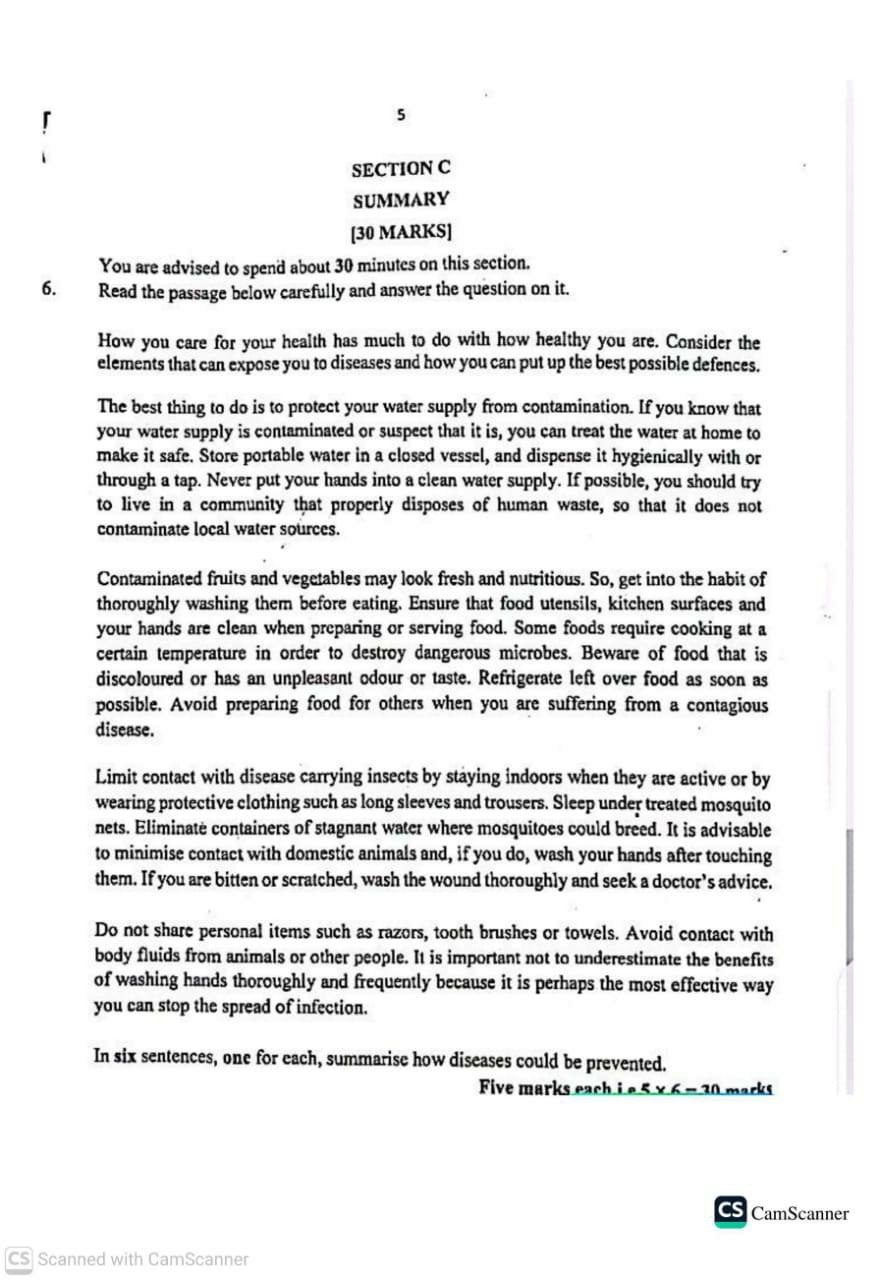
Question 6 — Summary (Disease Prevention)
The passage stresses that preventing disease is better and cheaper than treating it. It explains that regular handwashing with soap and clean water is one of the most effective ways to stop the spread of infections. Vaccination protects individuals and communities from killer diseases like polio, measles and meningitis. Keeping the environment clean through proper waste disposal reduces breeding places for germs. Eating a balanced diet and exercising regularly strengthen the immune system, while avoiding overcrowded and poorly ventilated places lowers the risk of airborne infections. Overall, simple preventive habits save lives and money compared to waiting until illness occurs before seeking treatment.
 Examsmooth
Leave a comment