
Disclaimer: The answers provided on this page are for educational and revision purposes only and should not be used for any form of examination malpractice.
NECO 2026 Computer Practical Answers | Paper I
Welcome to this NECO 2026 Computer Studies Practical (Paper I) guide. This page provides structured sample answers and key points for Questions 1, 2, and 3. In the actual exam, you are required to attempt any two questions only.
QUESTION 1
1A \\u2014 Sample Content for the Practical Task (Microsoft Word)
Display the following question paper pages in order and full width, then complete the sample content as instructed.
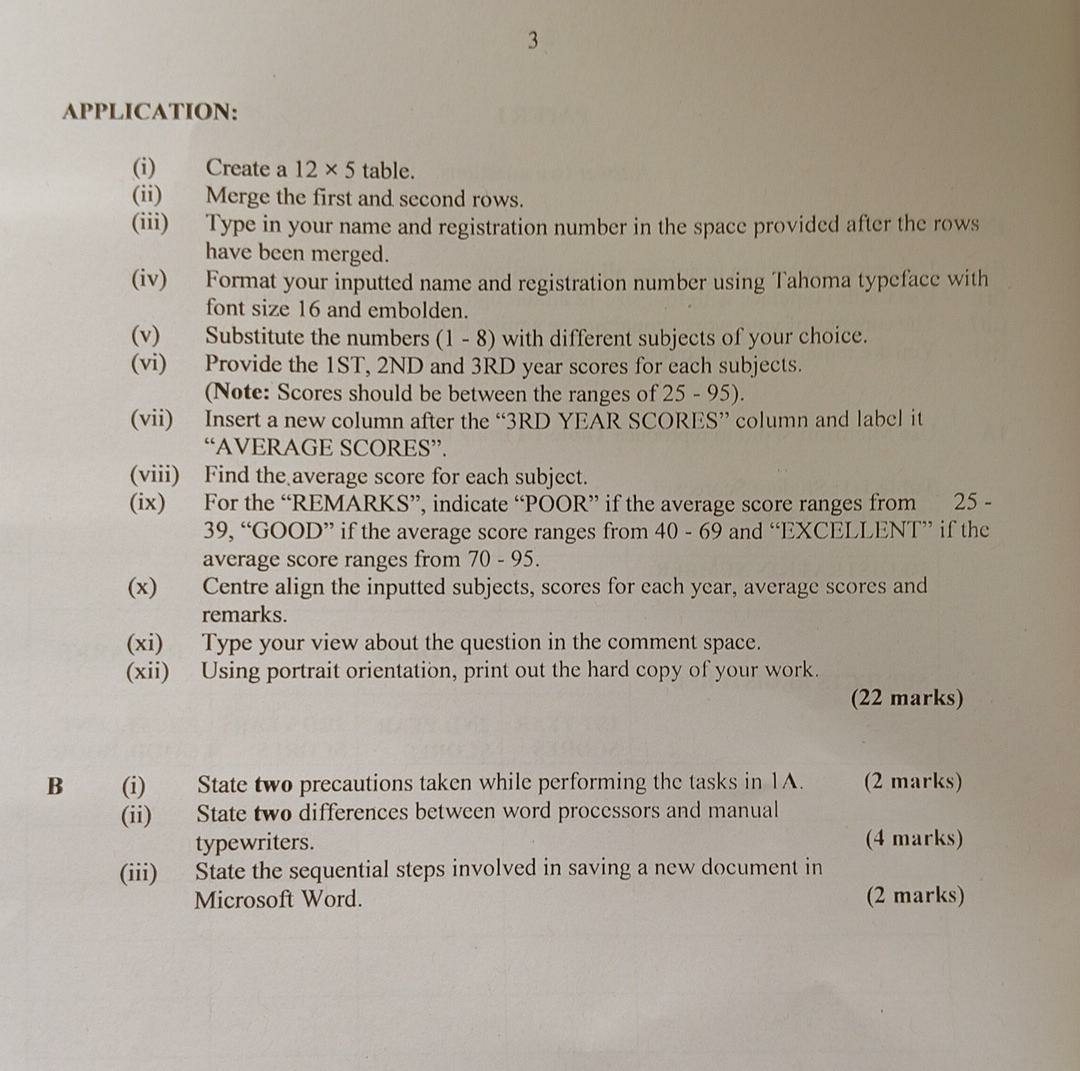
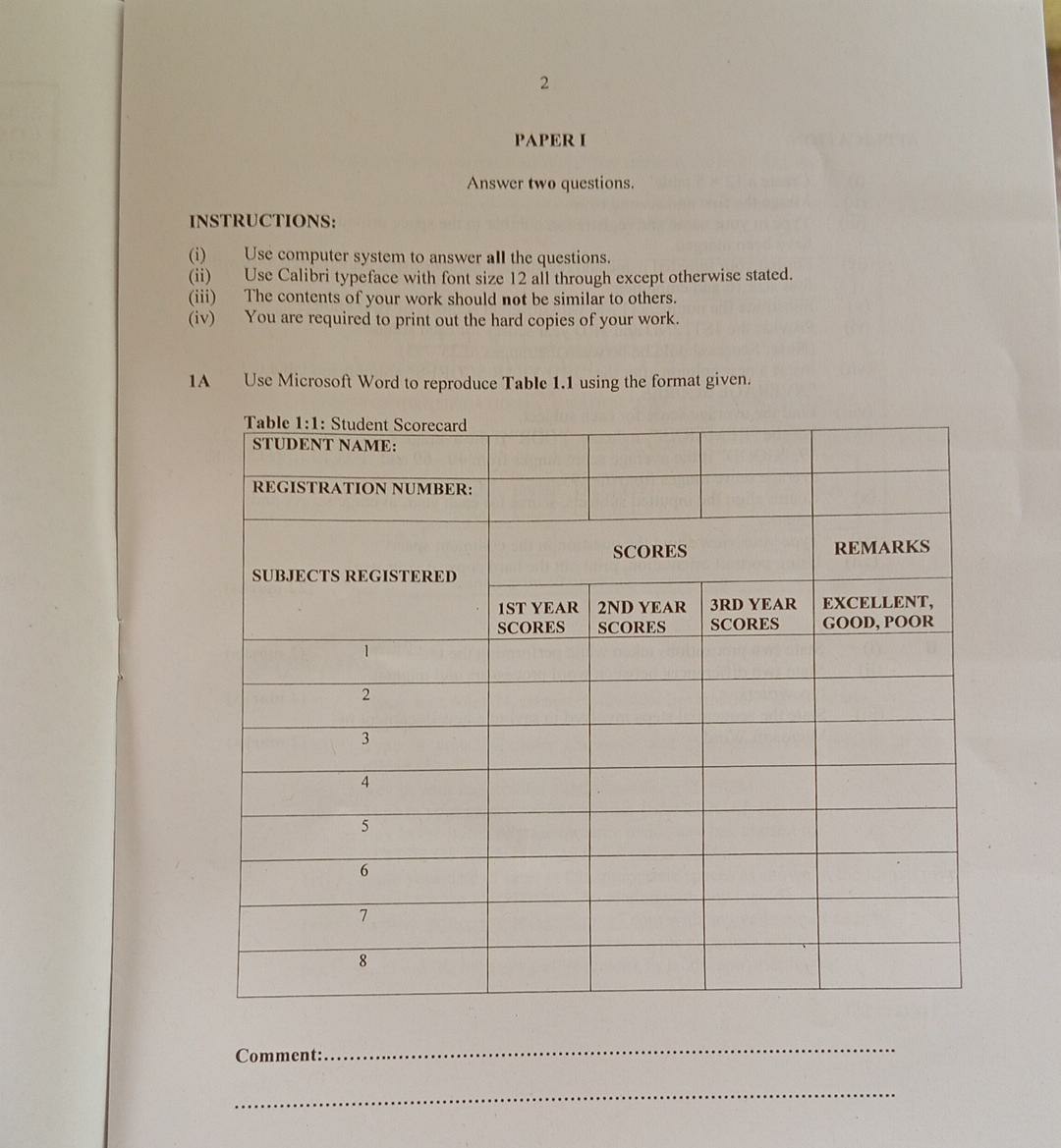


Sample Content Answers for the Microsoft Word Task
- i. Student Name: Your Full Name
- ii. Registration Number: Your Registration Number
- iii. Subjects: English, Mathematics, Biology, Chemistry, Physics, Economics, Government, Computer Science
- iv. Average Score Formula: (1st Year + 2nd Year + 3rd Year) \\u00f7 3
- v. Remarks:
- 25\ \u201339 = POOR
- 40\ \u201369 = GOOD
- 70\ \u201395 = EXCELLENT
- vi. Comment: The practical task was interesting and helped improve Microsoft Word table and formatting skills.
1B (i) \\u2014 Two Precautions While Performing Task 1A (Pick any two)
- Save your work frequently to avoid data loss.
- Proofread and verify all entries before printing.
- Ensure there is a stable power supply or backup.
- Follow the instructions carefully before formatting.
- Check page orientation and print preview before printing.
1B (ii) \\u2014 Two Differences Between Word Processors and Manual Typewriters (Pick any two)
- A word processor allows easy editing and correction, while a manual typewriter requires retyping to correct errors.
- A word processor can save documents electronically, while a manual typewriter cannot.
- A word processor supports formatting such as bold, italics, and colours, while a manual typewriter has limited formatting features.
- A word processor can insert images and tables, while a manual typewriter cannot.
- A word processor includes spell check and grammar tools, while a manual typewriter does not.
1B (iii) \\u2014 Sequential Steps to Save a New Document in MS Word
- Open Microsoft Word and create the document.
- Click File and select Save As.
- Choose the desired storage location.
- Enter a file name.
- Click Save.
QUESTION 2
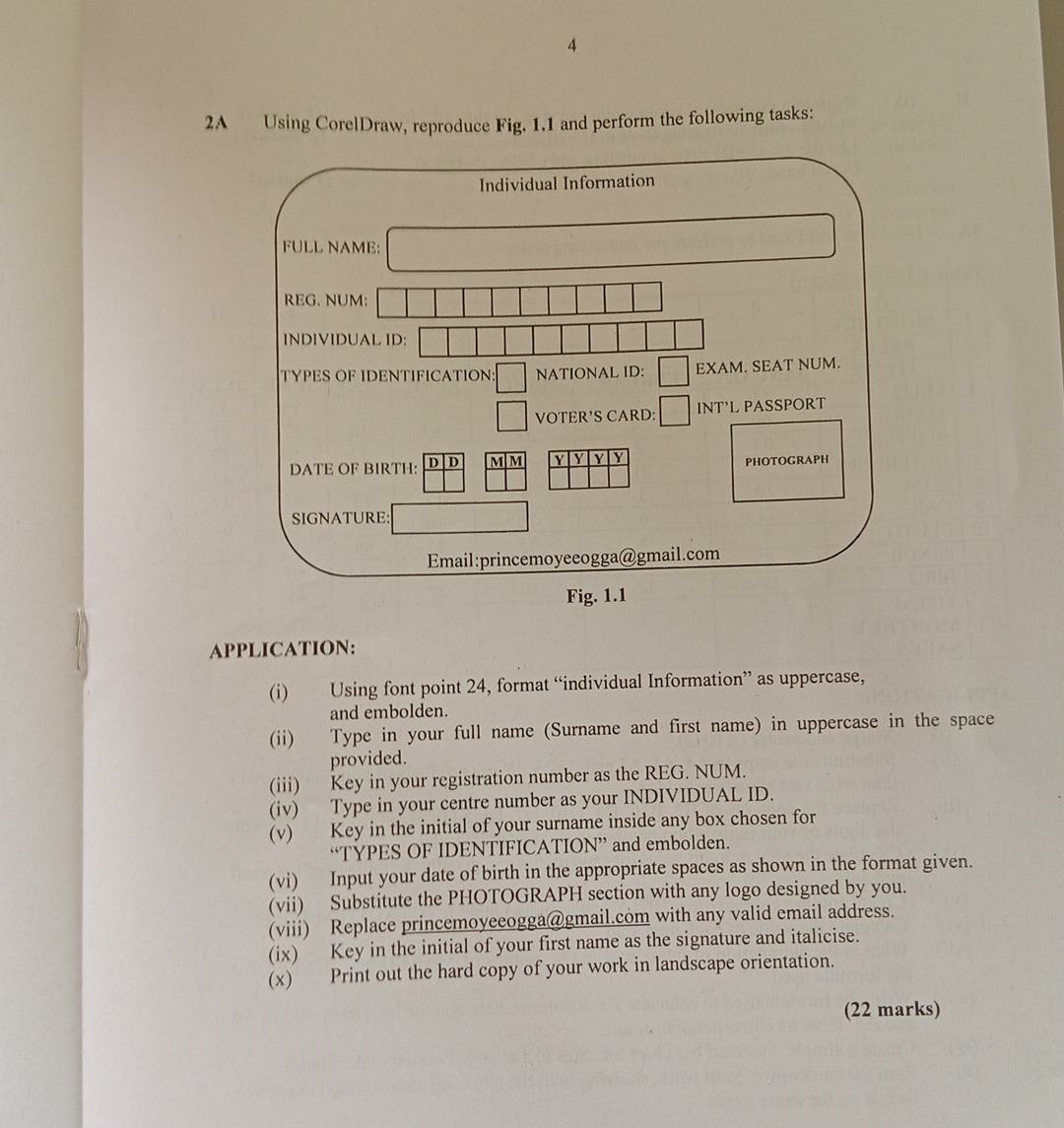
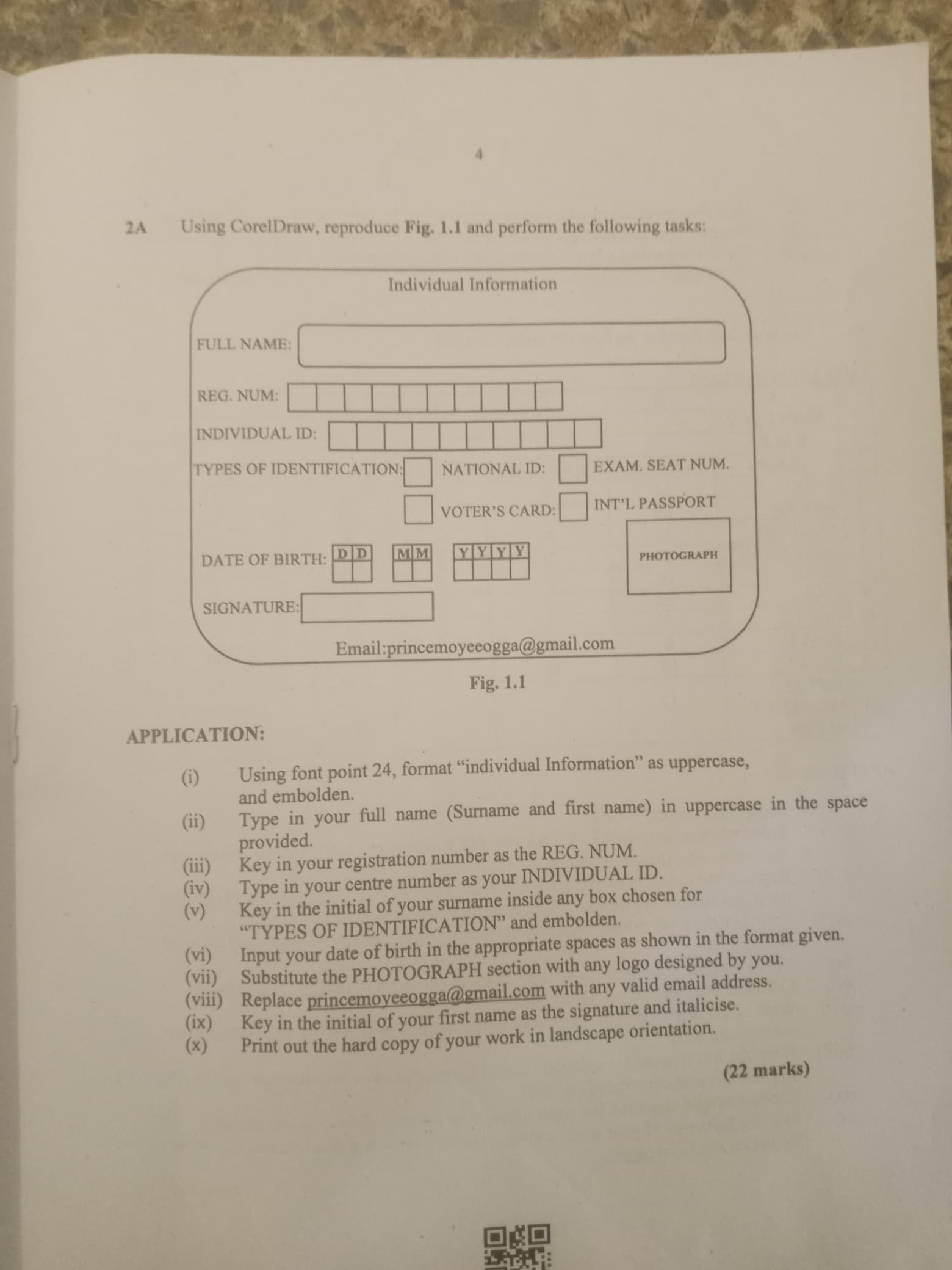
2A \\u2014 CorelDraw Practical Task
Note: This is a practical design task. Reproduce Fig. 1.1 as shown in the question paper (Individual Information form with name, registration number, ID, date of birth, photo box, and signature line) using CorelDraw tools and proper alignment.
2B (i) \\u2014 Two Precautions While Performing Task 2A (Pick any two)
- Save your CorelDraw work regularly.
- Use the correct page size and orientation before designing.
- Ensure accurate measurements and alignment.
- Check all text and objects before printing.
- Use appropriate tools to avoid accidental distortion of objects.
2B (ii) \\u2014 Four Formatting Tools in CorelDraw (Pick any four)
- Fill Tool
- Outline Pen Tool
- Transparency Tool
- Drop Shadow Tool
- Contour Tool
- Blend Tool
- Interactive Fill Tool
- Mesh Fill Tool
2B (iii) \\u2014 Sequential Steps to Create and Edit Shapes in CorelDraw (Pick any four steps)
- Open CorelDraw and create a new document.
- Select the desired Shape tool from the toolbox.
- Draw the required shape on the workspace.
- Use the Pick Tool to resize or reposition the shape.
- Edit the shape using the Shape Tool or node editing features.
- Apply fill colours and outline formatting as needed.
- Save the design after editing.
QUESTION 3
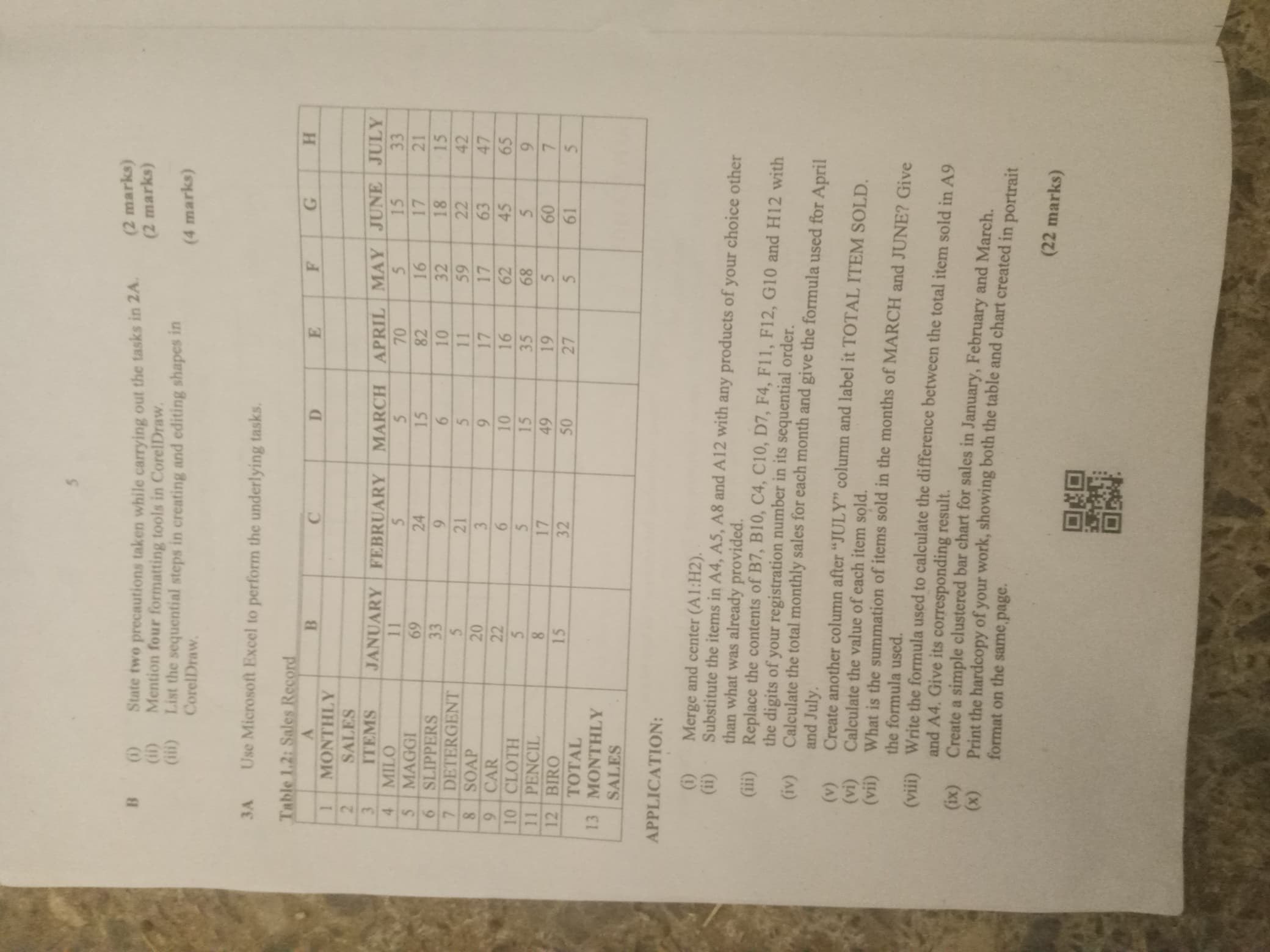
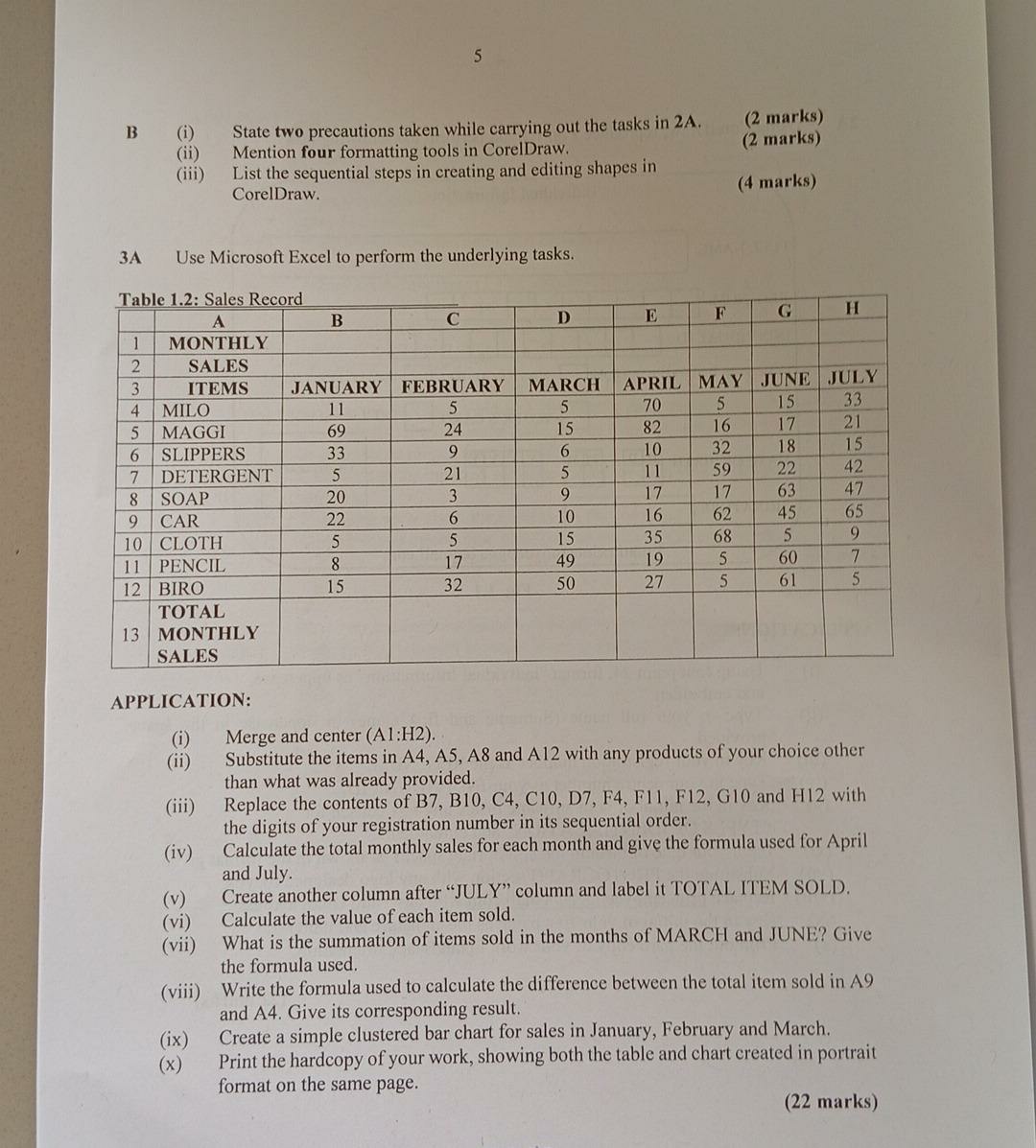
3A \\u2014 Microsoft Excel Practical Task
Note: This is a practical task. Enter the Monthly Sales Record data as shown in the question paper and insert the required chart (for example, a column or bar chart) as instructed.
3B (i) \\u2014 Two Precautions While Performing Task 3A (Pick any two)
- Save the Excel workbook regularly.
- Double-check formulas before finalizing calculations.
- Enter data carefully to avoid errors.
- Verify cell references before copying formulas.
- Preview the worksheet before printing.
3B (ii) \\u2014 Conditional Formatting
Conditional formatting is an Excel feature that automatically changes the appearance of cells based on specified rules or conditions, such as highlighting high values, low values, duplicates, or specific text.
3B (iii) \\u2014 Steps to Merge Cells in MS Excel
- Select the cells you want to merge.
- Go to the Home tab.
- In the Alignment group, click Merge & Center (or choose another merge option).
- The selected cells will be merged into one cell.
3B (iv) \\u2014 Two Uses of a Worksheet (Pick any two)
- To enter and store data in rows and columns.
- To perform calculations using formulas and functions.
- To organize and analyze data efficiently.
- To create charts and graphs from data.
- To sort and filter information for easier analysis.
✏️ Ensure you attempt any 2 questions only. Good luck!
 Examsmooth
Leave a comment