
🔥 IJMB 2026 CHEMISTRY II ANSWERS 🔥
Verified answers for IJMB 2026 Chemistry Paper II
✏️ More answers loading — check back shortly. Bookmark this page!
SECTION A — ANSWER ALL QUESTIONS
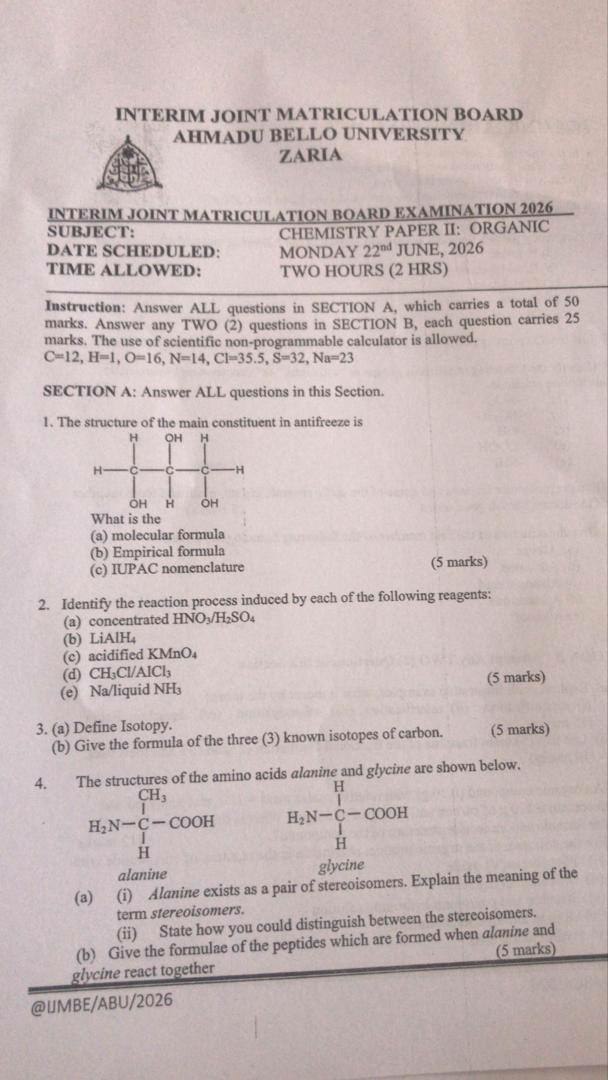
QUESTION 1
(a) Molecular formula: C3H8O3
(b) Empirical formula: C3H8O3
(c) IUPAC name: Propane-1,2,3-triol
QUESTION 2
(a) Nitration reaction (electrophilic substitution)
(b) Reduction reaction (reduces aldehydes, ketones, carboxylic acids, esters, etc.)
(c) Oxidation reaction
(d) Friedel–Crafts alkylation (methylation of an aromatic ring)
(e) Dissolving metal reduction (alkyne → trans-alkene)
QUESTION 3
(3a) Definition of Isotopy: Isotopy is the phenomenon where atoms of the same element have the same atomic number (same number of protons) but different mass numbers (different numbers of neutrons).
(3b) Three isotopes of carbon:
- (i) 126C (Carbon-12)
- (ii) 136C (Carbon-13)
- (iii) 146C (Carbon-14)
QUESTION 4
(4a)(i) Stereoisomers: Stereoisomers are compounds having the same molecular formula and structural formula but differing in the three-dimensional spatial arrangement of atoms or groups within the molecule, thereby giving rise to different properties.
(4a)(ii) Distinguishing stereoisomers: They can be distinguished by their optical activity. One stereoisomer rotates plane-polarized light in a clockwise direction while the other rotates it in an anticlockwise direction.
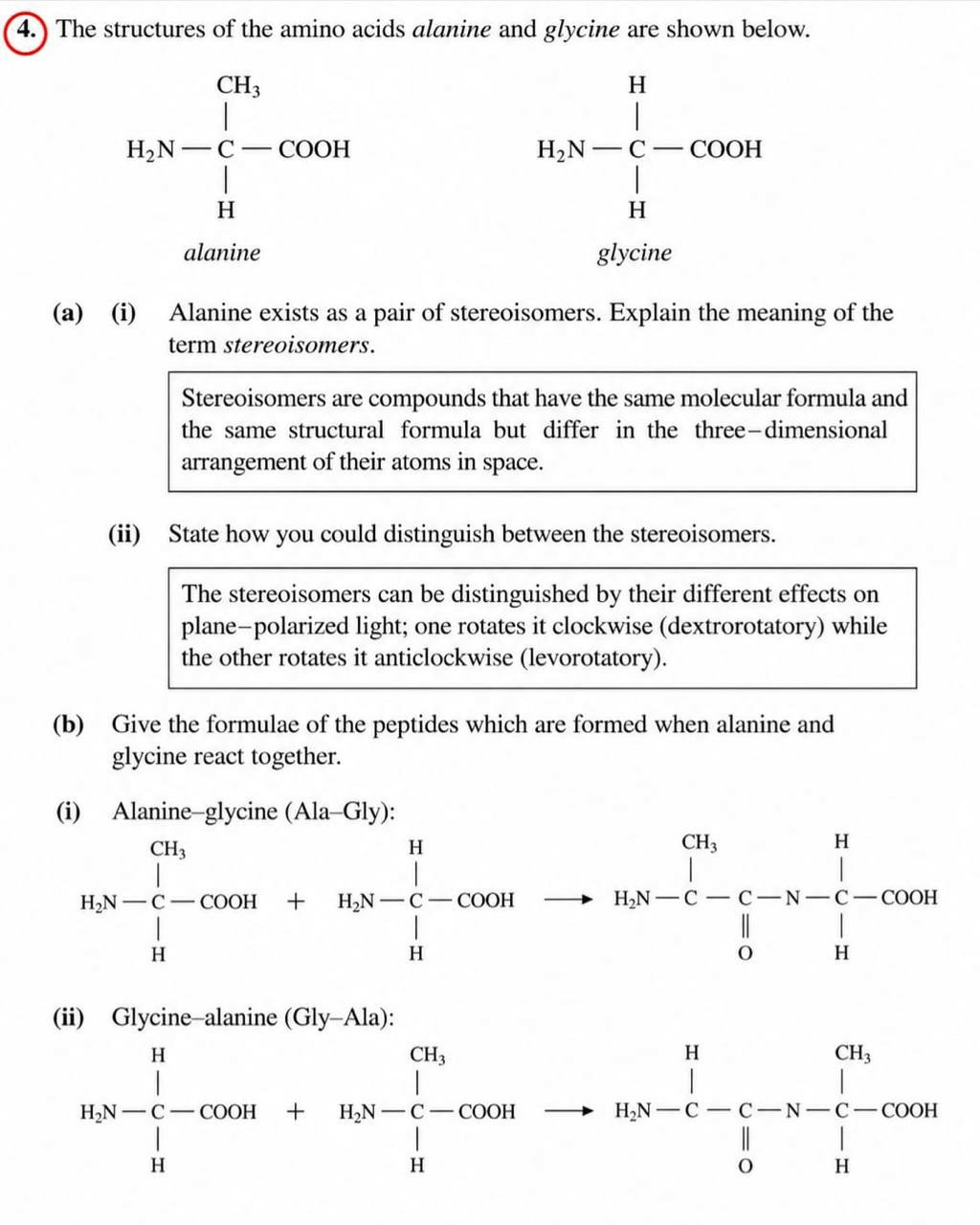
(4b) Dipeptides from alanine and glycine: When alanine and glycine react, a condensation reaction occurs with elimination of water, leading to formation of two dipeptides:
Alanyl-glycine: H2N–CH(CH3)–CO–NH–CH2–COOH
Glycyl-alanine: H2N–CH2–CO–NH–CH(CH3)–COOH
Q4b — Dipeptide structures of Alanyl-glycine and Glycyl-alanine
QUESTION 5
(5a) Likely mechanism: Free radical substitution
(5b) Type of bond fission: Homolytic fission (homolysis)
(5c) Number of different structural isomers of C10H21Cl that can be produced: 5
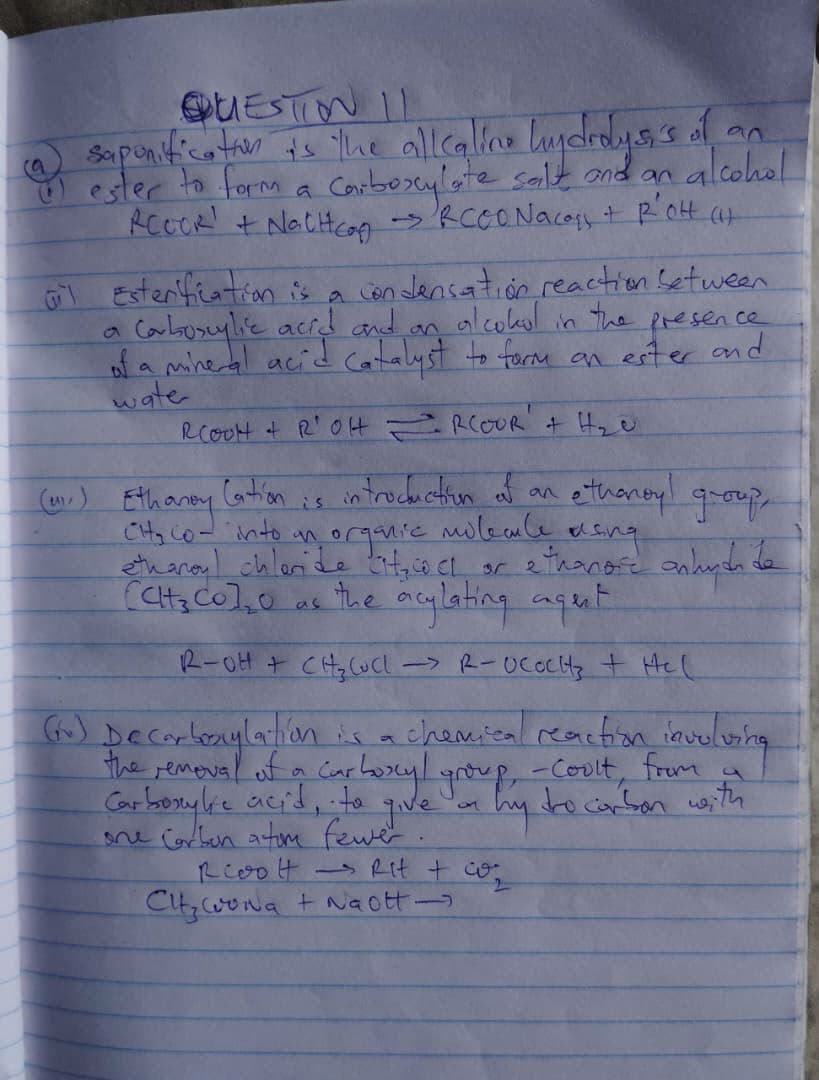
Q5d — Structural isomers of C10H21Cl
QUESTION 7
(Pick any five from the list below)
- (i) Methane (CH4)
- (ii) Ethane (C2H6)
- (iii) Propane (C3H8)
- (iv) Butane (C4H10)
- (v) Ethylene (Ethene, C2H4)
- (vi) Propylene (Propene, C3H6)
- (vii) Butadiene (C4H6)
- (viii) Benzene (C6H6)
- (ix) Toluene (C7H8)
- (x) Xylene
QUESTION 8 — Activating and Deactivating Groups
- (8a) –NO2 → Deactivating
- (8b) –SO3H → Deactivating
- (8c) –OH → Activating
- (8d) –COOH → Deactivating
- (8e) –NH2 → Activating
QUESTION 9
- (i) Hexane — C6H14
- (ii) Heptane — C7H16
- (iii) Octane — C8H18
- (iv) Nonane — C9H20
- (v) Decane — C10H22
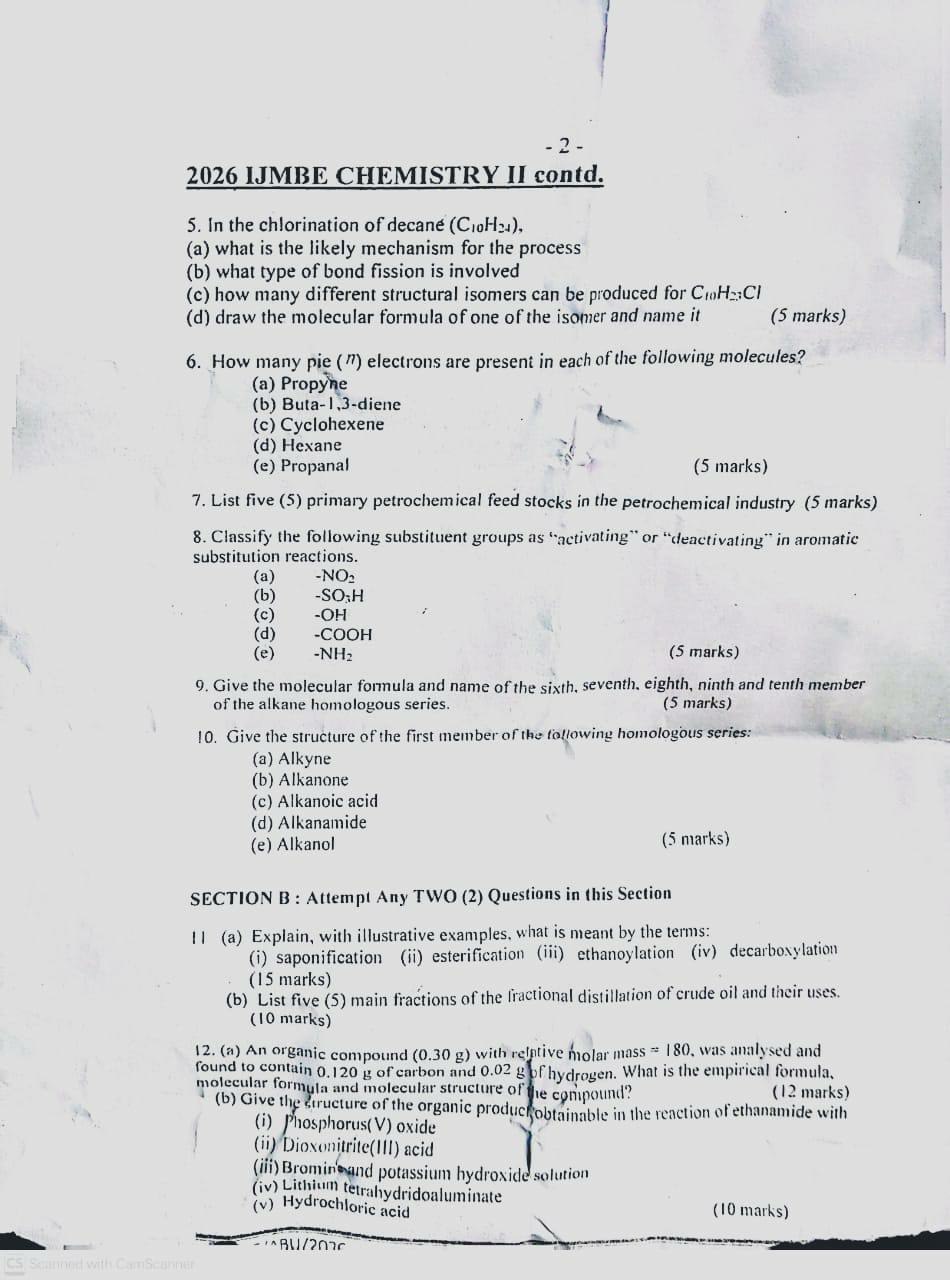
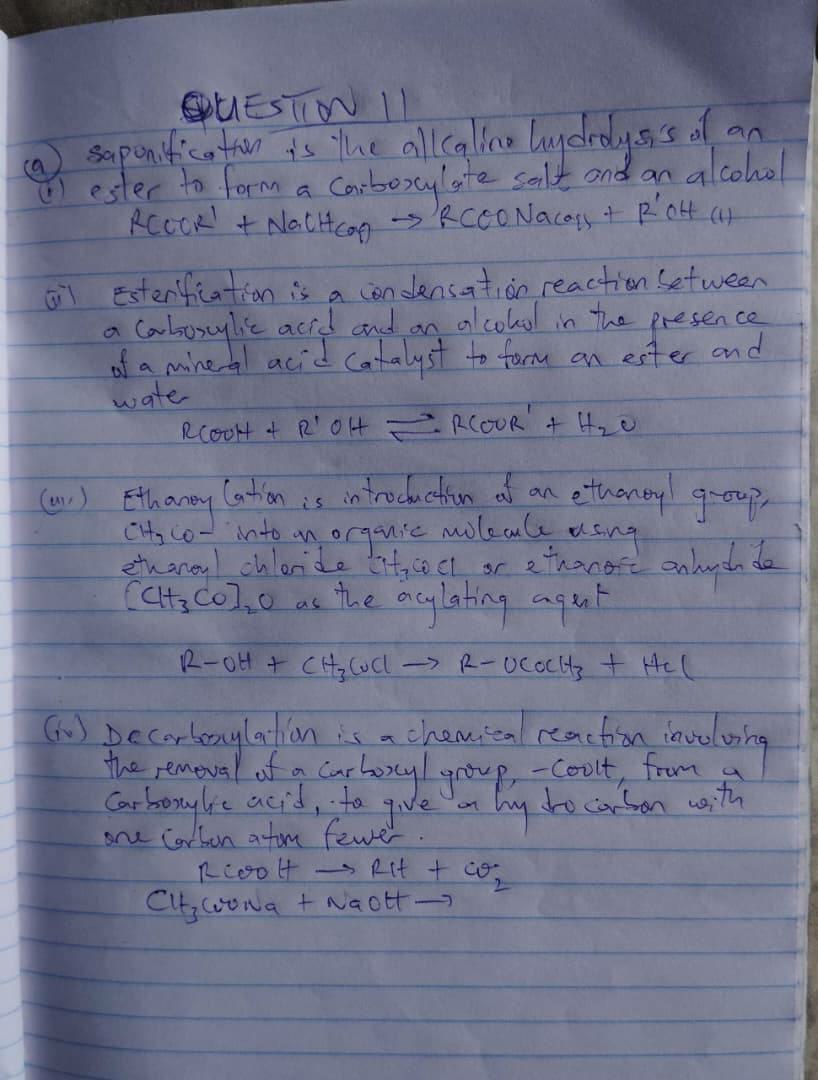
QUESTION 11 — Definitions and Images
(11a) Chemical reaction definitions:
- (i) Saponification: Alkaline hydrolysis of an ester to produce soap (sodium or potassium salt of a fatty acid) and glycerol. It involves treating a fat or oil with a strong alkali such as NaOH.
- (ii) Esterification: A condensation reaction between a carboxylic acid and an alcohol to form an ester and water. It is usually catalysed by a concentrated acid such as H2SO4.
- (iii) Ethanoylation (Acetylation): The introduction of an ethanoyl group (CH3CO–) into an organic compound. It is used to protect –OH or –NH2 groups in organic synthesis.
- (iv) Decarboxylation: The removal of a carboxyl group (–COOH) from an organic compound, releasing CO2 gas. For example, heating sodium ethanoate with soda lime produces methane.
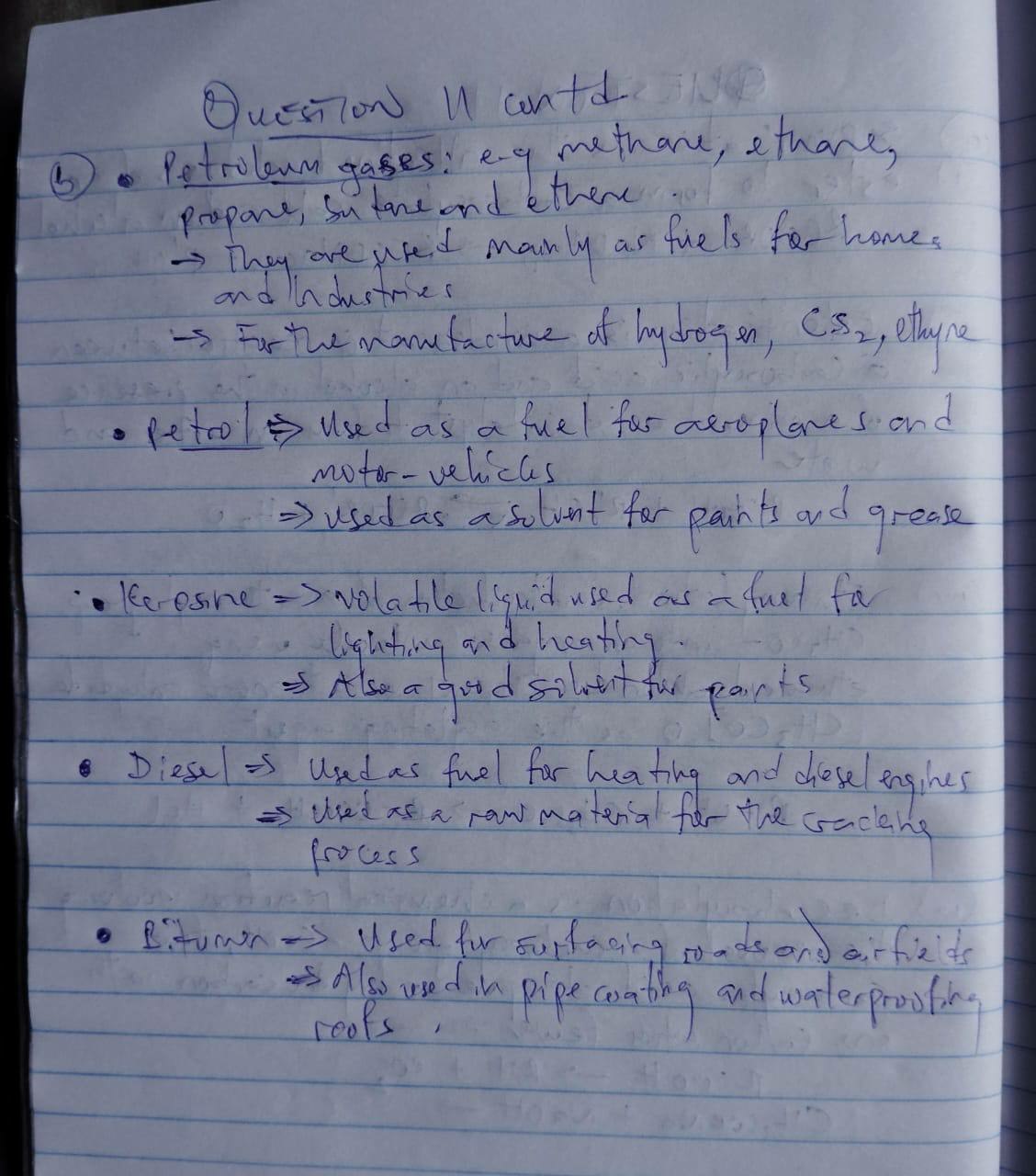
Q11 — Petroleum fractions and their uses
QUESTION 12
(12a) Empirical and Molecular Formula:
Given: Mass of C = 0.120 g, H = 0.02 g, O = 0.30 − 0.12 − 0.02 = 0.16 g
Moles: C = 0.12/12 = 0.01; H = 0.02/1 = 0.02; O = 0.16/16 = 0.01
Ratio C:H:O = 0.01 : 0.02 : 0.01 = 1:2:1
Empirical formula: CH2O
Empirical mass = 12 + 2 + 16 = 30
Molar mass = 180 → n = 180/30 = 6
Molecular formula: C6H12O6 (Glucose)
(12b) Products of reactions of Ethanamide:
- (i) Ethanamide + P4O10 → Ethanenitrile (CH3CN) + H2O
- (ii) Ethanamide + HNO2 → Ethanoic acid (CH3COOH) + N2 + H2O
- (iii) Ethanamide + Br2 + KOH → Methylamine (CH3NH2) — Hofmann bromamide reaction
- (iv) Ethanamide + LiAlH4 → Ethanamine (CH3CH2NH2)
- (v) Ethanamide + HCl/H2O → Ethanoic acid (CH3COOH) + NH4Cl
✏️ Q6 and Q10 loading soon — refresh this page for updates!
 Examsmooth
Leave a comment