
NABTEB 2026 Chemistry Paper I (Objective & Essay) – Questions & Answers
This page contains the official NABTEB 2026 Chemistry Paper I (Paper Code: 005-1) questions and detailed solutions for both the Objective and Essay sections, strictly based on the question paper images.
Date: Friday 19th June 2026
Time: 3:00pm – 5:30pm
Total Marks: 150
© NABTEB 2026
Use these solutions to check your work, learn how marks are awarded, and prepare better for future NABTEB Chemistry exams.
NABTEB 2026 Chemistry – Official Question Paper (Scanned Images)
Below are the scanned pages of the official NABTEB 2026 Chemistry Paper I question paper, in the correct order. Candidates can cross-check every question and confirm that all answers on this page are based strictly on what appears in these images.
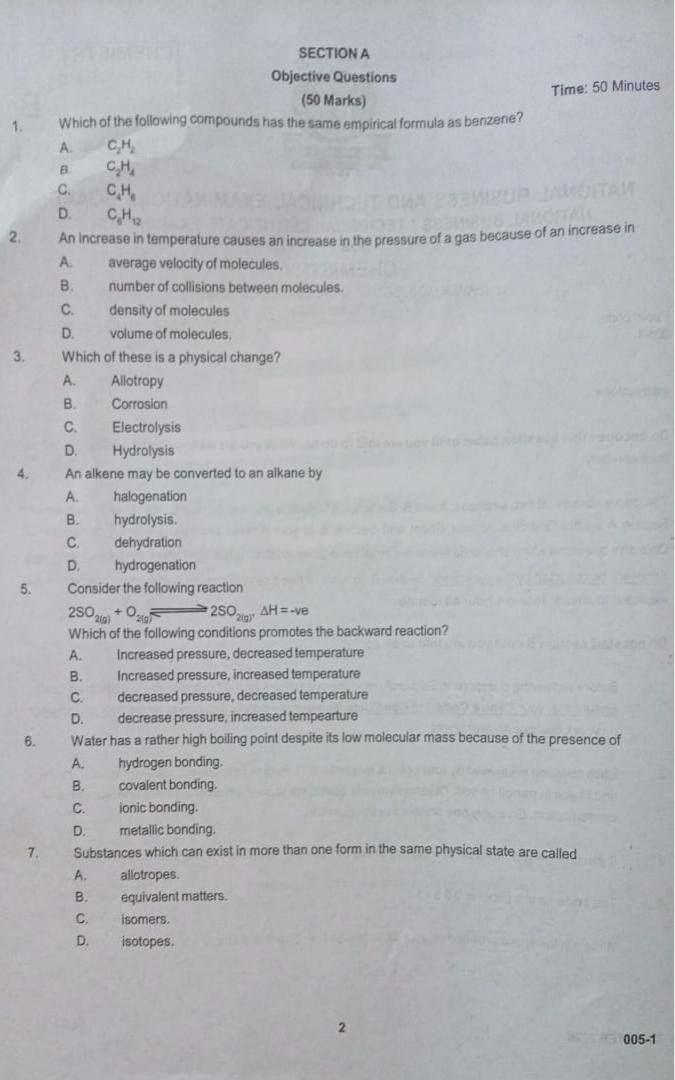
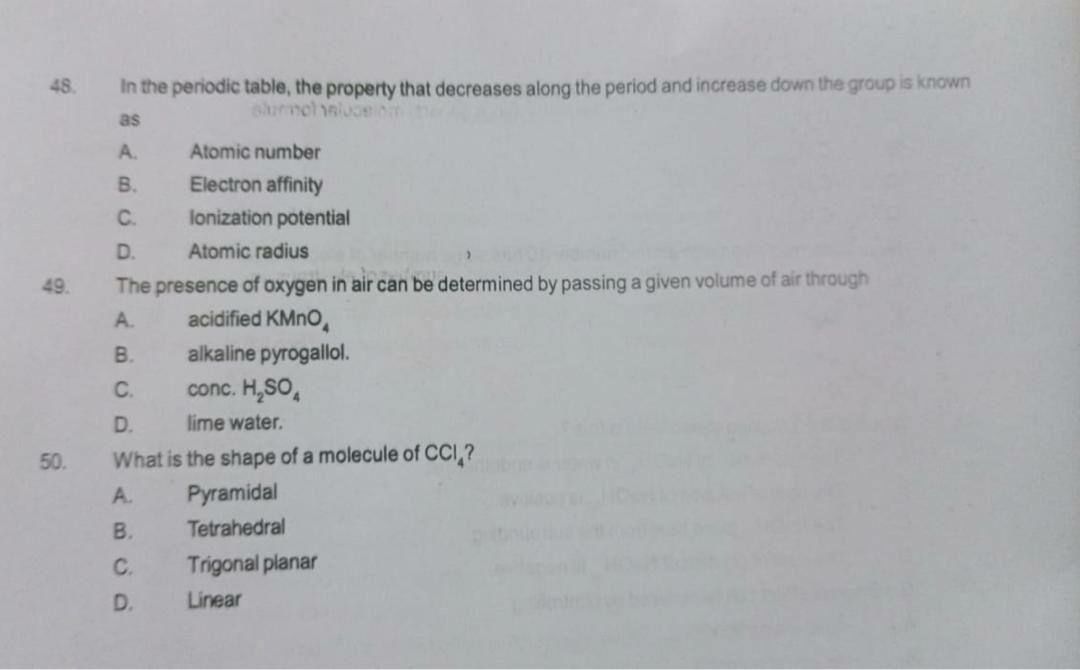
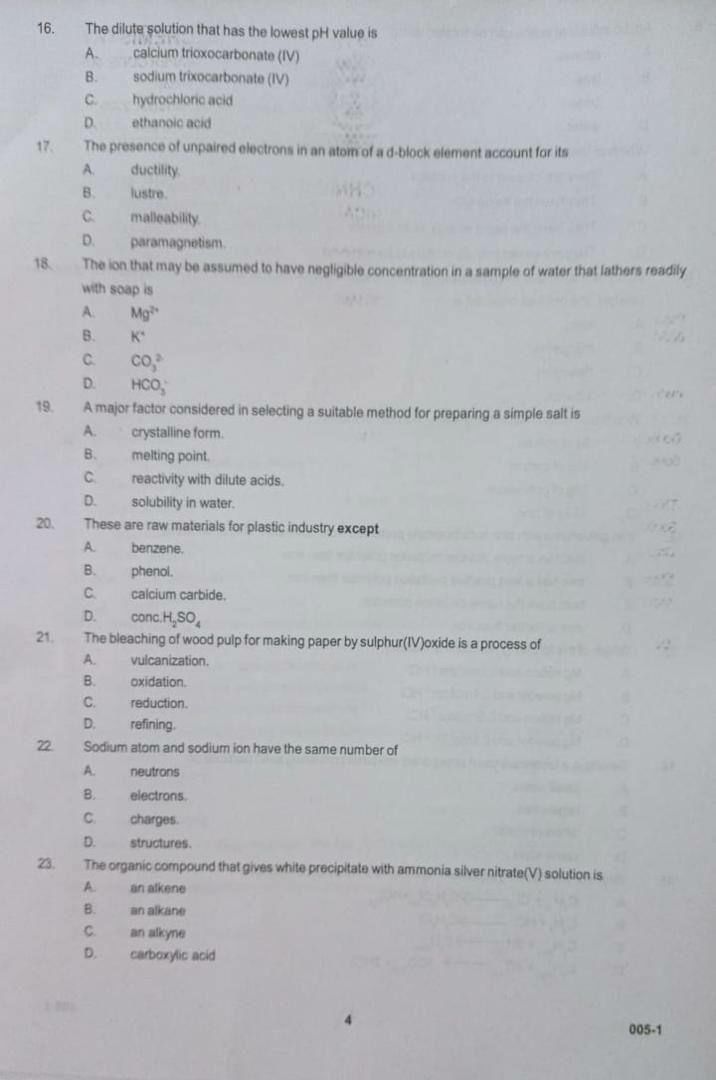
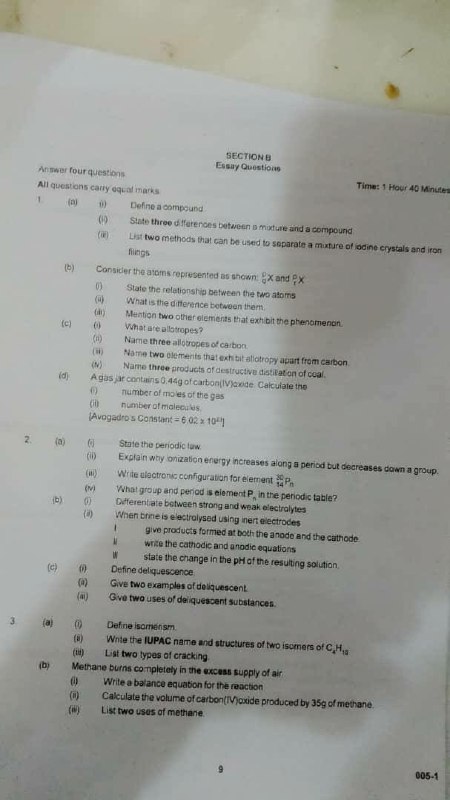
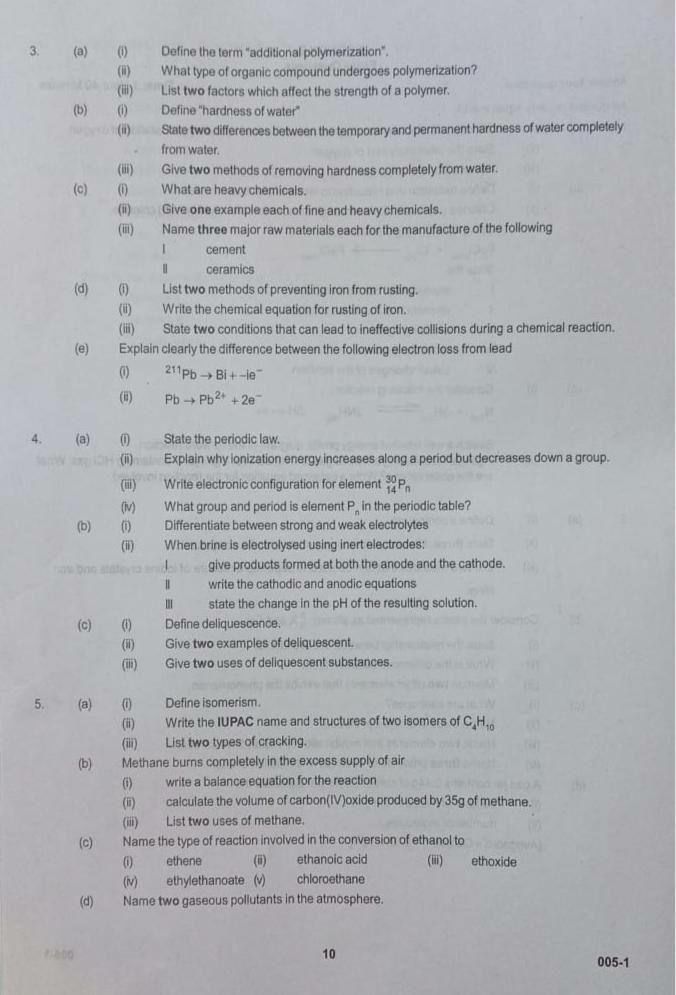
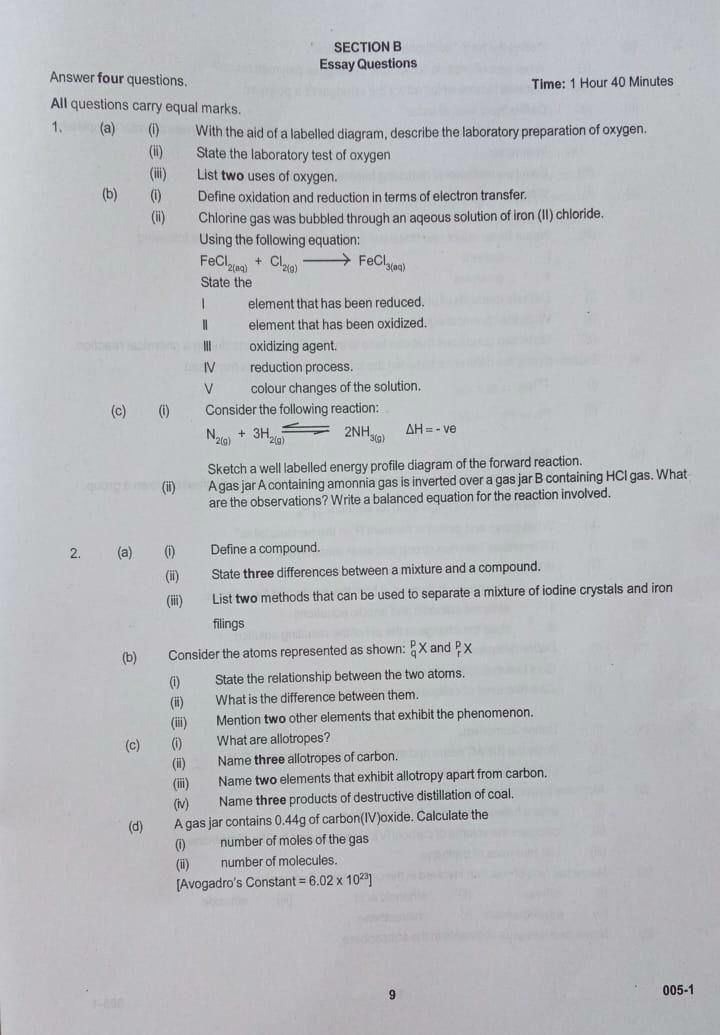
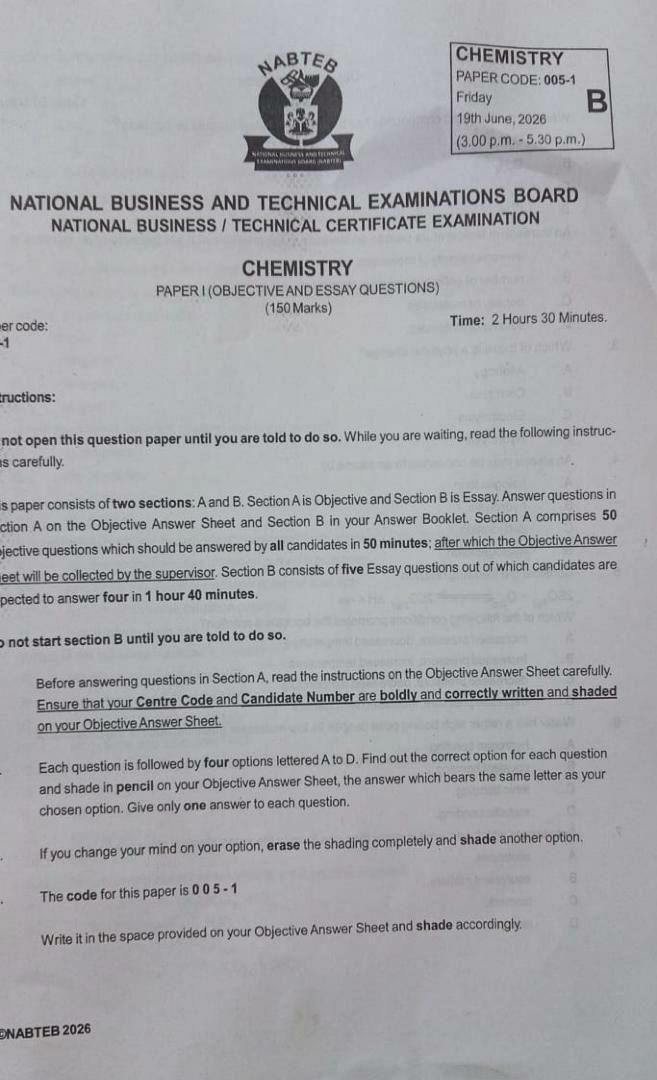
SECTION A – Objective Questions (Paper I)
The official paper contains 50 multiple-choice questions. Only the questions clearly visible in the scanned images are answered below. Questions 8–15 and 24–39 are not fully visible in the images, so they are not included here.
Objective Answers (Based Only on Visible Questions)
- Q1 – B
- Q2 – A
- Q3 – A
- Q4 – D
- Q5 – B
- Q6 – A
- Q7 – A
- Q16 – C
- Q17 – D
- Q18 – A
- Q19 – D
- Q20 – D
- Q21 – C
- Q22 – A
- Q23 – C
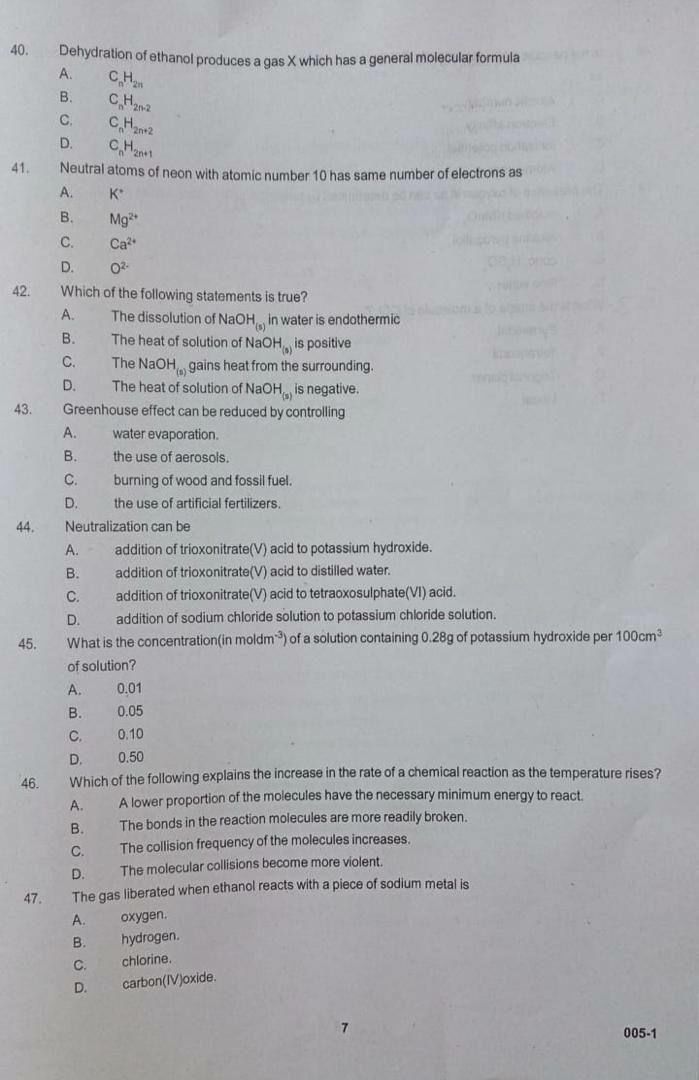
- Q40 – A
- Q41 – A
- Q42 – D
- Q43 – C
- Q44 – A
- Q45 – B
- Q46 – C
- Q47 – B
- Q48 – D
- Q49 – B
- Q50 – B
SECTION B – Essay Questions and Answers
Answer explanations here follow the exact wording of the questions that appear in the scanned paper. Each sub-question is clearly labelled to help you follow how marks are likely to be awarded.
Question 1
(a)(i) With the aid of a labelled diagram, describe the laboratory preparation of oxygen.
Principle: Oxygen gas is commonly prepared in the laboratory by the thermal decomposition of potassium trioxochlorate(V) (potassium chlorate), often in the presence of manganese(IV) oxide as a catalyst.
Diagram description (in words): A hard glass test tube (or ignition tube) is clamped horizontally. Inside the tube is a mixture of potassium trioxochlorate(V) crystals and a small amount of manganese(IV) oxide. The open end of the test tube is fitted with a cork or rubber stopper carrying a delivery tube. The delivery tube leads into a trough (bowl) of water and then into an inverted gas jar completely filled with water and standing on a gas jar shelf in the trough. The inverted gas jar is labelled “Oxygen gas”. A Bunsen burner is placed under the part of the test tube containing the mixture. All important parts (test tube, mixture, catalyst, delivery tube, water trough, gas jar, heat source) are labelled.
Procedure:
- Mix a small quantity of potassium trioxochlorate(V) (KClO3) with a little manganese(IV) oxide (MnO2) in a dry porcelain dish.
- Transfer the mixture into a dry hard glass test tube and fix it horizontally with a clamp and stand.
- Fit the test tube with a cork carrying a delivery tube, and pass the delivery tube into a trough of water, leading into an inverted gas jar filled with water.
- Gently heat the part of the test tube containing the mixture with a Bunsen burner. Do not heat the cork.
- As oxygen gas is evolved, it displaces the water in the inverted gas jar and is collected by downward displacement of water (since oxygen is only slightly soluble in water).
- Remove the delivery tube from the water before stopping the heating to prevent water from sucking back into the hot test tube.
Equation: 2KClO3(s) → 2KCl(s) + 3O2(g) (in the presence of MnO2 as catalyst).
(a)(ii) State the laboratory test of oxygen.
Insert a glowing (almost extinguished) splint into a gas jar containing the unknown gas. If the gas is oxygen, the glowing splint is rekindled (bursts into flame).
(a)(iii) List two uses of oxygen.
- In hospitals and emergency care for patients with breathing difficulties or during anaesthesia (medical oxygen).
- In oxy-acetylene or oxy-hydrogen flames for welding and cutting metals.
- (Any other valid use, e.g. in steel manufacture, combustion in rockets, etc., would attract marks, but only two are required.)
(b)(i) Define oxidation and reduction in terms of electron transfer.
- Oxidation is the loss of electrons by a substance.
- Reduction is the gain of electrons by a substance.
(b)(ii) For the reaction: FeCl2(aq) + Cl2(g) → FeCl3(aq), state the:
- (I) Element reduced – Chlorine (Cl) is reduced, because Cl2 gains electrons to form Cl– in FeCl3.
- (II) Element oxidized – Iron (Fe) is oxidized, because Fe2+ is converted to Fe3+ (loss of one electron).
- (III) Oxidizing agent – Chlorine gas, Cl2 (it accepts electrons and causes oxidation of Fe2+).
- (IV) Reduction process – Cl2(g) + 2e– → 2Cl–(aq).
- (V) Colour changes – The pale green colour of FeCl2 solution changes to a yellow/brown solution of FeCl3; the colour of chlorine gas (yellowish-green) fades as it is used up.
(c)(i) N2(g) + 3H2(g) ⇌ 2NH3(g), ΔH = –ve. Sketch a well labelled energy profile diagram of the forward reaction.
Description of the energy profile (forward reaction is exothermic):
- On the vertical axis, label “Potential energy” and on the horizontal axis label “Reaction pathway” (or “Progress of reaction”).
- Start with a higher energy level for the reactants (N2 + 3H2).
- Draw a curve rising to a maximum point labelled activated complex or transition state.
- From the peak, the curve falls to a lower energy level for the products (2NH3).
- Label the vertical difference between reactants and products as ΔH, showing it is negative (downwards arrow) since the reaction is exothermic.
- Label the vertical difference between reactants and peak as activation energy, Ea.
(c)(ii) Gas jar A containing ammonia is inverted over gas jar B containing hydrogen chloride gas. State the observations made and write a balanced equation for the reaction.
- Observation: A dense white smoke or white fumes appear at the boundary where the two gases meet in the jars. This white ring gradually spreads as the gases diffuse.
- Balanced equation: NH3(g) + HCl(g) → NH4Cl(s).
Question 2
(a)(i) Define a compound.
A compound is a pure substance formed when two or more elements chemically combine together in a fixed ratio by mass.
(a)(ii) State three differences between a mixture and a compound.
- Composition: A mixture has components combined in any proportion, while a compound has elements combined in a fixed ratio by mass.
- Separation: Components of a mixture can be separated by simple physical methods (filtration, distillation, etc.), whereas elements in a compound can only be separated by chemical means.
- Properties: A mixture retains the properties of its individual components, but a compound has entirely new properties different from those of the elements that formed it.
- Energy change / formation: Usually little or no heat change when a mixture is formed, but formation of a compound involves a definite heat change (exothermic or endothermic) and often light.
(a)(iii) List two methods that can be used to separate a mixture of iodine crystals and iron filings.
- Magnetic separation: Use a magnet to attract and remove the iron filings, leaving iodine behind.
- Sublimation: Gently heat the mixture so that iodine sublimes to form violet vapour, which is then cooled and re-deposited as crystals on a cold surface, leaving iron filings behind.
(b) Atoms ₄ᵢX and ₄ʲX:
- (i) Relationship: They are isotopes of the same element X (same atomic number 4, different mass numbers i and j).
- (ii) Difference: They have different numbers of neutrons and hence different mass numbers (i ≠ j), but the same number of protons and electrons.
- (iii) Two other elements that show this phenomenon: Examples include hydrogen (¹H, ²H, ³H) and carbon (¹²C, ¹³C, ¹⁴C), or chlorine (³⁵Cl, ³⁷Cl).
(c)(i) What are allotropes?
Allotropes are different physical forms of the same element in the same physical state, in which the atoms of the element are arranged or bonded in different ways.
(c)(ii) Name three allotropes of carbon.
- Diamond
- Graphite
- Amorphous carbon (e.g. charcoal, lampblack, coke) – any one form gains marks.
(c)(iii) Name two elements that exhibit allotropy apart from carbon.
- Oxygen (O2 and ozone O3).
- Phosphorus (white and red phosphorus).
- (Sulphur is another valid example.)
(c)(iv) Name three products of the destructive distillation of coal.
- Coke
- Coal tar
- Ammoniacal liquor (ammonia liquor)
- (Coal gas is also a major product; any three correct products gain full marks.)
(d) 0.44 g of carbon(IV) oxide (CO2, M = 44):
- (i) Number of moles: n = mass / molar mass = 0.44 g / 44 g mol-1 = 0.01 mol.
- (ii) Number of molecules: N = n × Avogadro’s constant = 0.01 × 6.02 × 1023 = 6.02 × 10²¹ molecules of CO2.
Question 3
(a)(i) Define “additional polymerization”.
Additional (addition) polymerization is a process in which many small unsaturated molecules (monomers) combine by addition, without the elimination of any small molecules, to form a large molecule (polymer).
(a)(ii) What type of organic compound undergoes polymerization?
Unsaturated organic compounds with multiple bonds, especially alkenes (and substituted alkenes), undergo addition polymerization.
(a)(iii) List two factors affecting the strength of a polymer.
- Degree of cross-linking between polymer chains (more cross-linking generally increases strength and rigidity).
- Length (molecular mass) of the polymer chains (longer chains often give stronger materials).
- Degree of crystallinity and packing of the chains.
- Presence of side groups or plasticizers (which can weaken or modify the strength).
(b)(i) Define “hardness of water”.
Hardness of water is the property of water that prevents it from readily forming lather with soap, due to the presence of dissolved calcium and/or magnesium salts.
(b)(ii) State two differences between temporary and permanent hardness of water.
- Cause: Temporary hardness is caused mainly by dissolved hydrogencarbonates of calcium and magnesium (e.g. Ca(HCO3)2), while permanent hardness is caused by chlorides and sulphates of calcium and magnesium (e.g. CaSO4, MgCl2).
- Removal by boiling: Temporary hardness is removed by boiling, but permanent hardness is not removed by boiling.
- Removal by simple methods: Temporary hardness can be removed by boiling or by adding slaked lime; permanent hardness requires methods such as ion-exchange (permutation), addition of washing soda, or use of synthetic resins.
(b)(iii) Give two methods of removing hardness completely from water.
- Using an ion-exchange (permutation) resin to replace Ca2+/Mg2+ with Na+ or H+.
- Adding washing soda (Na2CO3) to precipitate calcium and magnesium as their carbonates.
(c)(i) What are heavy chemicals?
Heavy chemicals are basic industrial chemicals that are produced in very large quantities (bulk) and are usually of relatively low unit cost, such as sulphuric acid, sodium hydroxide, and ammonia.
(c)(ii) Give one example each of fine and heavy chemicals.
- Fine chemical: A drug or pharmaceutical such as aspirin, or a dye, perfume, etc.
- Heavy chemical: Sulphuric acid (H2SO4), sodium hydroxide (NaOH), or ammonia (NH3) – any one is acceptable.
(c)(iii) Name three major raw materials for the manufacture of:
I. Cement
- Limestone (calcium carbonate).
- Clay or shale.
- Sand / silica / iron(III) oxide (as minor corrective materials) – any three valid materials for cement production.
II. Ceramics
- Clay (kaolin).
- Silica (sand).
- Feldspar or fluxes (e.g. potash, soda ash) – any three appropriate raw materials for ceramics.
(d)(i) List two methods of preventing iron from rusting.
- Coating the iron with paint, grease, or oil to prevent contact with air and moisture.
- Galvanizing: coating the iron with a layer of zinc.
- Electroplating with a less reactive metal, or using sacrificial protection (attaching a more reactive metal like magnesium) – any two gain marks.
(d)(ii) Write the chemical equation for the rusting of iron.
A commonly accepted overall equation is:
4Fe(s) + 3O2(g) + 6H2O(l) → 4Fe(OH)3(s).
The Fe(OH)3 further dehydrates to form hydrated iron(III) oxide (rust), Fe2O3·xH2O.
(d)(iii) State two conditions that can lead to ineffective collisions during a chemical reaction.
- Low temperature, which reduces the kinetic energy of particles so that many collisions do not attain the required activation energy.
- Very low concentration of reactants, which reduces collision frequency and makes effective collisions less likely.
- Improper orientation of colliding molecules (they do not align in the right way for bond breaking and forming).
(e) Explain clearly the difference between:
(i) ²¹¹Pb → Bi + –i e– (beta decay)
This represents a nuclear (radioactive) process. A neutron in the nucleus of ²¹¹Pb changes into a proton with the emission of a beta particle (an electron). The atomic number increases by 1 while the mass number remains the same, producing a new element (bismuth, Bi). Electrons here come from changes within the nucleus, not from ordinary chemical reactions.
(ii) Pb → Pb²⁺ + 2e–
This is a chemical oxidation process (loss of electrons) involving only the electrons in the outer shells of the lead atom. Lead is oxidized to lead(II) ion, Pb²⁺, in a normal redox or electrochemical reaction. The nucleus is not changed and the element remains lead, only its oxidation state changes.
Key difference: (i) is a nuclear transformation (radioactivity) changing one element to another, while (ii) is an ordinary chemical process changing only the oxidation state of the same element.
Question 4
(a)(i) State the periodic law.
The periodic law states that the physical and chemical properties of the elements are a periodic function of their atomic numbers.
(a)(ii) Explain why ionization energy increases along a period but decreases down a group.
- Across a period: From left to right in a period, the atomic number increases and nuclear charge increases, but the electrons are added to the same main energy level. The increased attraction between the nucleus and the outer electrons makes it more difficult to remove an electron, so ionization energy increases across a period.
- Down a group: As we go down a group, the number of electron shells increases, so the outermost electrons are farther from the nucleus and are more shielded by inner electrons. The effective nuclear attraction for the outer electrons is reduced, so they are more easily removed and ionization energy decreases down a group.
(a)(iii) Write the electronic configuration for element ³⁰₁₄Pn.
The element has atomic number 14, so it has 14 electrons. Its electronic configuration is:
1s² 2s² 2p⁶ 3s² 3p² or in shell notation: 2, 8, 4.
(a)(iv) What group and period is element Pn in the periodic table?
The outer shell has 4 electrons, so the element is in Group 14 (IV). It has three occupied shells (n = 1, 2, 3), so it is in the 3rd period of the periodic table.
(b)(i) Differentiate between strong and weak electrolytes.
- Strong electrolytes are substances that completely ionize in solution and therefore conduct electricity very well (e.g. HCl, NaOH, NaCl).
- Weak electrolytes are substances that are only partially ionized in solution and conduct electricity poorly (e.g. ethanoic acid, NH3 solution).
(b)(ii) When brine is electrolysed using inert electrodes:
- I. Products at anode and cathode:
- Anode (positive electrode): Chlorine gas, Cl2.
- Cathode (negative electrode): Hydrogen gas, H2. A solution of sodium hydroxide (NaOH) remains.
- II. Half-equations:
- Cathode (reduction): 2H2O(l) + 2e– → H2(g) + 2OH–(aq).
- Anode (oxidation): 2Cl–(aq) → Cl2(g) + 2e–.
- III. Change in pH of the resulting solution: The solution becomes more alkaline (pH increases) due to formation of sodium hydroxide.
(c)(i) Define deliquescence.
Deliquescence is the property of a substance by which it absorbs sufficient moisture from the atmosphere to dissolve in the water it has absorbed and form a solution.
(c)(ii) Give two examples of deliquescent substances.
- Calcium chloride (CaCl2).
- Sodium hydroxide pellets (NaOH).
- (Zinc chloride, magnesium chloride, etc., are also acceptable.)
(c)(iii) Give two uses of deliquescent substances.
- As drying agents (desiccants) to remove moisture from gases or from the atmosphere in desiccators.
- In packaging (e.g. silica gel and similar drying agents) to protect moisture-sensitive products.
Question 5
(a)(i) Define isomerism.
Isomerism is the phenomenon where two or more different compounds have the same molecular formula but different structural formulae (different arrangement of atoms in the molecule).
(a)(ii) Write the IUPAC names and structures of two isomers of C₄H₁₀.
- Butane (n-butane): CH₃–CH₂–CH₂–CH₃ (a straight-chain alkane with four carbon atoms).
- 2-methylpropane (isobutane):
A three-carbon chain with a methyl branch on the middle carbon:
CH₃–CH(CH₃)–CH₃.
(a)(iii) List two types of cracking.
- Thermal cracking.
- Catalytic cracking.
(b) Methane burns completely in an excess supply of air:
(i) Write a balanced equation for the reaction.
CH₄(g) + 2O₂(g) → CO₂(g) + 2H₂O(l).
(ii) Calculate the volume of CO₂ produced by 35 g of methane.
- Molar mass of CH₄ = 12 + 4(1) = 16 g mol⁻¹.
- Moles of CH₄ = 35 g ÷ 16 g mol⁻¹ = 2.1875 mol.
- From the equation, 1 mol CH₄ produces 1 mol CO₂.
Therefore, moles of CO₂ = 2.1875 mol. - At standard conditions, 1 mol of gas occupies 22.4 dm³ (or 24 dm³ depending on the data given; using 22.4 dm³ at STP):
Volume of CO₂ = 2.1875 × 22.4 dm³ ≈ 49.0 dm³.
(If the examiner specifies 24 dm³, then volume ≈ 52.5 dm³.)
(iii) List two uses of methane.
- As a domestic and industrial fuel (cooking gas/natural gas).
- As a starting material for the manufacture of chemicals such as methanol, hydrogen, and carbon black.
(c) Name the type of reaction in the conversion of ethanol to:
- (i) Ethene: Dehydration (elimination) reaction, usually by heating ethanol with excess concentrated H₂SO₄ or over hot Al₂O₃.
- (ii) Ethanoic acid: Oxidation reaction (ethanol is oxidized to ethanoic acid).
- (iii) Ethoxide (e.g. sodium ethoxide): Neutralization / acid–base reaction between ethanol (a weak acid) and a reactive metal or strong base (e.g. Na, NaH).
- (iv) Ethylethanoate: Esterification reaction between ethanol and ethanoic acid.
- (v) Chloroethane: Substitution reaction, where the –OH group of ethanol is replaced by a chlorine atom (e.g. using PCl₅, PCl₃, or HCl with a catalyst).
(d) Name two gaseous pollutants in the atmosphere.
- Sulphur(IV) oxide (SO₂).
- Nitrogen oxides (NO and NO₂, often written as NOx).
- (Carbon monoxide, CO, and chlorofluorocarbons, CFCs, are also examples; any two correct gaseous pollutants gain full marks.)
Join Examsmooth Study Channels
Get more NABTEB, WAEC, NECO and other exam updates, past questions and accurate answers directly on your phone.
 Examsmooth
Leave a comment