
2026 WAEC Biology Questions and Answers
Live updates for today's WAEC Biology exam on Examsmooth. Answers are currently loading — bookmark this page and keep refreshing. We'll post the verified answers as soon as they are ready.
Status: Biology OBJ & Essay answers are being compiled. Stay on this page and refresh every few minutes.



WAEC Biology OBJ Answers 2026
This section will be updated with the complete, accurate WAEC Biology OBJ (multiple-choice) answers for 2026 as soon as verification is complete. Use this only as support after you have attempted the questions yourself.
WAEC 2026 Biology OBJ Answers (Verified)
- 01. A virus
- 02. Spirogyra arr; fern arr; cycad arr; Tridax
- 03. Possess chlorophyll
- 04. Mitochondrion
- 05. *
- 06. *
- 07. Contractile vacuole and kidney
- 08. Movement and nutrition
- 09. Chloroplast
- 10. Carbon (IV) oxide
- 11. Fertilization
- 12. Undergo mitotic division
- 13. Earthworm and hydrostatic skeleton
- 14. Parenchyma
- 15. Erythrocyte
- 16. Is excreted with minimal water loss
- 17. Maintenance of a steady internal environment of the body
- 18. Medulla oblongata
- 19. Oestrogen
- 20. Imbibition
- 21. Potometer
- 22. Stomata
- 23. NADP
- 24. Hydra
- 25. Diabetes
- 26. Saprophytic
- 27. Increased competition and food shortage
- 28. Encourage birth control measures
- 29. Light, rainfall and temperature
- 30. Numbers
- 31. Trees
- 32. Faeces
- 33. One partner benefits and the other neither loses nor benefits
- 34. Periodic shedding of exoskeleton for growth
- 35. Possesses haustoria
- 36. Increase in number of antelopes
- 37. Using old newspapers to make tissue papers
- 38. Petroleum, coal, tin and copper
- 39. Exploiting new crude oil reserves
- 40. I and II only
- 41. Blood group
- 42. Discontinuous
- 43. Chiasma formation
- 44. 25%
- 45. Interphase of mitosis
- 46. 16
- 47. Diabetes
- 48. More variation in a population
- 49. Evolution
- 50. Sedimentary rocks
Note: Questions 05 and 06 are currently not available and are marked with an asterisk (*).
WAEC Biology Essay / Theory Answers 2026
Here we will post well-structured Biology Essay/Theory answers with clear explanations, correct diagrams where needed, and marking scheme-focused points to help you understand and revise.
WAEC 2026 Biology Essay Answers ✅
QUESTION 1
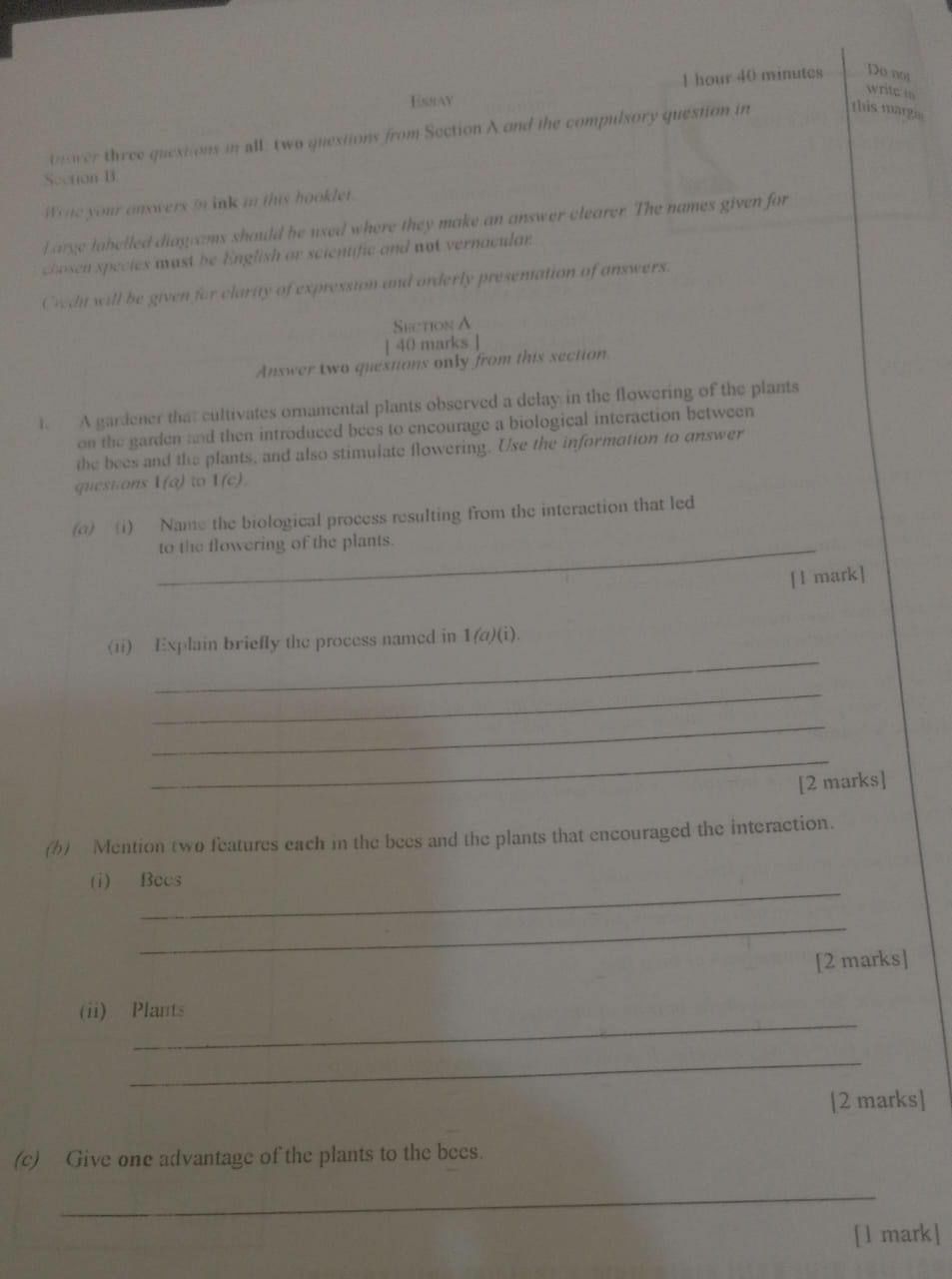
(1d)(i) Essential parts of a flower:
- Androecium (stamens)
- Gynoecium (carpels/pistil)
(1d)(ii) Non-essential parts of a flower:
- Petals (corolla)
- Sepals (calyx)
(1e) Double Fertilization: Double fertilization is the process in which two male gametes take part in fertilization. One male gamete fuses with the egg cell to form a zygote, while the other fuses with the two polar nuclei to form the endosperm.
(1f) Characteristics of an Explosive Dispersal Fruit (any two):
- The fruit is a dry pod that splits open when ripe.
- The pod bursts explosively, scattering the seeds.
- The fruit has elastic valves that aid seed dispersal.
- The pod becomes dry and dehiscent at maturity.
(1g) Type of placentation:
| Fruit | Type of Placentation |
|---|---|
| Cowpea | Marginal |
| Okra | Axile |
| Pawpaw | Parietal |

(1g) Type of Placentation:
| Fruit | Type of Placentation |
|---|---|
| Cowpea | Marginal |
| Okra | Axile |
| Pawpaw | Parietal |
QUESTION 2
(2a) Translocation: Translocation is the movement of manufactured food materials, mainly sugars, from the leaves to other parts of the plant through the phloem tissues for storage and utilization.
QUESTION 3

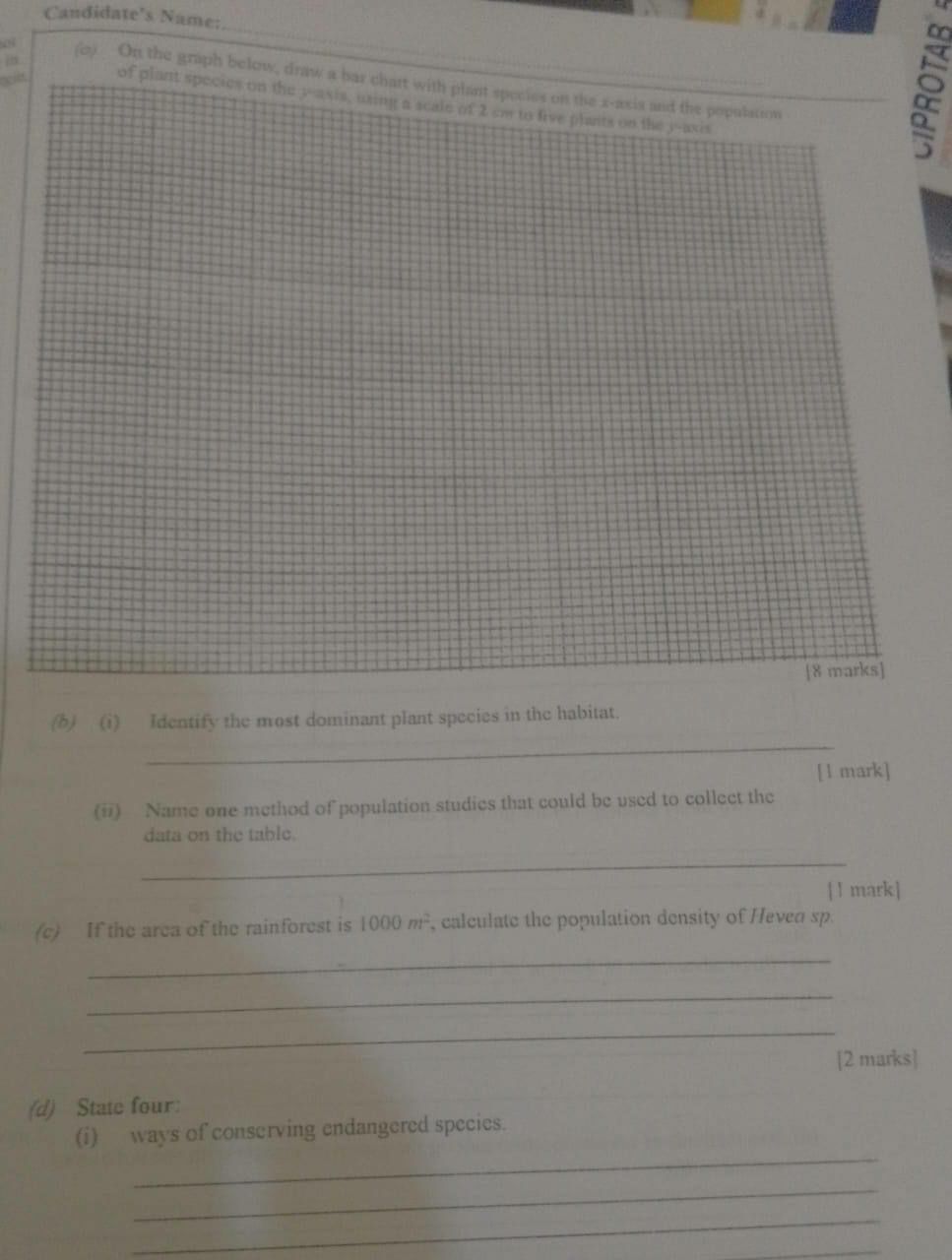
(3a) Bar Chart — Population of Plant Species: The bar chart shows the population of plant species in the area as follows:
- Mahogany: 10
- Iroko: 25
- Obeche: 15
- Hevea sp.: 5
- Delonix sp.: 10
(X-axis: Plant species; Y-axis: Population of plant species; Scale: 2 cm to 5 plants)
(3b)(i) Iroko.
(3b)(ii) Quadrat method.
(3c) Population Density: Population density = Population ÷ Area = 5 ÷ 1000 = 0.005 plants/m². Therefore, the population density of Hevea sp. is 0.005 plants/m².
(3d)(i) Conservation measures (any four):
- Establishment of game reserves and national parks.
- Afforestation and reforestation programmes.
- Enforcement of laws against indiscriminate hunting and logging.
- Public education on conservation of natural resources.
- Establishment of botanical gardens and zoological gardens.
- Controlled harvesting of forest resources.
- Protection of natural habitats from destruction.
- Breeding endangered species in captivity and reintroducing them into the wild.
QUESTION 4
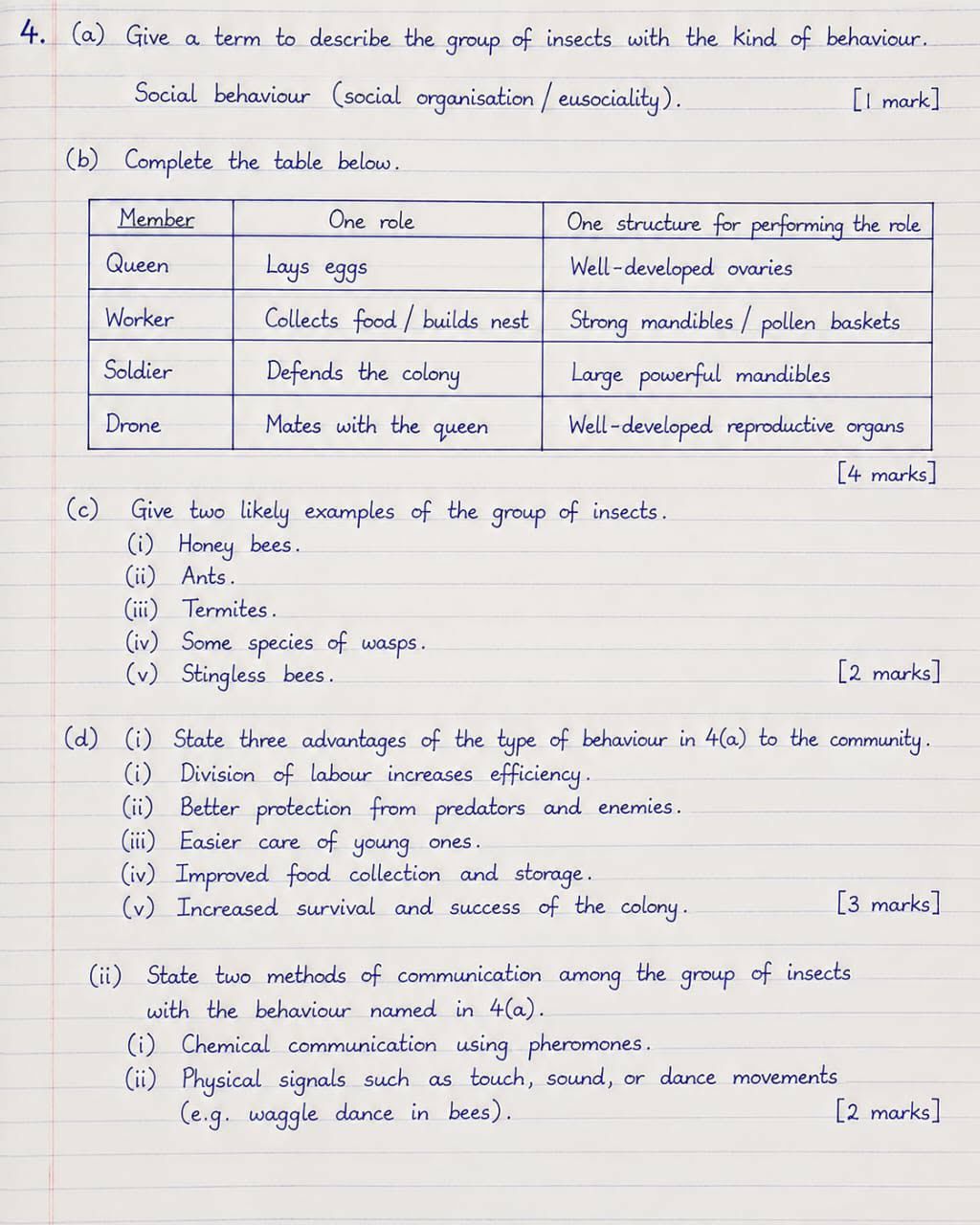
(4a) The term used to describe the group of insects with this kind of behaviour is social behaviour (also known as social organisation / eusociality).
(4b) Table — Members, Roles and Structures:
| Member | One Role | One Structure for Performing the Role |
|---|---|---|
| Queen | Lays eggs | Well-developed ovaries |
| Worker | Collects food / builds nest | Strong mandibles / pollen baskets |
| Soldier | Defends the colony | Large powerful mandibles |
| Drone | Mates with the queen | Well-developed reproductive organs |
(4c) Two likely examples of the group of insects:
- Honey bees
- Ants
- Termites (any two)
(4d)(i) Three advantages of social behaviour to the community (any three):
- Division of labour increases efficiency.
- Better protection from predators and enemies.
- Easier care of young ones.
- Improved food collection and storage.
- Increased survival and success of the colony.
(4d)(ii) Two methods of communication among social insects:
- Chemical communication using pheromones.
- Physical signals such as touch, sound, or dance movements (e.g. waggle dance in bees).
(4a)(i) Iron
(4a)(ii) Vitamin K
(4a)(iii) Haemophilia
(4b) Food sources rich in iron:
- Spinach
- Broccoli
- Kale
(4c) Pre-transfusion tests:
- Blood typing and crossmatching: To determine the patient’s blood type and match it with compatible donor blood.
- Complete Blood Count (CBC): To assess the levels of red blood cells, white blood cells, and platelets.
- Coagulation tests: Such as prothrombin time (PT) and activated partial thromboplastin time (APTT) to evaluate the blood clotting ability.
(4d) Blood group compatibility:
- Two compatible blood group types for a person with blood group A are A positive (A+) and A negative (A-).
- The likely blood groups of the patient’s parents could be A and O.
(4e)(i) Why haemophilia is more common in males: Haemophilia is an X-linked recessive disorder, meaning the gene responsible is located on the X chromosome. Males have only one X chromosome (XY), so if the X chromosome they inherit from their mother carries the haemophilia gene, they will manifest the disorder. Females have two X chromosomes (XX), so they need to inherit the haemophilia gene from both parents to manifest the disorder.
(4e)(ii) Condition for female offspring to manifest haemophilia: A female offspring would manifest haemophilia if she inherits an X chromosome with the haemophilia gene from her carrier mother and her father also carries the haemophilia gene on his X chromosome.
(4e)(iii) Other sex-linked/genetic disorders: Down syndrome; Cystic fibrosis.
QUESTION 5
(5a) Potato Blight: Potato blight is a serious plant disease that affects potatoes and is caused by a fungus-like organism known as Phytophthora infestans. It spreads rapidly under cool and wet conditions, attacking leaves, stems, and tubers. The disease causes dark patches on leaves which later rot and collapse, leading to a significant reduction in crop yield. In severe cases, it can destroy an entire potato farm if not properly controlled. Control measures include the use of resistant varieties, proper field hygiene, crop rotation, and application of fungicides.
(5b) Climate Change: Climate change is the long-term alteration in the average weather conditions of the Earth, such as temperature, rainfall, and wind patterns. It is mainly caused by increased concentrations of greenhouse gases like carbon dioxide and methane due to human activities such as burning fossil fuels, deforestation, and industrial processes. Climate change leads to effects such as rising global temperatures, melting ice caps, sea level rise, droughts, floods, and disruption of ecosystems. It can also affect agriculture, water supply, and human health. Mitigation measures include afforestation, reduced carbon emissions, and the use of renewable energy sources.
Join the Examsmooth WAEC 2026 WhatsApp Channel
Get fast alerts when the 2026 WAEC Biology answers drop, plus updates for other subjects, exam tips, and more. Join our official WhatsApp channel so you don't miss any update.

 Examsmooth
Leave a comment