
2026 WAEC Marketing Questions and Answers
🔥 Examsmooth is the ONLY place you’ll get accurate and real-time 2026 WAEC Marketing answers. Bookmark this page and keep refreshing!
WAEC 2026 Marketing — Official Question Paper


WAEC 2026 Marketing — Official Question Paper
WAEC 2026 Marketing OBJ Answers ✅
The 2026 WAEC Marketing objective answers will be posted here as soon as the exam starts. Keep refreshing this page.
WAEC 2026 Marketing OBJ Answers
(OBJ answers coming soon — keep refreshing)
WAEC 2026 Marketing Essay/Theory Answers ✅
Check below for the complete Marketing essay answers. We update this page in real time.
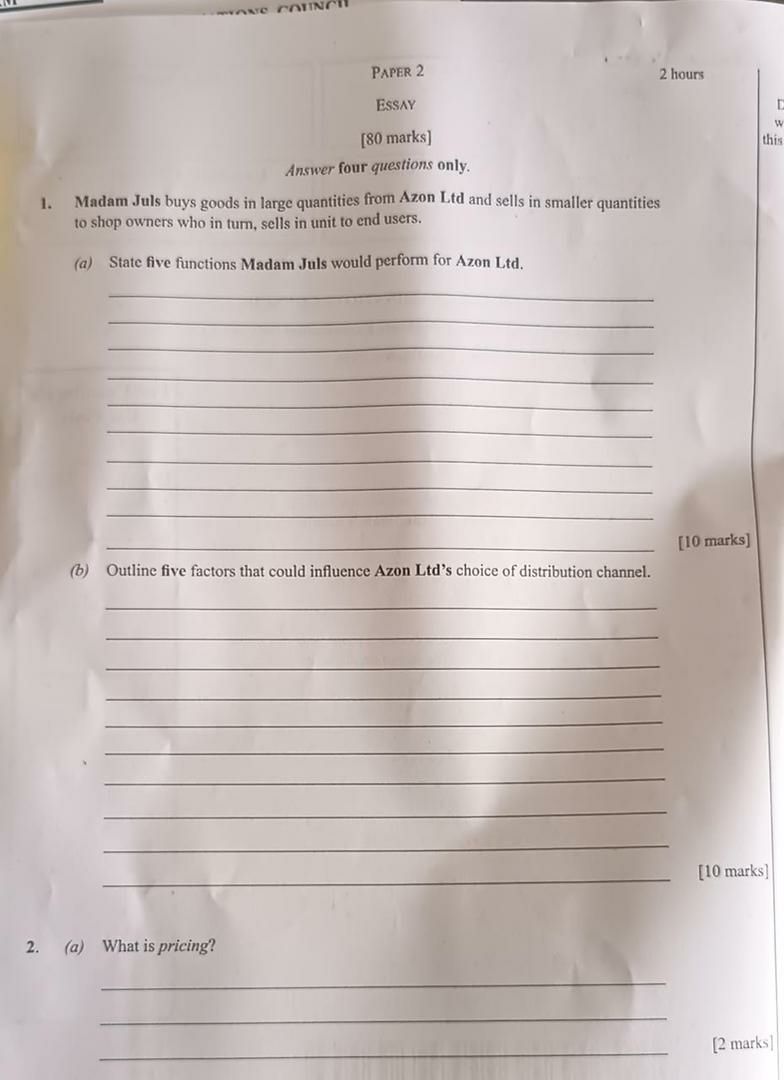
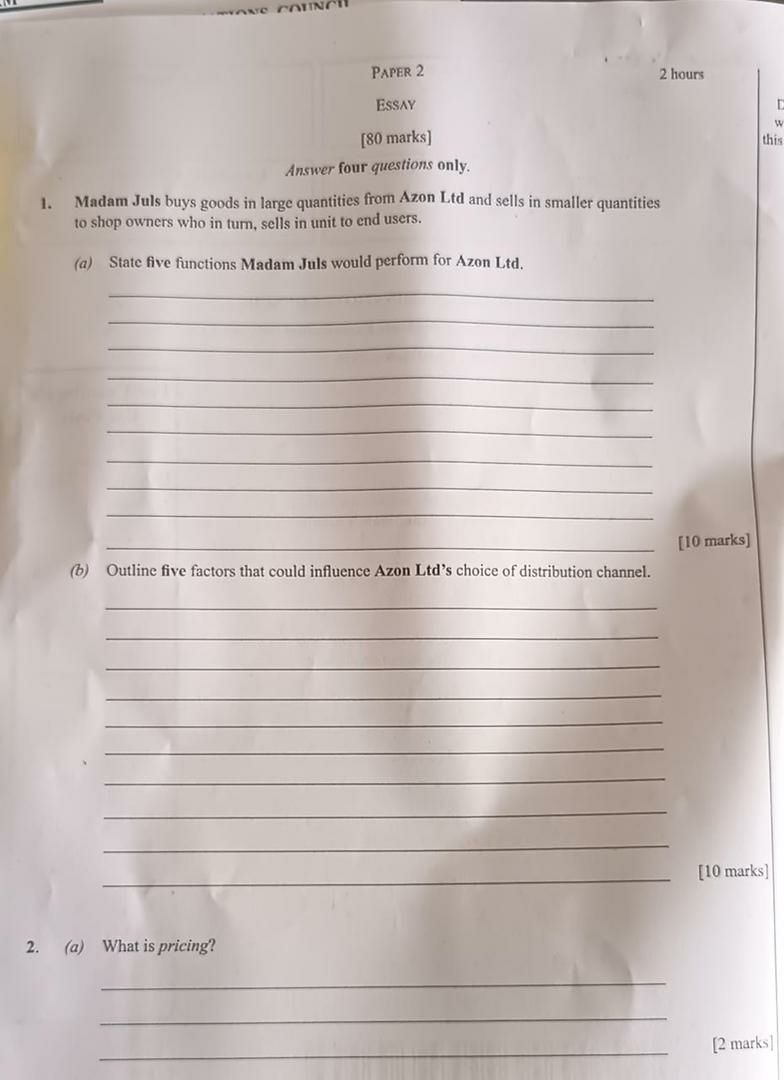
Question 1 — Madam Juls (Wholesaler for Azon Ltd)
(1a) Five functions of a wholesaler:
- Buying in bulk from manufacturers and selling in smaller quantities to retailers.
- Warehousing/storing goods until they are needed by retailers.
- Providing credit facilities to retailers.
- Transporting goods from manufacturers to retailers.
- Breaking bulk — dividing large quantities into smaller units suitable for retailers.
- Providing market information to both manufacturers and retailers.
- Bearing the risk of price fluctuations and spoilage of goods.
(Any five)
(1b) Five factors influencing choice of distribution channel:
- Nature of the product — perishable goods require short/direct channels.
- Nature of the market — consumer market vs industrial market.
- Cost of distribution — cheaper channels are preferred.
- Size of the market — wide markets may require more middlemen.
- Financial strength of the producer — financially strong producers may use direct channels.
- Government regulations — some products may be regulated on how they are distributed.
- Competition — producers may adopt the channels used by competitors.
(Any five)
Question 2 — Pricing
(2a) What is pricing?
Pricing is the process of determining the amount of money a buyer will pay for a product or service. It involves setting a price that covers costs, generates profit, and remains competitive in the market.
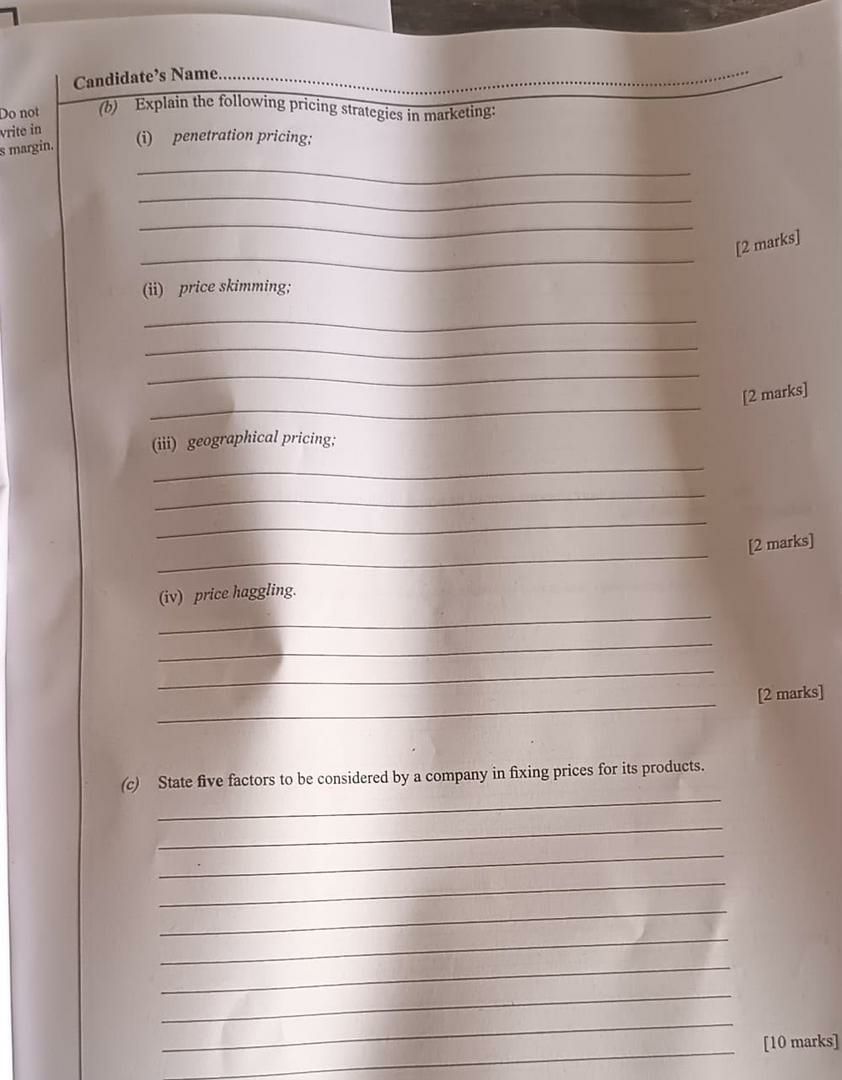
(2b) Explanation of the following pricing strategies:
(i) Penetration Pricing: Penetration pricing is a strategy where a product is introduced into the market at a very low price to attract a large number of customers quickly and gain market share. The price may be raised later after the product becomes established.
(ii) Price Skimming: Price skimming is a strategy where a new product is launched at a very high price to maximize profits from customers willing to pay a premium. The price is gradually reduced over time to attract more price-sensitive customers.
(iii) Geographical Pricing: Geographical pricing is a strategy where different prices are charged for the same product in different locations, based on transportation costs, distance from the producer, or market conditions in each region.
(iv) Price Haggling: Price haggling (or bargaining) is a strategy where the buyer and seller negotiate the final price of a product. The initial price is not fixed, and both parties reach an agreed price through discussion. This is common in open markets and real estate transactions.
(2c) Five factors in fixing prices:
- Cost of production.
- Level of competition in the market.
- Government regulations and price controls.
- Demand and supply conditions.
- The target market and consumer purchasing power.
- Business objectives (profit maximization, market share).
(Any five)
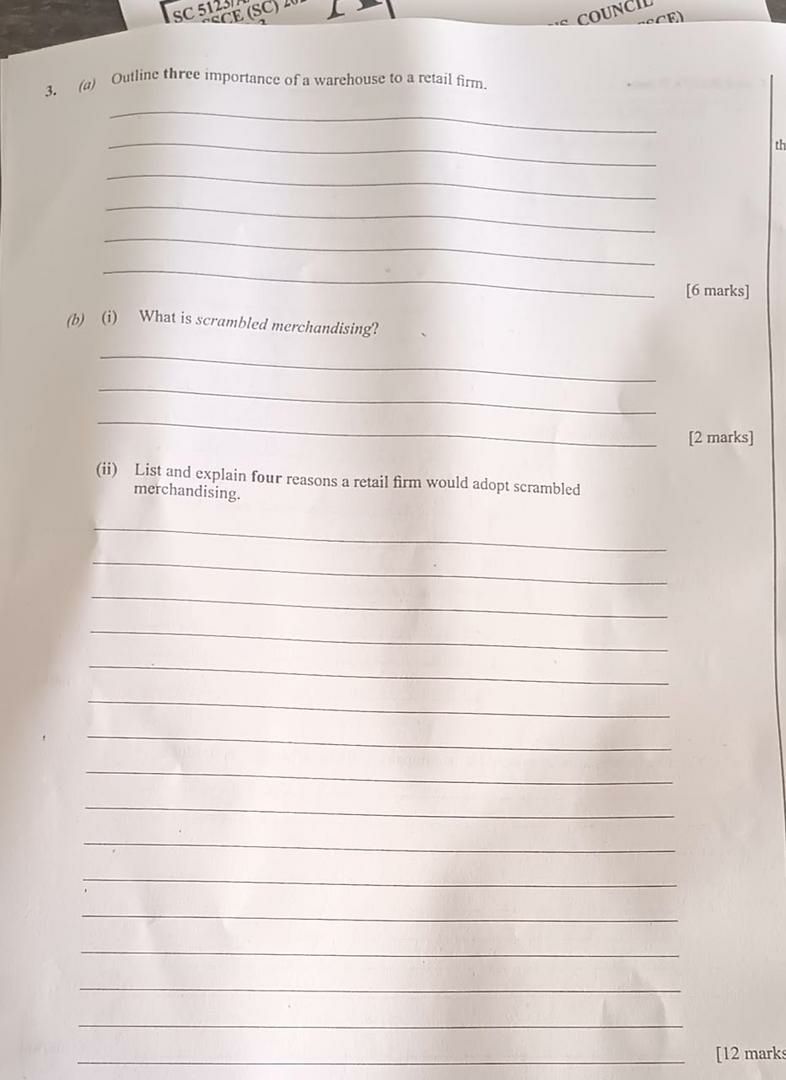
Question 3 — Warehouse & Scrambled Merchandising
(3a) Three importance of warehouse to a retail firm:
- It provides storage space for goods, ensuring steady supply to customers.
- It helps the retailer to buy in bulk and take advantage of trade discounts.
- It ensures continuity of business during periods of short supply or high demand.
- It helps in preserving and protecting goods from damage, theft, or deterioration.
(Any three)
(3b)(i) What is scrambled merchandising?
Scrambled merchandising is a retail practice where a store sells products that are outside its original or traditional line of business. For example, a pharmacy selling food items or a supermarket selling electronics alongside groceries.
(3b)(ii) Four reasons a retail firm would adopt scrambled merchandising:
- To increase sales revenue and profit by offering more products.
- To attract more customers who may buy other items while shopping.
- To make use of available floor space more profitably.
- To remain competitive and meet the changing needs of customers.
- To reduce the risk of depending on a single product line.
(Any four)
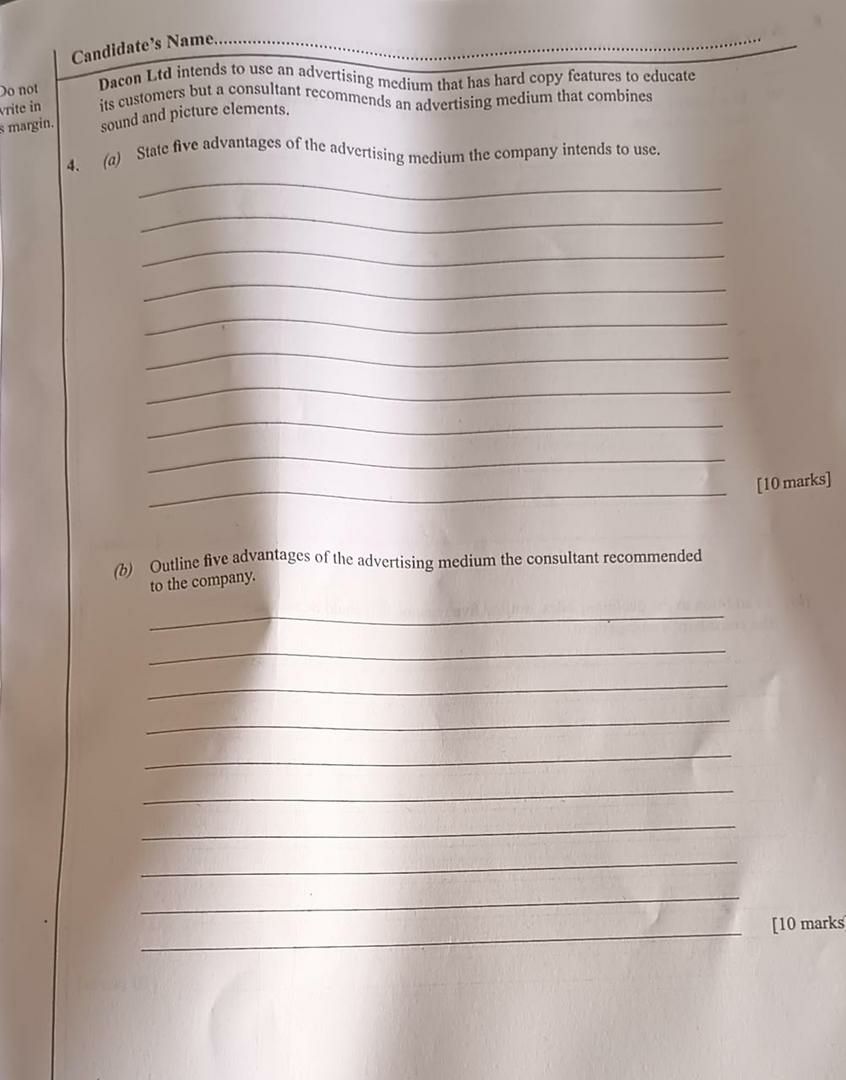
Question 4 — Advertising (Dacon Ltd)
(4a) Five advantages of newspaper advertising:
- It has wide coverage and reaches many readers.
- It is relatively cheap compared to other media.
- Readers can refer back to the advertisement at any time.
- It can target specific geographical areas or audiences.
- It provides detailed information about the product.
- It is credible and trusted by many readers.
(Any five)
(4b) Five advantages of television (TV) advertising:
- It has a very wide reach — both literate and illiterate audiences.
- It combines sight, sound, and motion making it more persuasive and memorable.
- It can demonstrate the product in use, making it more convincing.
- It reaches a mass audience quickly.
- It creates strong brand awareness and emotional connection with viewers.
- It can target specific audiences through programme selection and timing.
(Any five)
Question 5 — Market Research for a Toy Shop
(5a) Stages of market research (in logical order):
- Define the problem/research objectives — identify what information is needed.
- Research design — plan how the research will be conducted.
- Data collection — gather primary and secondary data using questionnaires, interviews, observation, etc.
- Data analysis — process and interpret the collected data.
- Report writing — present findings and recommendations.
- Implementation — use findings to make business decisions.
(5b) Five other reasons necessitating engagement of a marketing consultant:
- To provide expert knowledge and professional advice on marketing strategies.
- To help the business identify new market opportunities.
- To assist in developing an effective marketing plan.
- To evaluate the effectiveness of existing marketing activities.
- To provide an objective, unbiased view of the business and its market.
- To help the business understand consumer behaviour and preferences.
(Any five)
Question 6 — Products & Transport
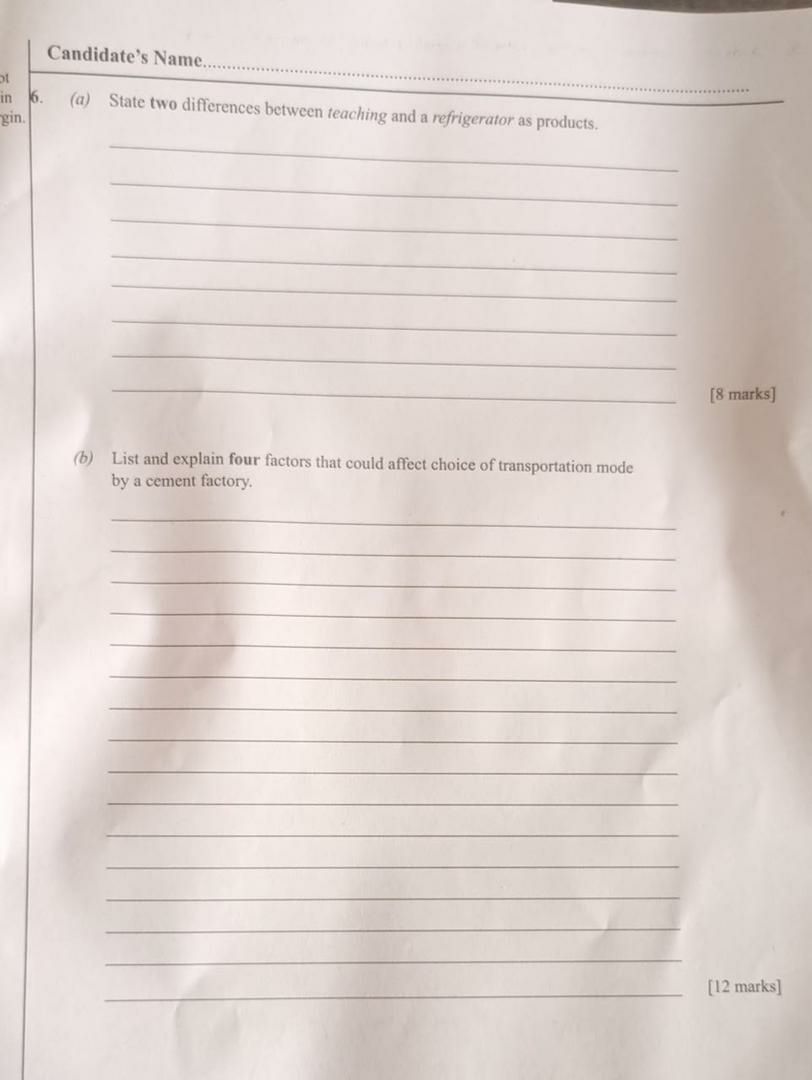
(6a) Two differences between teaching (service) and refrigerator (physical product):
- Teaching is intangible (cannot be touched or seen), while a refrigerator is tangible (can be physically touched and seen).
- Teaching is produced and consumed at the same time (inseparability), while a refrigerator is produced first and then purchased and consumed later.
- Teaching cannot be stored or inventoried, while a refrigerator can be stored in a warehouse before sale.
- The quality of teaching may vary from teacher to teacher (heterogeneity), while refrigerators are produced to a consistent standard.
(Any two)
(6b) Four factors affecting choice of transport mode for a cement factory:
- Cost of transportation — the cheapest mode that ensures safe delivery.
- Nature of the product — cement is heavy and bulky, favouring road or rail transport.
- Distance to the destination — long distances may favour rail or water transport.
- Availability of transport infrastructure — roads, railways, or waterways near the factory.
- Speed required — urgent deliveries may require road transport.
- Volume of goods to be transported — large volumes suit rail or water transport.
(Any four)
 Examsmooth
Leave a comment