
WAEC 2026 Chemistry 1 (OBJ) \\u2014 Answers
Use this quick-reference table for all 50 WAEC 2026 Chemistry 1 (OBJ) answers, then scroll down for full explanations.
| Questions | Answers |
|---|---|
| 1–10 | B C C A C A B D A D |
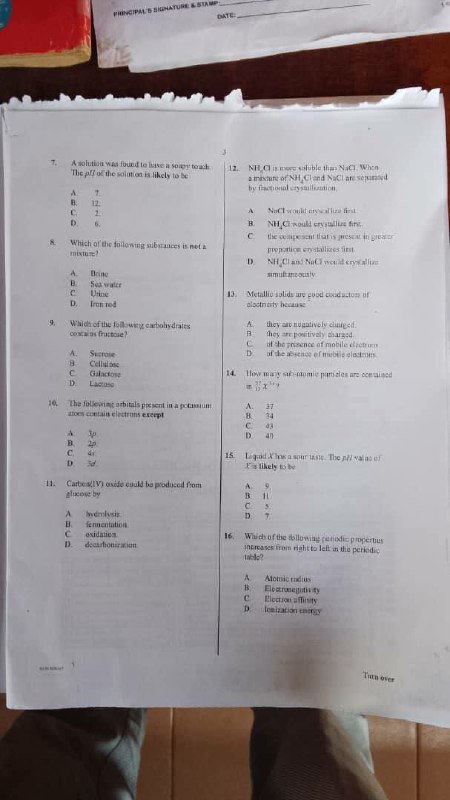
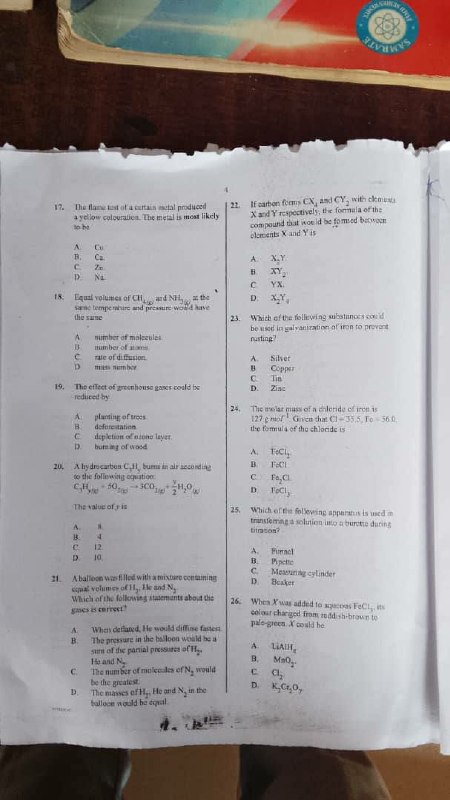
| 11–20 | B A C D C A D A A B |
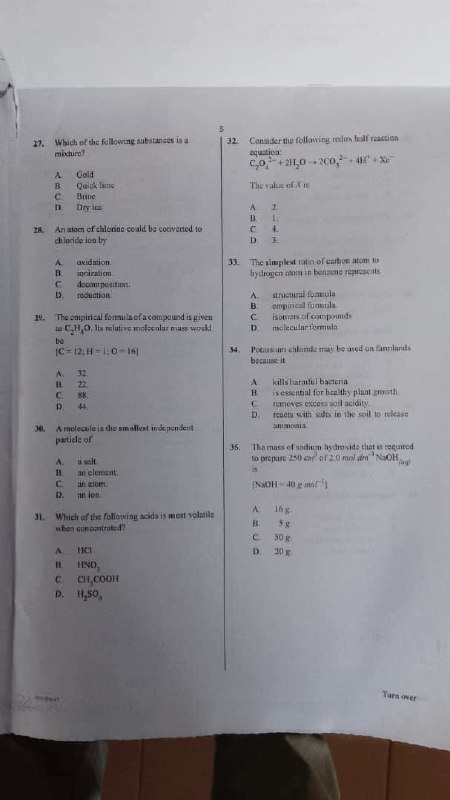
| 21–30 | B D D A A A C B C B |
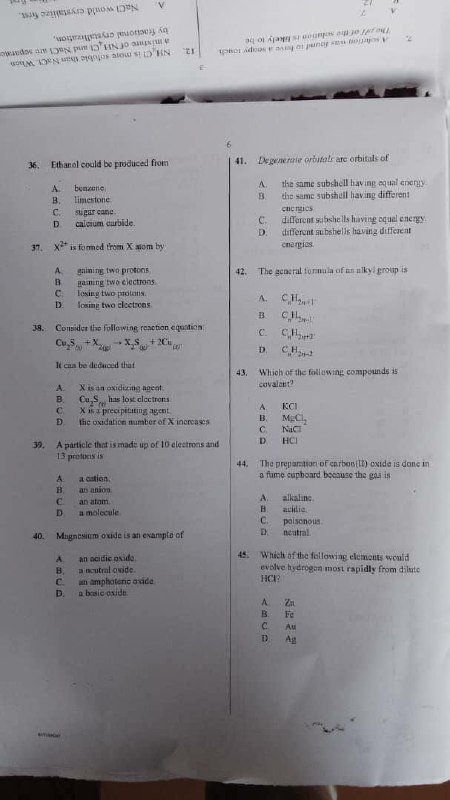
| 31–40 | A A B B D C D B A D |
| 41–50 | A A D C A D D C A B |
OBJ Answer Explanations
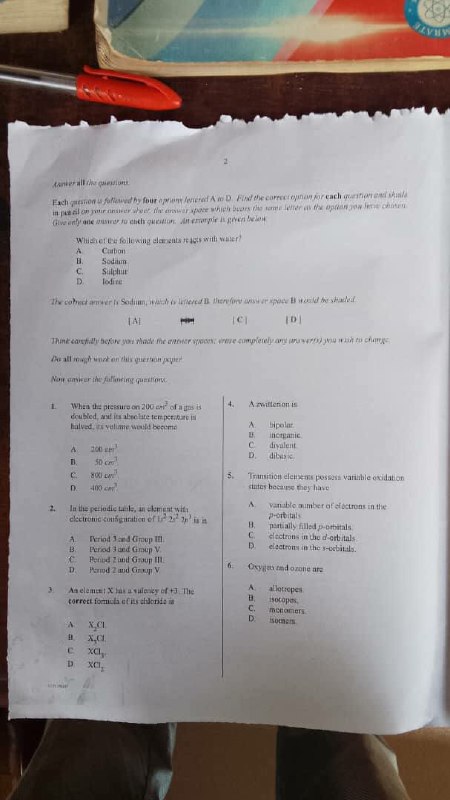
- B – Combined gas law: P2 = 2P1, T2 = \\xbdT1 \\u2192 V2 = 50 cm3.
- C – 1s22s22p3 \\u2192 7 electrons, Period 2.
- C – X3+ with Cl− \\u2192 XCl3.
- A – Zwitterion is bipolar (both positive and negative charges).
- C – Transition elements have variable oxidation states due to partially filled d-orbitals.
- A – O2 and O3 are allotropes.
- B – Soapy touch indicates an alkaline solution with pH about 12.
- D – An iron rod is a pure substance (element), not a mixture.
- A – Sucrose is formed from glucose and fructose.
- D – A potassium atom has no 3d electrons.
- B – CO2 from glucose by fermentation.
- A – NaCl is less soluble and crystallizes first.
- C – Metals conduct electricity due to mobile electrons.
- D – For \\u00b2\\u2077\\u2081\\u2083X: protons = 13, neutrons = 14, electrons = 13 \\u2192 total subatomic particles = 40.
- C – Sour taste indicates an acidic solution with pH about 5.
- A – Atomic radius increases from right to left across a period.
- D – Yellow flame in a flame test indicates sodium (Na).
- A – At the same temperature and pressure, equal volumes of gases contain the same number of molecules (Avogadro’s law).
- A – Planting trees reduces the greenhouse effect by absorbing CO2.
- B – Correct balancing of C4H8 combustion.
- B – Dalton’s law: total pressure equals the sum of partial pressures.
- D – C forms CX4 and CY4; both X and Y are monovalent and combine to form XY.
- D – Zinc is used for galvanization.
- A – Relative molecular mass of FeCl2: 56 + 71 = 127 g mol−1.
- A – A funnel is used for transferring liquid into a burette.
- A – Fe3+ (reddish-brown) to Fe2+ (pale green) is reduction; LiAlH4 is the reducing agent.
- C – Brine is a mixture of salt and water.
- B – Cl to Cl− involves gain of an electron, which is reduction (ion formation).
- C – Empirical formula mass C2H5O = 45; n = 2, so molecular formula C4H10O and molar mass 88 g mol−1.
- B – A molecule is the smallest independent particle of an element or compound.
- A – HCl is the most volatile among the options.
- A – Balancing the redox half-equation gives a coefficient of 2.
- B – The simplest ratio of atoms gives the empirical formula.
- B – KCl is essential for plant growth.
- D – Moles = 2.0 \\xd7 0.25 = 0.5 mol; mass = 0.5 \\xd7 40 = 20 g.
- C – Ethanol is obtained from sugar cane by fermentation.
- D – X2+ means the atom has lost two electrons.
- B – In Cu2S, copper loses electrons, so it is oxidized.
- A – 13 protons and 10 electrons give a +3 charge, so it is a cation.
- D – MgO is a basic oxide.
- A – Degenerate orbitals belong to the same subshell and have the same energy.
- A – General formula for an alkyl group is CnH2n+1.
- D – HCl is a covalent compound.
- C – CO is a poisonous gas.
- A – Zinc evolves hydrogen gas most rapidly from dilute HCl.
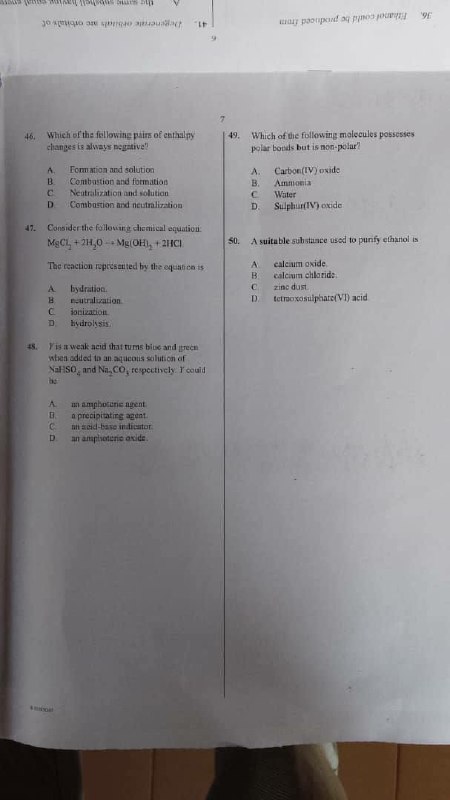
- D – Combustion and neutralization reactions are always exothermic (\\u0394H negative).
- D – MgCl2 + 2H2O \\u2192 Mg(OH)2 + 2HCl is hydrolysis.
- C – A weak acid that changes colour is an acid–base indicator.
- A – CO2 has polar bonds but is a non-polar molecule due to its linear shape.
- B – Calcium chloride is used to purify ethanol by removing water.
2026 WAEC Chemistry 2 Questions and Answers (Essay/Theory)
Live 2026 WAEC Chemistry 2 (Essay/Theory) answers are being posted here in real time during the exam.
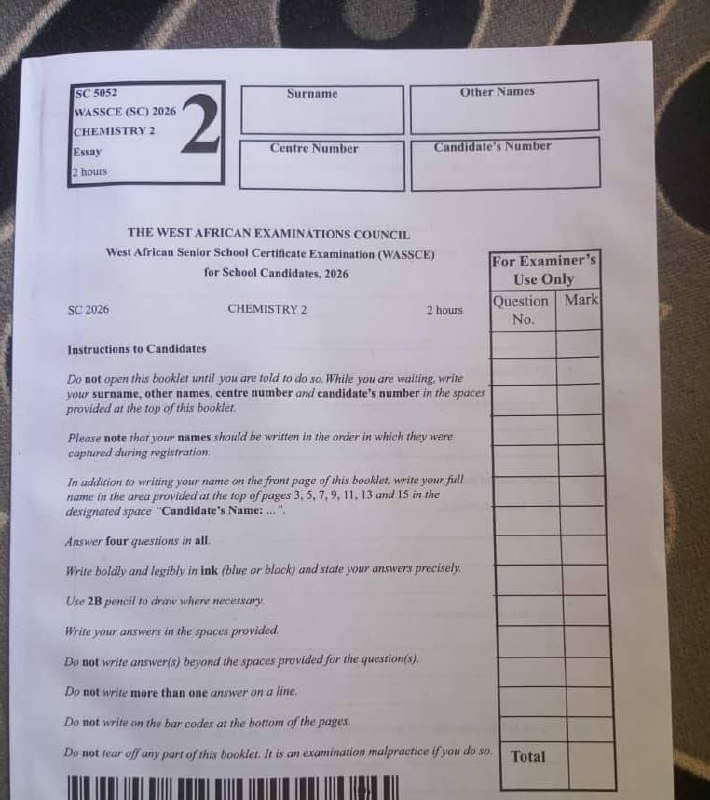
WAEC 2026 Chemistry 2 \\u2014 Question Paper
Scroll through the full question paper pages below.
WAEC 2026 Chemistry 1 (OBJ) \\u2014 Question Paper
Scroll through the full Chemistry 1 OBJ question paper pages below.
Answers on this page are being updated in real time as the 2026 WAEC Chemistry 2 (Essay/Theory) exam progresses. Bookmark this page now and keep refreshing your browser to see the latest verified solutions.
WAEC 2026 Chemistry 2 — Question 1 Answers
(1a)(i) Suspension (any one):
- Muddy water
- Chalk in water
- Sand in water
- Flour in water
- Clay in water
(1a)(ii) Colloid (any one):
- Milk
- Fog
- Smoke
- Jelly
- Starch solution
(1b) Isoelectronic series is a group of atoms, ions or molecules having the same number of electrons and the same electronic configuration.
(1c)(i) Heat of formation is the heat change when one mole of a compound is formed from its constituent elements in their standard states.
(1c)(ii) Heat of combustion is the heat change when one mole of a substance is completely burnt in excess oxygen.
(1d) Helium is preferred because it is chemically inert and non-flammable, whereas hydrogen is highly flammable and can easily explode when mixed with air.
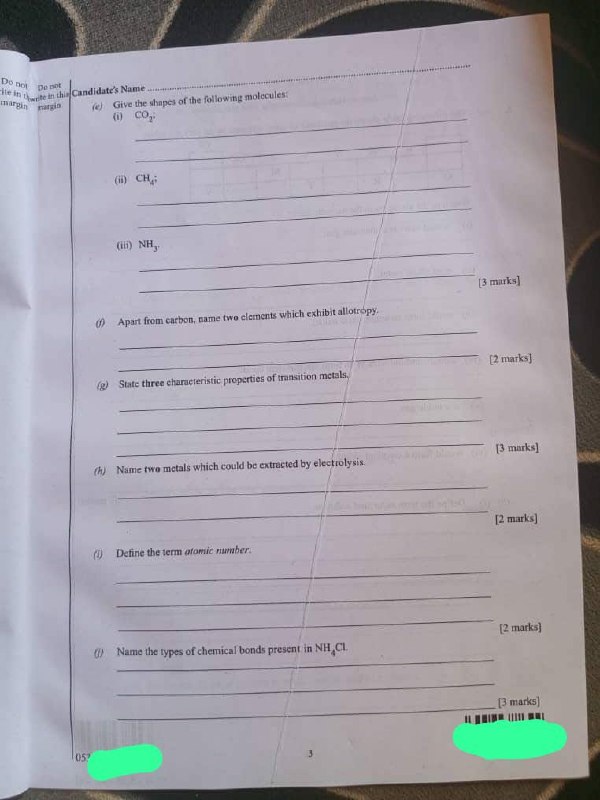
(1e) Shapes of molecules:
- CO2: Linear
- CH4: Tetrahedral
- NH3: Trigonal pyramidal
(1f) Elements that exist as allotropes:
- Sulphur
- Phosphorus
(1g) Properties of transition metals (any three):
- They exhibit variable oxidation states.
- They form coloured compounds.
- They act as catalysts.
- They form complex ions.
- They have high melting and boiling points.
- They are good conductors of heat and electricity.
- They are hard and dense metals.
(1h) Metals that are extracted by electrolysis:
- Aluminium
- Sodium
(1i) Atomic number is the number of protons in the nucleus of an atom and is equal to the number of electrons in a neutral atom.
(1j) Types of bonds in water (H2O):
- Covalent bond
- Coordinate (dative) bond
- Ionic bond
Get More WAEC Chemistry 2 Updates
For fast alerts when new 2026 WAEC Chemistry 2 answers are added, join our official Examsmooth WhatsApp channel.
WAEC 2026 Chemistry 2 \\u2014 Question 2 Answers
(2a) Periodic Table — Element Identification
| Sub-question | Answer |
|---|---|
| (i) Would exist as a diatomic gas | M |
| (ii) Is an alkali metal | O |
| (iii) Would form an amphoteric oxide | R |
| (iv) Would combine with M to form electrovalent bonds | O |
| (v) Is a noble gas | V |
| (vi) Would form a covalent oxide | T |
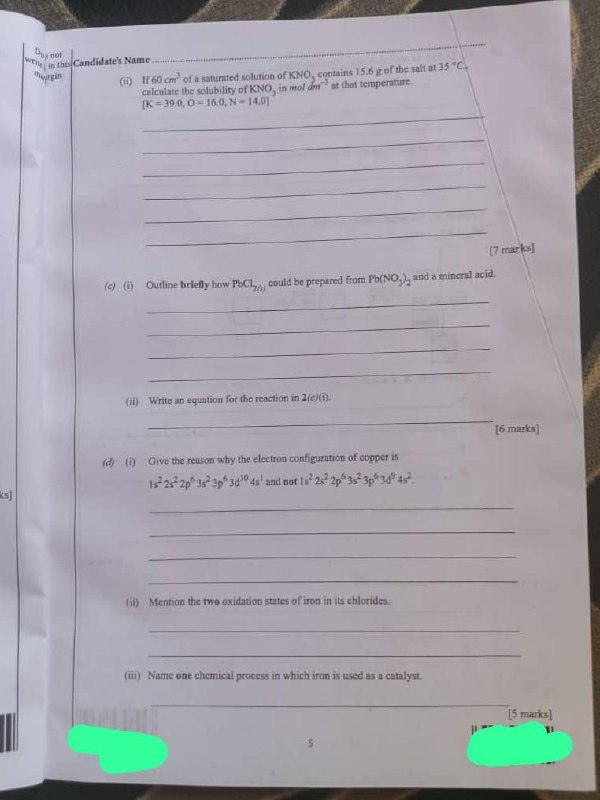
(2b)(i) A saturated solution is a solution that contains the maximum amount of solute that can dissolve in a given amount of solvent at a particular temperature.
(2b)(ii) Calculation:
60 cm3 of saturated KNO3 solution contains 15.6 g of KNO3
Mass of KNO3 in 1000 cm3 (1 dm3) = (15.6 × 1000) / 60 = 260 g dm-3
Molar mass of KNO3 = K + N + 3O = 39 + 14 + (16 × 3) = 101 g mol-1
Solubility = 260 / 101 = 2.57 mol dm-3
∴ Solubility of KNO3 = 2.57 mol dm-3
(2c)(i) Preparation of lead(II) chloride:
- Prepare an aqueous solution of lead(II) nitrate.
- Add dilute hydrochloric acid to the solution.
- A white precipitate of lead(II) chloride is formed.
- Filter off the precipitate.
- Wash the precipitate with distilled water.
- Dry the precipitate between filter papers.
(2c)(ii) Equation: Pb(NO3)2(aq) + 2HCl(aq) → PbCl2(s) + 2HNO3(aq)
(2d)(i) Copper has the electronic configuration 3d104s1 because a completely filled 3d subshell is more stable than a partially filled 3d subshell. Therefore, one electron from the 4s orbital is transferred to the 3d orbital.
(2d)(ii) Oxidation states of iron:
- +2 (ferrous)
- +3 (ferric)
(2d)(iii) Iron is used as a catalyst in the Haber process (manufacture of ammonia).
WAEC 2026 Chemistry 2 — Question 3 Answers
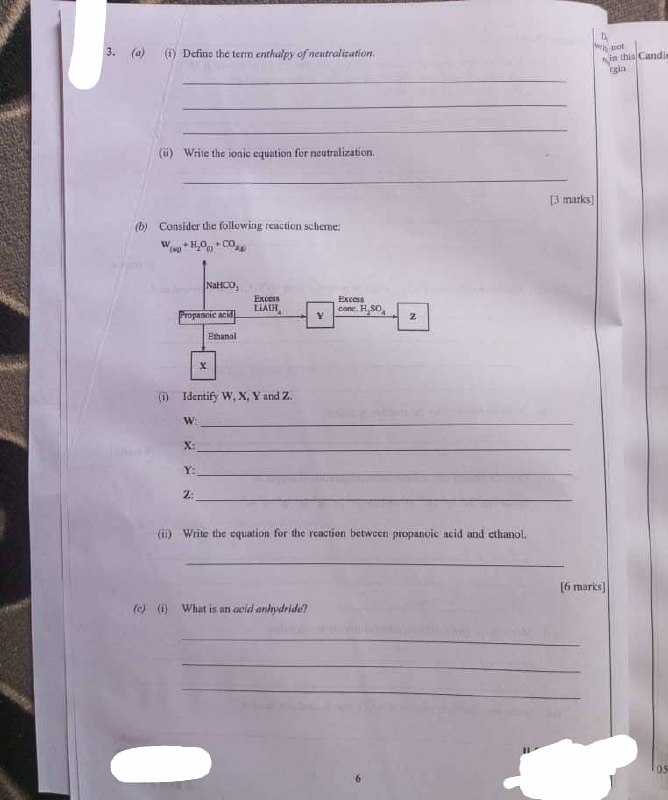
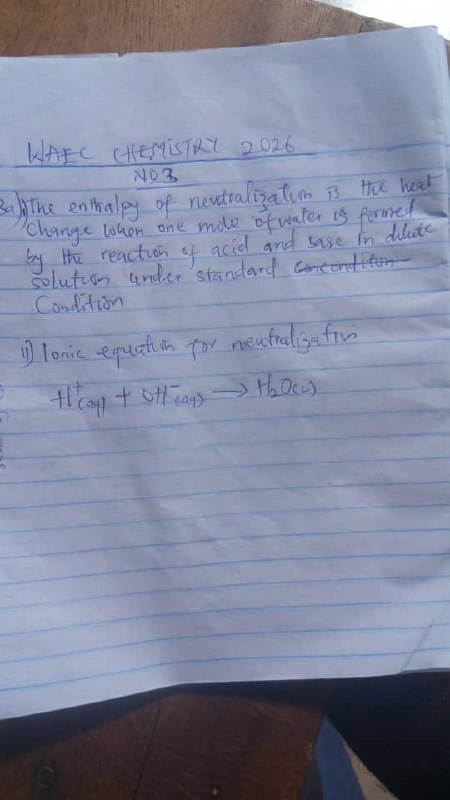
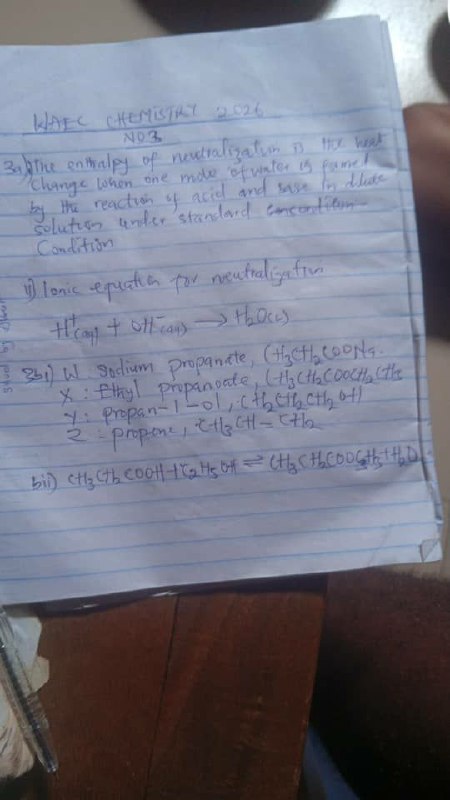
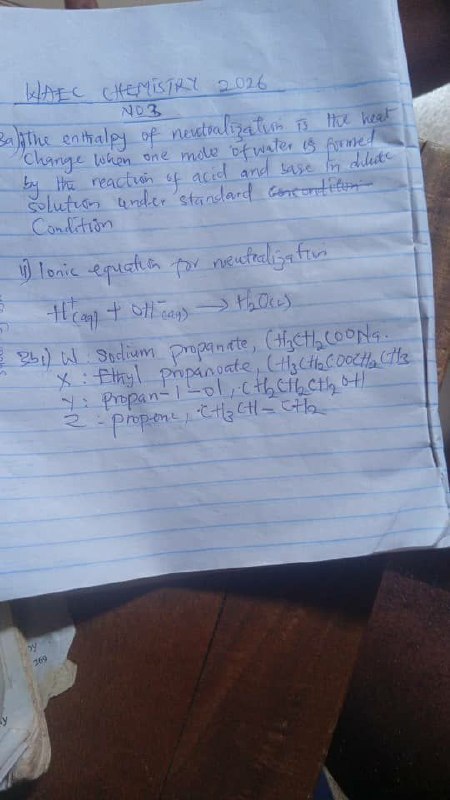
(3a)(i) Enthalpy of neutralization is the energy change when an acid reacts with a base to form one mole of water under standard conditions.
(3a)(ii) H+(aq) + OH−(aq) → H2O(l)
(3b)(i)
- W: Sodium propanoate (CH3CH2COONa)
- X: Ethyl propanoate (CH3CH2COOC2H5)
- Y: Propan-1-ol (CH3CH2CH2OH)
- Z: Propene (CH3CH=CH2)
(3b)(ii) CH3CH2COOH + C2H5OH ↔ CH3CH2COOC2H5 + H2O (in the presence of concentrated H2SO4 catalyst)
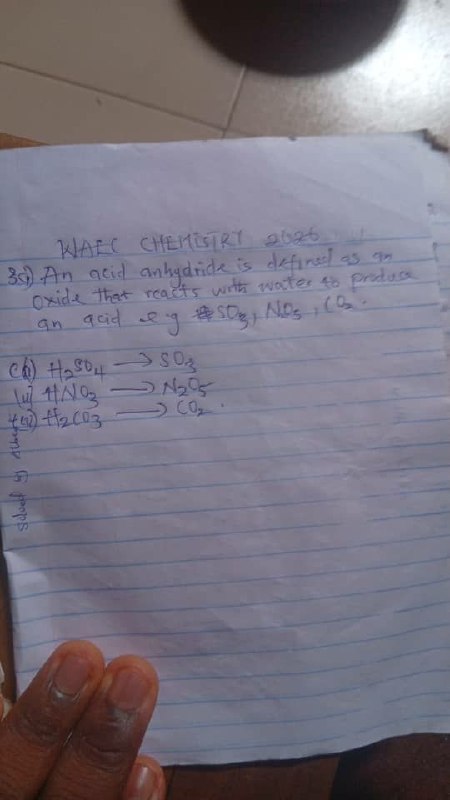
(3c)(i) An acid anhydride is a compound formed by the removal of one molecule of water from two molecules of a carboxylic acid. It has the general formula (RCO)2O.
(3c)(ii)
- (I) H2SO4 → SO3
- (II) HNO3 → N2O5
- (III) H2CO3 → CO2
(3d)(i) Al2O3 is dissolved in molten cryolite (Na3AlF6) to lower the melting point from about 2050°C to around 950°C. The molten mixture is electrolyzed using carbon (graphite) electrodes. At the cathode, aluminium ions are reduced: Al3+ + 3e− → Al. Molten aluminium, being denser, sinks and collects at the bottom of the cell. At the anode, oxide ions are oxidized: 2O2− → O2 + 4e−.
(3d)(ii) Carbon (graphite) electrodes.
(3d)(iii) The oxygen produced at the anode reacts with the carbon anode at high temperature to form carbon dioxide (C + O2 → CO2), gradually burning it away, so it must be replaced periodically.
(3e)(i) Using Graham’s law: rateX / rateO2 = √(M(O2) / M(X))
2 = √(32 / M(X))
4 = 32 / M(X)
M(X) = 32 / 4 = 8 g mol−1
(3e)(ii) Moles of X = 5 / 22.4 = 0.2232 mol
Mass = 0.2232 × 8 = 1.79 g
WAEC 2026 Chemistry 2 — Question 4 Answers
(4a)(i) Introduce a burning splint into the gas. Hydrogen burns with a "pop" sound.
(4a)(ii) Uses of hydrogen:
- It is used in the Haber process for manufacturing ammonia.
- It is used in the hydrogenation of vegetable oils to produce margarine.
- It is used as rocket fuel.
(4a)(iii)
- (I) 2Na + H2 → 2NaH
- (II) H2 + CuCl2 → Cu + 2HCl
- (III) H2 + Cl2 → 2HCl
(4b)(i)
- (I) Tin is resistant to corrosion and does not react with food substances, so it protects the food from contamination.
- (II) Copper is an excellent conductor of electricity and is ductile, making it easy to draw into wires.
(4b)(ii)
- (I) Haematite (Fe2O3) — ore of iron
- (II) Cassiterite (SnO2) — ore of tin
(4b)(iii)
- (I) Steel (alloy of iron)
- (II) Brass (alloy of copper)
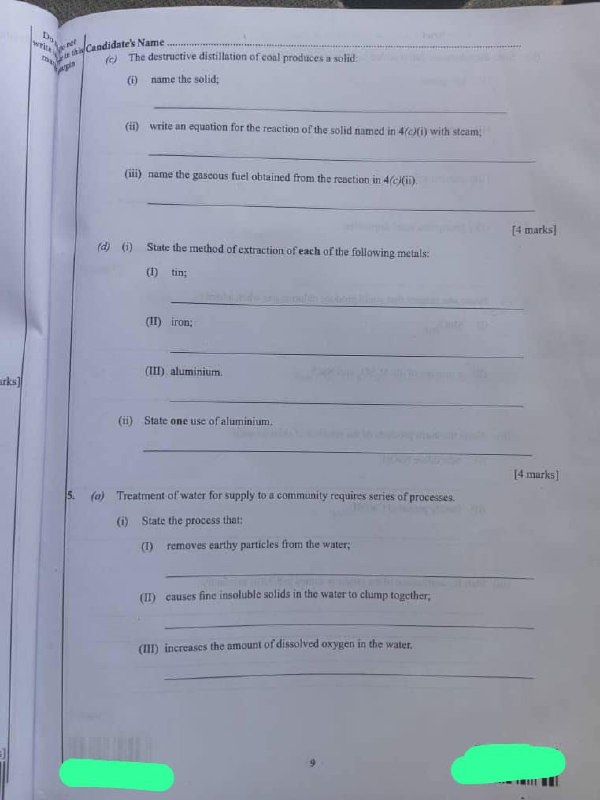
(4c)(i) Coke
(4c)(ii) C + H2O → CO + H2
(4c)(iii) Water gas (a mixture of carbon monoxide and hydrogen)
(4d)(i)
- (I) Tin — reduction of its ore (cassiterite) with carbon/coke
- (II) Iron — reduction of its ore (haematite) with carbon in a blast furnace
- (III) Aluminium — electrolysis of its molten ore (electrolytic reduction)
(4d)(ii) Aluminium is used in making cooking utensils and aircraft bodies.
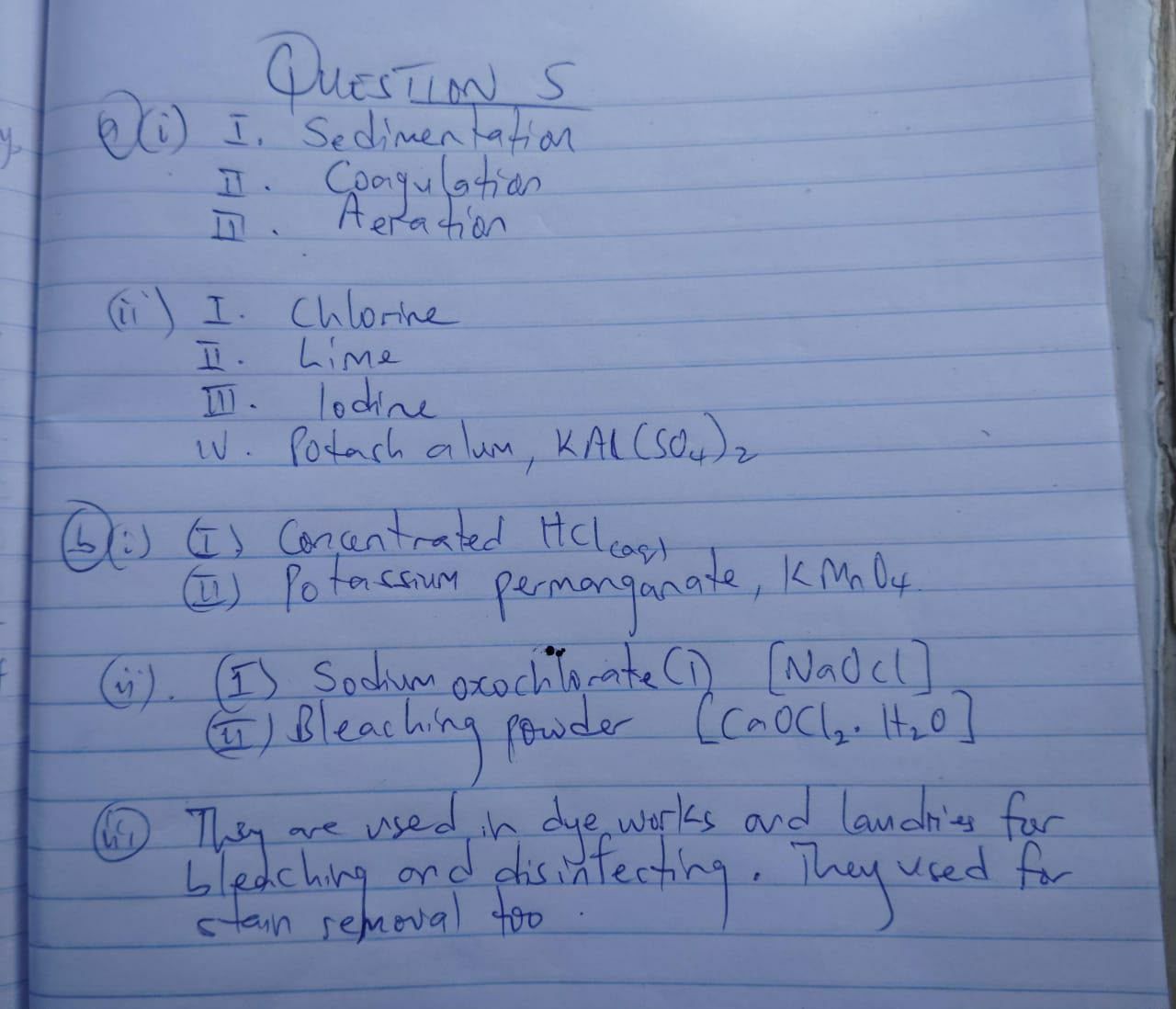
WAEC 2026 Chemistry 2 — Question 5 Answers
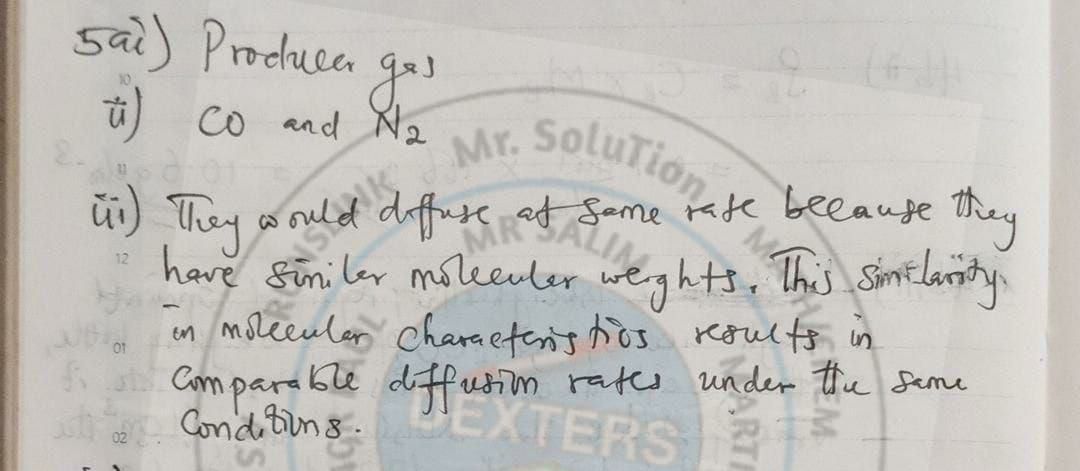
(5a)(i) Stages in water purification:
- (I) Removes earthy particles from the water: Sedimentation / Filtration
- (II) Causes fine insoluble solids to clump together: Coagulation / Flocculation (adding alum — aluminium sulphate)
- (III) Increases the amount of dissolved oxygen: Aeration
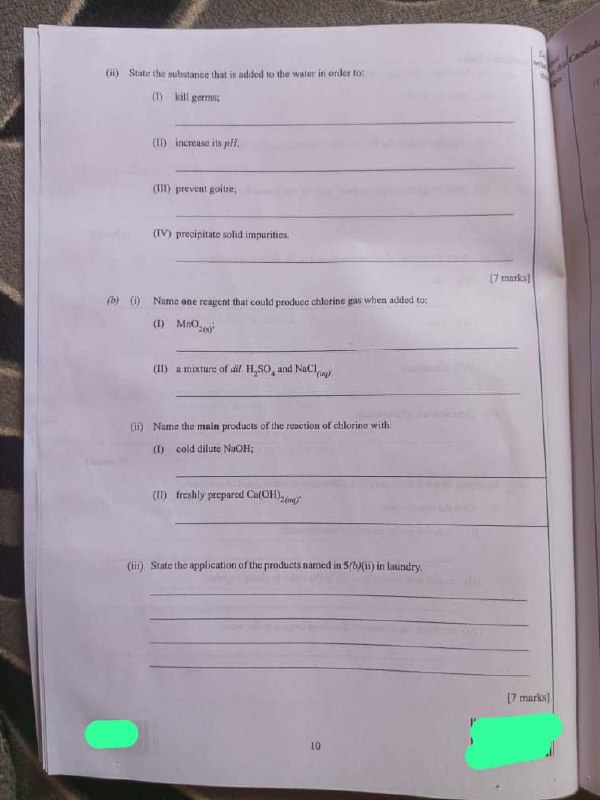
(5a)(ii) Substances added to water and their purposes:
- (I) Kill germs: Chlorine (Cl2) / chloramine
- (II) Increase its pH: Lime / calcium hydroxide Ca(OH)2
- (III) Prevent goitre: Iodine / potassium iodide (KI)
- (IV) Precipitate solid impurities: Alum / aluminium sulphate Al2(SO4)3
(5b)(i) Laboratory preparation of chlorine:
- (I) Using MnO2(s): React with concentrated hydrochloric acid (conc. HCl)
Equation: MnO2 + 4HCl → MnCl2 + Cl2 + 2H2O - (II) Using a mixture of dilute H2SO4 and NaCl(aq): React with potassium permanganate(VII) / KMnO4 (or MnO2)
(5b)(ii) Products when chlorine reacts with:
- (I) Cold dilute NaOH: Sodium chloride (NaCl) and sodium hypochlorite (NaOCl)
Cl2 + 2NaOH → NaCl + NaOCl + H2O - (II) Freshly prepared Ca(OH)2(aq): Calcium chloride (CaCl2) and calcium hypochlorite Ca(OCl)2 — commonly called bleaching powder
2Cl2 + 2Ca(OH)2 → CaCl2 + Ca(OCl)2 + 2H2O
(5b)(iii) The products (bleaching powder/hypochlorite) are used as bleaching agents in laundry to remove stains and whiten fabrics/clothes. They also disinfect laundry.
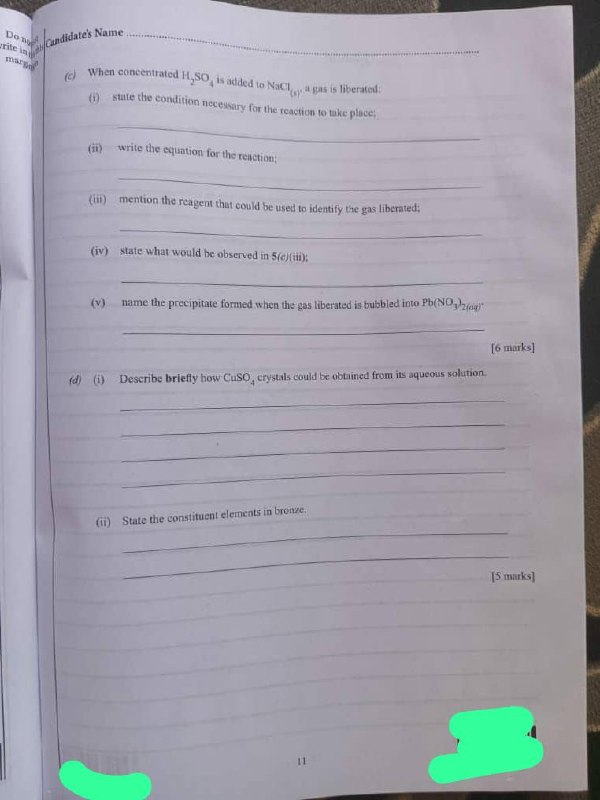
(5c)(i) Presence of Heat
(5c)(ii) H2SO4(conc.) + 2NaCl(s) → Na2SO4(aq) + 2HCl(g)
(5c)(iii) Ammonia (NH3) solution
(5c)(iv) White dense fumes are produced when ammonia is brought near the gas (HCl).
NH3(g) + HCl(g) → NH4Cl(s) (white fumes)
(5c)(v) Lead(II) chloride — PbCl2 (white precipitate)
(5d)(i) Heat/evaporate the aqueous CuSO4 solution to reduce the volume, then allow to cool so that CuSO4·5H2O crystals form. This process is called crystallization.
(5d)(ii) Composition of bronze:
- (i) Copper (Cu)
- (ii) Tin (Sn)

 Examsmooth
Leave a comment