
WAEC 2026 Geography Paper 3 Question Paper Images
Preview the original WAEC 2026 Geography Paper 3 (Physical & Practical Geography) question paper pages below before checking the answers.

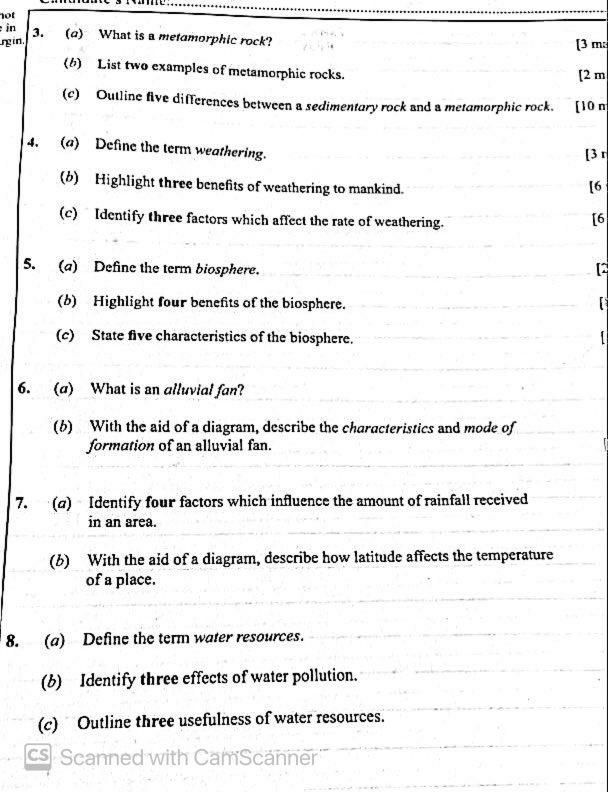
2026 WAEC Geography Paper 3 Questions and Answers (Physical & Practical Geography)
Verified solutions for WAEC 2026 Geography Paper 3 are being uploaded in real time. Keep refreshing this page for more updates and corrections.
Answers may be updated as more students submit feedback. Always cross-check with your school teacher or official WAEC marking scheme.
Question 3 – Metamorphic Rocks
(3a) A metamorphic rock is a rock that has been changed from its original form by intense heat, pressure, or chemical action within the Earth’s crust without melting completely.
(3b) Examples of metamorphic rocks:
- Marble
- Slate
(3c) Differences between sedimentary and metamorphic rocks (pick any five in the exam):
- Sedimentary rocks are formed by deposition, compaction, and cementation of sediments, while metamorphic rocks are formed when existing rocks are altered by heat and pressure.
- Sedimentary rocks usually contain fossils, while metamorphic rocks rarely contain fossils because the fossils are destroyed during metamorphism.
- Sedimentary rocks have distinct layers or strata, while metamorphic rocks have foliated bands or crystalline structures.
- Sedimentary rocks are generally softer, while metamorphic rocks are generally harder.
- Sedimentary rocks are formed at or near the Earth’s surface, while metamorphic rocks are formed deep within the Earth’s crust.
- Sedimentary rocks are less compact, while metamorphic rocks are more compact and dense.
- Sedimentary rocks include sandstone and limestone, while metamorphic rocks include marble and slate.
- Sedimentary rocks are less resistant to heat and pressure, while metamorphic rocks are more resistant to heat and pressure.
Question 4 – Weathering
(4a) Weathering is the gradual breakdown, disintegration, and decomposition of rocks at or near the Earth’s surface by physical, chemical, or biological processes.
(4b) Importance of weathering (pick any three in the exam):
- It helps in the formation of soil.
- It releases minerals needed for plant growth.
- It provides materials for construction such as sand and clay.
- It exposes valuable mineral deposits for mining.
- It aids agricultural activities through fertile soil formation.
- It contributes to the formation of landforms and scenic landscapes.
- It improves water infiltration and groundwater storage.
- It supplies raw materials for industries such as ceramics and brick making.
(4c) Factors affecting weathering (pick any three in the exam):
- Climate.
- Temperature changes.
- Rainfall amount.
- Nature and composition of rocks.
- Rock structure and degree of jointing.
- Vegetation cover.
- Relief or slope of the land.
- Human activities.
Question 5 – The Biosphere
(5a) The biosphere is the zone of the Earth where living organisms exist and interact with one another and with their physical environment, including the atmosphere, hydrosphere, and lithosphere.
(5b) Importance of the biosphere (pick any four in the exam):
- It provides habitat for living organisms.
- It supplies food for humans and animals.
- It provides raw materials for industries.
- It helps in maintaining ecological balance.
- It produces oxygen necessary for life.
- It regulates the carbon cycle and climate.
- It serves as a source of medicinal plants and drugs.
- It supports agriculture, forestry, and fishing activities.
(5c) Characteristics of the biosphere (pick any five in the exam):
- It is the zone where life exists on Earth.
- It contains a great variety of living organisms.
- It interacts with the atmosphere, hydrosphere, and lithosphere.
- It is dynamic in nature.
- It depends mainly on solar energy.
- It is characterized by interdependence among organisms.
- It has continuous nutrient cycling.
- It contains diverse ecosystems.
Question 6 – Alluvial Fan
(6a) An alluvial fan is a fan-shaped deposit of sediments such as sand, gravel, and silt formed when a river or stream flows from a steep slope onto a flat plain and loses its velocity, causing it to deposit its load.
(6b) Diagram requirement: Candidates are required to draw a neat, well-labelled diagram of an alluvial fan in the exam.
Characteristics of an alluvial fan:
- It is fan-shaped or cone-shaped in appearance.
- It is formed at the foot of a mountain or steep slope.
- It consists of deposited materials such as sand, gravel, pebbles, and silt.
- It has a gentle outward slope from the apex to the edges.
- The sediments are thickest near the apex and thinner towards the margins.
- It is usually crossed by several distributary channels.
Mode of formation of an alluvial fan:
- A river or stream flows down a steep mountain slope carrying large quantities of sediments.
- On reaching a flat plain or valley floor, the gradient suddenly decreases.
- The river loses velocity and transporting power.
- Coarse materials such as gravel and pebbles are deposited first near the mouth of the slope.
- Finer materials such as sand and silt are carried farther and deposited towards the outer edges.
- Repeated deposition over time causes the sediments to spread outward in a fan-like pattern, resulting in the formation of an alluvial fan.
Question 7 – Rainfall and Latitude
(7a) Factors influencing the amount of rainfall received by a place (pick any four in the exam):
- Relief or topography influences rainfall because mountains force moist air to rise, cool, and condense, resulting in rainfall.
- Distance from the sea affects rainfall because areas closer to the sea receive more moisture-laden winds and therefore more rainfall.
- Prevailing winds influence rainfall depending on whether they carry moisture from the ocean or dry air from the land.
- Latitude affects rainfall because different latitudinal zones receive varying amounts of heat and atmospheric moisture.
- Ocean currents influence rainfall as warm currents increase evaporation and rainfall, while cold currents reduce rainfall.
- Vegetation cover affects rainfall because plants release moisture into the atmosphere through transpiration.
- Atmospheric pressure systems influence rainfall since low-pressure areas encourage rising air and precipitation, while high-pressure areas discourage rainfall.
- Temperature affects rainfall because higher temperatures increase evaporation and the amount of moisture available in the atmosphere.
(7b) Diagram requirement: Candidates are required to draw a diagram showing the relationship between latitude and temperature.
Explanation of the relationship between latitude and temperature:
- Latitude is the angular distance of a place north or south of the Equator.
- Temperature generally decreases from the Equator towards the Poles.
- Places near the Equator receive the sun’s rays almost vertically throughout the year.
- Vertical rays are concentrated on a smaller surface area and therefore produce higher temperatures.
- As latitude increases, the sun’s rays strike the Earth at a more oblique angle.
- Oblique rays spread over a larger surface area and provide less heat per unit area.
- The rays also pass through a thicker layer of the atmosphere, causing more heat to be absorbed and scattered.
- Consequently, places in low latitudes experience higher temperatures.
- Places in middle latitudes experience moderate temperatures.
- Places in high latitudes experience low temperatures due to the highly slanting rays of the sun.
- Therefore, there is an inverse relationship between latitude and temperature: as latitude increases, temperature decreases.
Stay Updated – More WAEC Geography 2026 Answers Loading
Bookmark this page now and keep refreshing. We will continue to add more verified WAEC 2026 Geography Paper 3 answers and corrections as they are confirmed.
Share this page with your classmates and always confirm with your teacher and official WAEC materials before final submission.
 Examsmooth
Leave a comment