
WAEC 2026 Livestock Farming Practical Specimen Questions and Answers
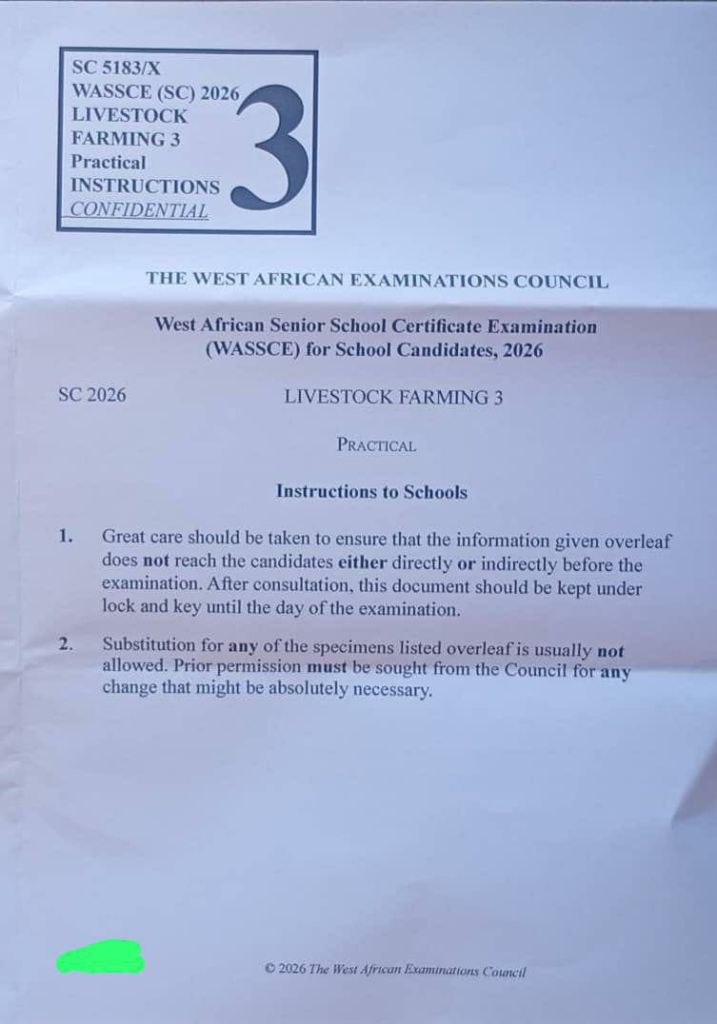
The WAEC 2026 Livestock Farming Practical is a very important paper for Nigerian students who want high scores in Agricultural Science. By studying likely WAEC Livestock Farming Practical specimen 2026 questions and answers in advance, you will understand the tools, organs and management practices you will meet in the exam hall.
This guide collects well-structured WAEC 2026 Livestock Practical answers to common specimen-based questions so you can revise faster and stay confident before the exam day.

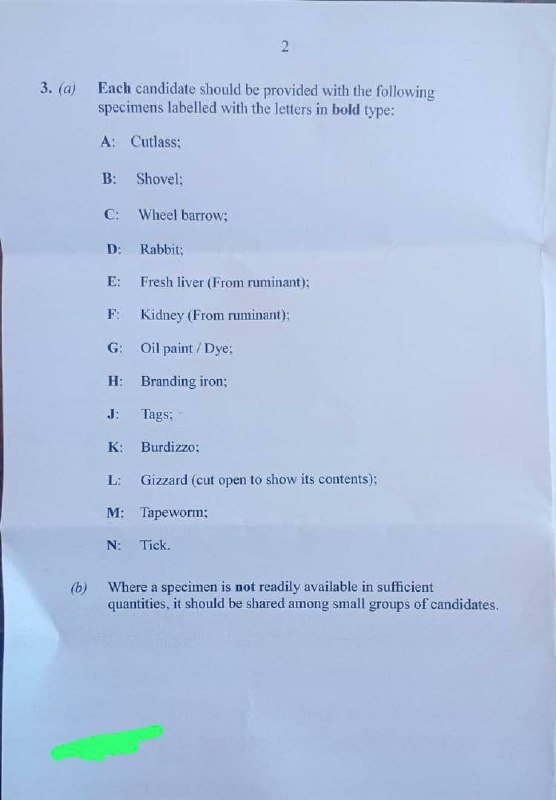
2026 WAEC LIVESTOCK FARMING PRACTICAL ANSWERS ✅
QUESTION 1
(a) Three uses each of Specimens A, B and C in animal husbandry:
A (Cutlass):
- Used for cutting forage/feed.
- Used for cutting ropes and sacks.
- Used for trimming animal parts/hair.
B (Shovel/Bucket):
- Used for carrying feed.
- Used for carrying water.
- Used for collecting farm products.
C (Rope/Halter):
- Used for restraining animals.
- Used for tying animals.
- Used for leading animals.
(b) One precaution when using Specimen A:
- Handle carefully to avoid injury/cuts.
(c) Five ways of maintaining Specimen C:
- Clean after use.
- Store in a dry place.
- Oil metal parts regularly.
- Repair worn-out parts promptly.
- Keep away from rain/moisture.
QUESTION 2
(a) Four benefits of raising Specimen D:
- Source of meat.
- Source of income.
- Provides manure.
- Source of employment.
(b) Three materials that can be used in providing housing for Specimen D:
- Wood.
- Wire mesh.
- Roofing sheets/thatch.
(c) Three functions each of Specimens E and F:
E:
- Digestion of food.
- Absorption of nutrients.
- Storage of food temporarily.
F:
- Removal of waste products.
- Regulation of water balance.
- Filtration of blood.
(d) Two other organs that perform similar function as Specimen F:
- Skin.
- Lungs.
QUESTION 3
(a) One common use of Specimens G, H and J:
- They are used for administering drugs/vaccines to animals.
(b) Two advantages each of using Specimens G, H and J:
G:
- Easy to use.
- Saves time.
H:
- Ensures accurate measurement.
- Reduces wastage of drugs.
J:
- Fast method of treatment.
- Helps prevent disease outbreak.
(c) One disadvantage each of using Specimens G, H and J:
G:
- Can injure animals if not properly used.
H:
- Expensive to maintain.
J:
- May transmit diseases if not sterilized.
(d)(i) One use of Specimen K:
- Used for identification of animals.
(d)(ii) Two advantages of using Specimen K on farm animals:
- Prevents theft/mixing of animals.
- Makes record keeping easy.
(d)(iii) Two disadvantages of using Specimen K on farm animals:
- Causes pain/injury.
- May lead to infection.
QUESTION 4
(a)(i) One primary host of Specimen M:
- Cattle.
(a)(ii) Two secondary hosts of Specimen M:
- Goat.
- Sheep.
(b)(i) Three effects of Specimen M in farm animals:
- Causes irritation.
- Causes loss of blood.
- Transmits diseases.
(b)(ii) Three effects of Specimen N in farm animals:
- Causes weakness.
- Reduces productivity.
- Causes weight loss.
(d) Three ways of controlling Specimens M and N in farm animal production:
M:
- Regular spraying with insecticides.
- Maintain clean environment.
- Isolate infected animals.
N:
- Deworm animals regularly.
- Proper sanitation.
- Avoid overcrowding.

 Examsmooth
Leave a comment