
*Economics OBJ Answer*⤵️
1-10: D E C E B E B C B D
11-20: C B C D E B E D E C
21-30: C A E E C D E B E E
31-40: A A A B C E C D C C
41-50: B A C D E B A D B D
51-60: E D E D C B C D B D
NECO 2025 ECONOMICS-ESSAY
(1a)
(i) Population of children = 162/360 × 140 = 63million
(ii) Population of old people = 108/360 × 140 = 42million
(iii) Active population = 90/360 × 140 = 35million
(iv) Dependent population = Population of children + Population of old people = 63,000,000 + 42,000,000
= 105,000,000
= 105million
(1b)
(i) The demand for goods and services required by the youths and old ones because they form the large percentage of the population
(ii) If the items required by the young and old ones are not produced locally, there will be increased importation and resultant strain in the balance of payment
(iii) Low level of savings and investment because of the high dependency ratio
(iv) Increased taxation and borrowing by government to meet increased demand for consumable items because the taxable population is small
(v) High prospective labour force because if the large proportion of young ones
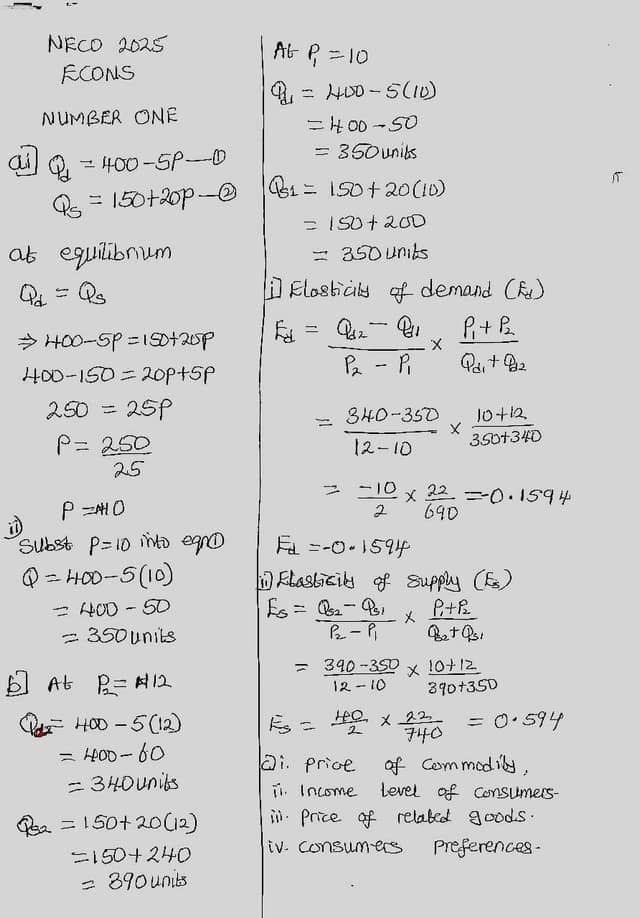
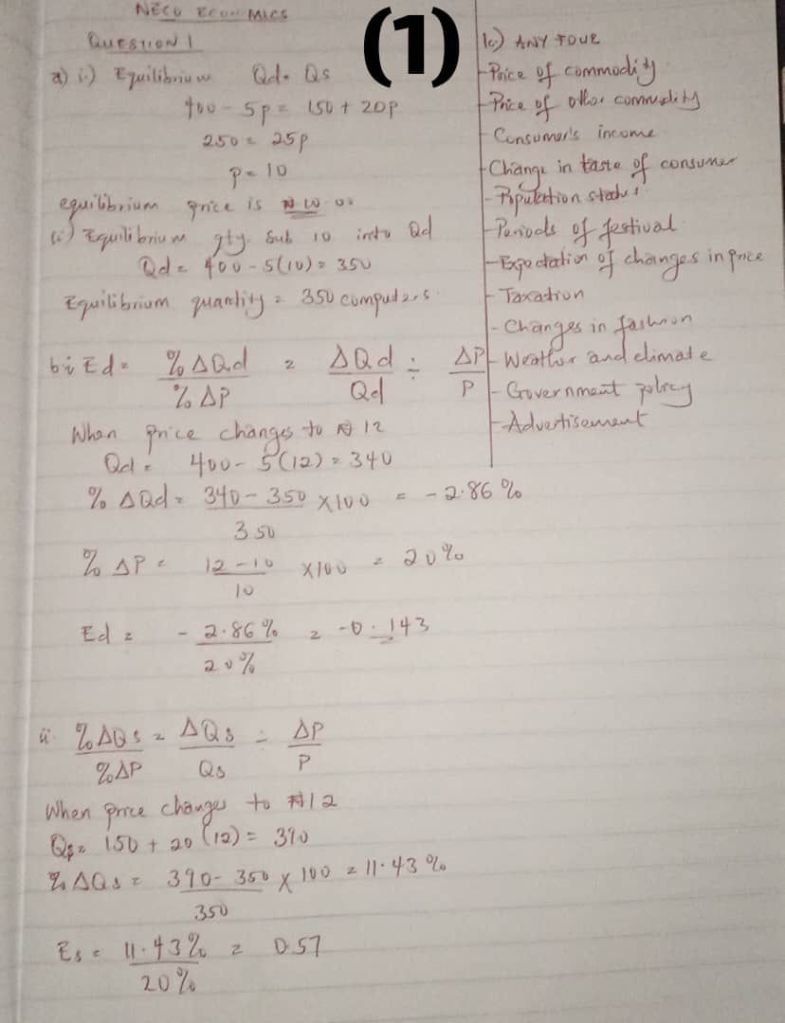
*Question 1*
from the Economics Paper II:
Given:
*Demand function:*
Qd = 400 – 5P
*Supply function:*
Qs = 150 + 20P
—
(a) i. *Equilibrium Price* occurs when *Qd = Qs*
So,
400 – 5P = 150 + 20P
⇒ 400 – 150 = 5P + 20P
⇒ 250 = 25P
⇒ *P = 10*
—
(a) ii. *Equilibrium Quantity*:
Substitute *P = 10* into either Qd or Qs:
Qd = 400 – 5(10) = 400 – 50 = *350*
Or
Qs = 150 + 20(10) = 150 + 200 = *350*
So, *Equilibrium Quantity = 350 units*
—
(b) If *P = 12*, calculate:
i. *Elasticity of Demand (Ed)*
Formula:
*Ed = (dQ/dP) × (P/Q)*
From Qd = 400 – 5P,
dQ/dP = -5
Use P = 12:
Qd = 400 – 5(12) = 400 – 60 = 340
Now:
Ed = (–5) × (12 / 340) = –60 / 340 = *–0.176 (in magnitude: 0.18)*
ii. *Elasticity of Supply (Es)*
From Qs = 150 + 20P
dQ/dP = 20
Qs = 150 + 20(12) = 150 + 240 = 390
Es = 20 × (12 / 390) = 240 / 390 = *0.615*
—
(c) Four factors that affect demand:
1. Price of the good
2. Consumer income
3. Prices of related goods (substitutes/complements)
4. Consumer preferences
5. Population size
6. Future expectations of price (any 4 accepted)
*ECONOMICS ANSWER NUMBER 4*
(4)
(Pick Any FIVE)
(i) Production: The study of economics assists us to determine what to produce, when to produce , factors of production and how to produce goods and services required to satisfy human wants.The technique for solving those problems come within the framework of the Economics discipline.
(ii) Satisfaction of wants: The study of economics helps us to utilise the principles of choice, opportunity cost ,scale of preference etc inorder to satisfy human wants. Study of economics becomes more of a practical necessity and a moral obligation since economics issues and problems touch upon the daily lives of all human being.
(iii) Rational decision: A study o Economics enables the individual to contribute his quota towards increasing the well being of society. Economics enables the individuals to choose certain wants among the numerous needs using scare resources
(iv) Provision of tools: The study of economics provides basic tools for analysing economic problems among individuals,firms and government.It helps the individual to build up a body of economics principles and equips him with the tools of economic analysis which will enable him to understand current issues and problems confronting society.
(v) Development of programmes and planning: Study of Economics enables the government to develop certain programmes that are beneficial to the people. Economics assists planners in planning for development. They are able to out into practice, those techniques and principles learnt in economics, which would help to accelerate economic development.
(vi) maximisation of profits: Economics enables traders and businessmen to maximise their profit using economic principles in their business. It enables them to understand and learn marketing strategies which would helps the producer to maximise profits with minimum social costs to the society.
: *ECONOMICS ANSWER NUMBER 7*
(7a)
Co-operative society is defined as a voluntary business organisation in which a group of individuals with common interests pool their resources together to promote the economic welfare of their members in the production, distribution and consumption of goods and services.
(7b)
(i) Production co-operative society:
Producers co-operative society is formed by producers of similar products who organise co-operative production and undertake joint marketing of their products on a wholesale or retail basis. They share useful information among members.
(ii) Consumers co-operative society: Consumers co-operative society is owned and operated by a group of ultimate consumers who pool their resources together to purchase goods and services in large quantities and distribute them mainly to its members. The operating policies used are open membership, democratic control, limited interest paid on capital invested, and proportinate dividends based on their level of purchases or patronage.
(iii) Wholesale co-operative society: Wholesale co-operative society is formed by small-scale wholesalers who purchase goods in bulk from the manufacturers at reasonable prices and sell in small quantities to retail co-operatives. They can raise large sums of money to finance wholesale purchases when they come together. As an entity, they have the better bargaining power to purchase in bulk from the manufacturers.











(11a)
(PICK ANY TWO)
(i) A budget deficit occurs when government spending is more than revenue, while a budget surplus occurs when government revenue is more than spending.
(ii) Budget deficit leads to borrowing or debt accumulation, while budget surplus results in savings or reserve buildup.
(iii) Budget deficit may lead to inflation due to excessive government spending, while budget surplus may help control inflation.
(iv) Budget deficit may indicate poor financial management, while budget surplus may show fiscal discipline.
(v) Budget deficit is often associated with developing economies, while surplus is more common in developed or well-managed economies.
(vi) A budget deficit may reduce investor confidence, while a surplus may boost investor confidence.
(11b)
(PICK ANY FOUR)
(i) Mobilization of Capital: The stock exchange provides a platform where businesses and governments can raise long-term capital by issuing shares and bonds to investors.
(ii) Liquidity of Investments: It enables investors to convert their shares or securities into cash quickly, promoting flexibility and access to funds when needed.
(iii) Determination of Share Prices: The stock exchange helps determine the value of securities through the forces of demand and supply, providing fair and transparent pricing.
(iv) Encouragement of Savings and Investment: It encourages the public to save and invest in securities rather than keeping money idle, thus fostering economic growth.
(v) Economic Indicator: The stock exchange serves as a barometer of economic performance, reflecting changes in economic activities and investor confidence.
(vi) Risk Reduction through Diversification: It offers various investment opportunities which allow investors to spread their risk across multiple sectors and companies.
(vii) Facilitation of Mergers and Acquisitions: Companies use the stock market to raise capital or acquire other firms, promoting expansion and restructuring of businesses.
(viii) Regulation and Protection of Investors: The stock exchange operates under strict rules to ensure transparency, prevent fraud, and protect the interest of investors.
===============================
(12)
(PICK ANY FIVE)
(i) Improve Salary and Welfare Packages: One of the major reasons professionals leave Nigeria is poor remuneration. The government should provide competitive salaries, allowances, and welfare packages that match international standards, especially for doctors, engineers, and lecturers.
(ii) Upgrade Infrastructure and Work Environment: Lack of modern equipment, power supply, and good office conditions often frustrate professionals. Upgrading hospitals, research labs, universities, and ICT systems will motivate skilled workers to remain and contribute locally.
(iii) Create More Job Opportunities: Many skilled Nigerians leave the country due to unemployment or underemployment. The government should promote job creation through industrialization, support for SMEs, and strategic investment in key sectors like tech, agriculture, and health.
(iv) Promote Political Stability and Good Governance: Political instability, corruption, and insecurity make people lose faith in the system. By ensuring good governance, transparency, and justice, citizens will feel safer and more motivated to remain in the country.
(v) Encourage Diaspora Return Programs: Introduce attractive policies to encourage Nigerians abroad to return home, such as tax breaks, startup grants, and resettlement support. Countries like India and China have successfully used this model.
(vi) Invest in Quality Education and Research: When universities are properly funded, lecturers paid on time, and academic strikes ended, professionals will be encouraged to stay and build careers in Nigeria.
(vii) Recognize and Reward Excellence: Introduce national recognition and reward systems for top-performing professionals in every field. Celebrating achievements boosts morale and reduces the urge to migrate.
(viii) Partner with the Private Sector: The government should work with companies to develop innovation hubs, internship programs, and mentorship schemes that retain young talents within the country.
(ix) Tackle Insecurity: Widespread insecurity drives professionals to seek safer environments abroad. Strengthening national security and law enforcement will make Nigeria a more attractive place to live and work.
(10a)
Localisation in industries refers to the concentration or grouping of similar or related industries in a particular geographical area or location. This happens when firms within the same industry choose to set up their operations close to each other in order to benefit from shared resources, infrastructure, labour, and markets.
(10b)
=Advantages=
(PICK ANY THREE)
(i) Availability of Skilled Labour: Firms enjoy access to a pool of trained and experienced workers who specialize in that particular industry.
(ii) Development of Ancillary Services: Support industries like transportation, maintenance, packaging, and finance are likely to grow around the area, improving efficiency.
(iii) Shared Infrastructure: Industries in the same location can share roads, electricity, water supply, and communication facilities, reducing individual costs.
(iv) Quick Access to Raw Materials and Suppliers: Localisation encourages suppliers to establish close to production centers, ensuring steady and cheap supply of raw materials.
(v) Knowledge and Innovation Sharing: Firms benefit from the free flow of ideas, technical know-how, and innovation when clustered together.
(vi) Market Expansion: A large concentration of industries attracts more buyers and sellers, creating a robust and ready market for goods and services.
=Disadvantages=
(PICK ANY TWO)
(i) Environmental Pollution: Concentration of industries in one area can lead to excessive pollution of air, water, and land.
(ii) High Competition: Too many firms in one place can lead to over-saturation of the market, reducing profits and survival chances for smaller firms.
(iii) Pressure on Infrastructure: Overpopulation of industries can strain local infrastructure like roads, housing, electricity, and water supply.
(iv) Risk of Regional Imbalance: Other regions may be neglected in terms of development, leading to inequality and underdevelopment elsewhere.
(v) Labour Exploitation: High demand for labour may lead to low wages or exploitation if regulations are not enforced.
(vi) Vulnerability to Disasters: If the area faces natural or man-made disasters (like flood, fire, or economic crash), all industries clustered there may collapse together.
(9a)
Debt servicing is the process by which a country makes regular payments to settle the interest and repay the principal amount borrowed through loans. These loans can be internal (borrowed within the country) or external (borrowed from foreign countries or international financial institutions like the IMF or World Bank). Failure to service debts on time can lead to loss of creditworthiness and reduced access to future funding.
(9b)
Gross National Product (GNP) is the total market value of all final goods and services produced in a given year by the nationals of a country, regardless of whether the production occurs within the country or abroad. It includes income earned by citizens and businesses abroad but excludes income earned by foreigners within the country.
(9c)
Disinflation refers to a decrease in the rate of inflation over time. It means that while prices are still rising, they are increasing at a slower rate than before. It is often a sign of effective economic policies aiming to stabilize the economy and control inflation. Disinflation should not be confused with deflation, which is an actual fall in the general price level.
(9d)
A surplus budget occurs when a government’s revenue exceeds its expenditure within a specific budget year. This means the government is earning more money than it spends on services, salaries, infrastructure, and other public needs. A surplus budget can be used to pay off national debt, build reserves, or invest in developmental projects.
(9e)
Poverty alleviation refers to all efforts made by the government or non-governmental organizations (NGOs) to reduce or eliminate poverty in a society. These efforts may include creating job opportunities, providing free or subsidized education and health care, giving grants or loans to small businesses, and running social welfare programs. The goal is to improve the standard of living and ensure equal opportunities for all citizens.
=================================
(7a)
Balance of Payments (BOP) is a record that shows the total economic transactions between one country and the rest of the world over a specific period of time. It includes trade in goods and services, investments, and financial transfers
(7b)
(PICK ANY FIVE)
(i) Export Promotion: Government can encourage and support the production and export of local goods by giving incentives to exporters, reducing export duties, and improving infrastructure.
(ii) Import Restriction: Restricting the importation of non-essential goods through higher tariffs, import quotas, or outright bans can help reduce foreign exchange spending.
(iii) Currency Devaluation: Reducing the value of a country’s currency makes imports more expensive and exports cheaper, which can boost exports and reduce imports.
(iv) Foreign Loans and Aid: A country can seek financial assistance from international organizations or friendly nations to support its balance of payments position temporarily.
(v) Tourism Promotion: Encouraging tourism can help earn more foreign exchange as foreign tourists bring in money that boosts the country’s reserves.
(vi) Increase in Foreign Investment: Attracting foreign investors to invest in local businesses and industries can bring foreign exchange into the country.
(vii) Encouraging Remittances: The government can create incentives for citizens working abroad to send money home through official channels.
(viii) Import Substitution: Producing locally what is normally imported can help save foreign exchange and reduce dependence on foreign goods.
====================================
(6)
(PICK ANY FIVE)
(i) Provision of Basic Infrastructure: The government can promote industrialisation by building essential infrastructure such as electricity, good road networks, water supply, railways, and telecommunication systems. These are vital for transporting raw materials and finished goods, reducing costs, and making industries more efficient and competitive.
(ii) Access to Low-Interest Loans and Credit: Industries, especially small and medium enterprises (SMEs), often lack the capital to expand or upgrade. Government can encourage industrialisation by providing accessible and affordable loans through banks or special financial institutions. Grants and soft loans will reduce startup challenges for new industries.
(iii) Establishment of Industrial Layouts and Free Trade Zones: The government can create special areas like industrial estates, free trade zones, and export processing zones with ready infrastructure and tax incentives. These zones reduce overhead costs and encourage local and foreign investors to set up industries.
(iv) Investment in Technical Education and Vocational Training: A skilled workforce is key to industrial growth. Government can invest in polytechnics, technical schools, and training centres to equip citizens with practical and industrial skills needed by manufacturers and industries.
(v) Protection of Local/Infant Industries: To support new industries, the government can place tariffs on imported goods, offer subsidies, or introduce import bans on products that can be made locally. This protects young industries from foreign competition until they grow stronger.
(vi) Implementation of Friendly Industrial Policies: Government can introduce favourable laws and regulations such as tax holidays, reduced company taxes, and import duty waivers. These policies reduce the burden on industries and encourage private sector participation in industrial growth.
(vii) Encouragement of Local Raw Material Development: Industrialisation depends on raw materials. Government can encourage agriculture and mining sectors to produce and supply raw materials locally. This reduces dependence on imports and cuts production costs.
(viii) Security and Political Stability: No industry can grow in an unsafe environment. By ensuring peace, security, and stable political leadership, the government creates an enabling environment where investors feel confident to build and grow industries
(4a)
(PICK ANY TWO)
(i) In capitalism, individuals own and control the means of production, while in socialism, the government owns and controls them.
(ii) Capitalism encourages competition, while socialism promotes cooperation and collective interest.
(iii) The profit motive drives capitalism, while socialism focuses on public welfare and equality.
(iv) Prices are determined by demand and supply in capitalism, while in socialism, prices are fixed by the government.
(v) Capitalism supports private ownership of property, while socialism discourages or limits private ownership.
(vi) Capitalism often leads to income inequality, while socialism aims to reduce the gap between the rich and the poor.
(4b)
(i) Private Ownership of Resources: In a free market economy, individuals and private businesses have the right to own and control the factors of production such as land, capital, and enterprises. The government plays little or no role in controlling property. Owners are free to use their resources as they choose, which encourages personal initiative and investment.
(ii) Price Determined by Demand and Supply: Prices of goods and services are not set by the government but are determined by the interaction of demand and supply in the market. When demand is high and supply is low, prices go up; when supply is high and demand is low, prices fall. This system ensures that goods are allocated efficiently based on market forces.
(4c)
(PICK ANY FOUR)
(i) Lack of incentive to work hard due to equal reward system.
(ii) Government may mismanage resources.
(iii) Bureaucracy can delay decision-making.
(iv) Limited consumer choice due to government control.
(v) High taxation to fund social programs.
(vi) Innovation may be discouraged due to lack of competition.
(3a)
(i) Transaction Motive: This is the need to hold money for day-to-day expenses such as buying food, transport, and paying bills. Individuals and businesses keep money to carry out regular transactions.
(ii) Precautionary Motive: This is the need to keep money aside for unforeseen situations like emergencies, sickness, accidents, or unexpected expenses. People hold money “just in case.”
(iii) Speculative Motive: This is the desire to hold money to take advantage of future investment opportunities. For example, if interest rates are expected to rise or prices of bonds are expected to fall, people may hold cash and wait.
(3b)
(PICK ANY FOUR)
(i) Loss of Investment Opportunity: Keeping too much cash means missing out on potential profits that could come from investing in productive ventures.
(ii) Reduction in Wealth Value: Inflation reduces the purchasing power of money. Over time, the same amount of cash buys fewer goods.
(iii) Increased Temptation to Spend: People who hold a lot of cash are more likely to spend carelessly on non-essentials.
(iv) Lack of Capital for Growth: Businesses holding excess cash may fail to expand, buy machines, or enter new markets, which limits growth.
(v) Opportunity Cost: Money not invested elsewhere is a lost opportunity to earn better returns from assets like shares or real estate.
(vi) Security Risk: Holding large amounts of cash increases the risk of theft, loss, or fire damage.
(vii) Lower Returns Compared to Investments: Cash earns less than bonds, stocks, or savings accounts. So it’s not profitable in the long run.
(viii) Slows Economic Activity: If too many people hoard cash, money doesn’t circulate in the economy. This can reduce demand and economic growth.
*NECO ECONOMICS ANSWERS*
*NUMBER THREE*
(3a)
(i) Transaction Motive: This is the need to hold money for day-to-day expenses such as buying food, transport, and paying bills. Individuals and businesses keep money to carry out regular transactions.
(ii) Precautionary Motive: This is the need to keep money aside for unforeseen situations like emergencies, sickness, accidents, or unexpected expenses. People hold money “just in case.”
(iii) Speculative Motive: This is the desire to hold money to take advantage of future investment opportunities. For example, if interest rates are expected to rise or prices of bonds are expected to fall, people may hold cash and wait.
(3b)
(PICK ANY FOUR)
(i) Loss of Investment Opportunity: Keeping too much cash means missing out on potential profits that could come from investing in productive ventures.
(ii) Reduction in Wealth Value: Inflation reduces the purchasing power of money. Over time, the same amount of cash buys fewer goods.
(iii) Increased Temptation to Spend: People who hold a lot of cash are more likely to spend carelessly on non-essentials.
(iv) Lack of Capital for Growth: Businesses holding excess cash may fail to expand, buy machines, or enter new markets, which limits growth.
(v) Opportunity Cost: Money not invested elsewhere is a lost opportunity to earn better returns from assets like shares or real estate.
(vi) Security Risk: Holding large amounts of cash increases the risk of theft, loss, or fire damage.
(vii) Lower Returns Compared to Investments: Cash earns less than bonds, stocks, or savings accounts. So it’s not profitable in the long run.
(viii) Slows Economic Activity: If too many people hoard cash, money doesn’t circulate in the economy. This can reduce demand and economic growth.
*NECO ECONOMICS ANSWERS*
*NUMBER SEVEN*
(7a)
Balance of Payments (BOP) is a record that shows the total economic transactions between one country and the rest of the world over a specific period of time. It includes trade in goods and services, investments, and financial transfers
(7b)
(PICK ANY FIVE)
(i) Export Promotion: Government can encourage and support the production and export of local goods by giving incentives to exporters, reducing export duties, and improving infrastructure.
(ii) Import Restriction: Restricting the importation of non-essential goods through higher tariffs, import quotas, or outright bans can help reduce foreign exchange spending.
(iii) Currency Devaluation: Reducing the value of a country’s currency makes imports more expensive and exports cheaper, which can boost exports and reduce imports.
(iv) Foreign Loans and Aid: A country can seek financial assistance from international organizations or friendly nations to support its balance of payments position temporarily.
(v) Tourism Promotion: Encouraging tourism can help earn more foreign exchange as foreign tourists bring in money that boosts the country’s reserves.
(vi) Increase in Foreign Investment: Attracting foreign investors to invest in local businesses and industries can bring foreign exchange into the country.
(vii) Encouraging Remittances: The government can create incentives for citizens working abroad to send money home through official channels.
(viii) Import Substitution: Producing locally what is normally imported can help save foreign exchange and reduce dependence on foreign goods.
*NECO ECONOMICS ANSWERS*
*NUMBER SIX*
(6)
(PICK ANY FIVE)
(i) Provision of Basic Infrastructure: The government can promote industrialisation by building essential infrastructure such as electricity, good road networks, water supply, railways, and telecommunication systems. These are vital for transporting raw materials and finished goods, reducing costs, and making industries more efficient and competitive.
(ii) Access to Low-Interest Loans and Credit: Industries, especially small and medium enterprises (SMEs), often lack the capital to expand or upgrade. Government can encourage industrialisation by providing accessible and affordable loans through banks or special financial institutions. Grants and soft loans will reduce startup challenges for new industries.
(iii) Establishment of Industrial Layouts and Free Trade Zones: The government can create special areas like industrial estates, free trade zones, and export processing zones with ready infrastructure and tax incentives. These zones reduce overhead costs and encourage local and foreign investors to set up industries.
(iv) Investment in Technical Education and Vocational Training: A skilled workforce is key to industrial growth. Government can invest in polytechnics, technical schools, and training centres to equip citizens with practical and industrial skills needed by manufacturers and industries.
(v) Protection of Local/Infant Industries: To support new industries, the government can place tariffs on imported goods, offer subsidies, or introduce import bans on products that can be made locally. This protects young industries from foreign competition until they grow stronger.
(vi) Implementation of Friendly Industrial Policies: Government can introduce favourable laws and regulations such as tax holidays, reduced company taxes, and import duty waivers. These policies reduce the burden on industries and encourage private sector participation in industrial growth.
(vii) Encouragement of Local Raw Material Development: Industrialisation depends on raw materials. Government can encourage agriculture and mining sectors to produce and supply raw materials locally. This reduces dependence on imports and cuts production costs.
(viii) Security and Political Stability: No industry can grow in an unsafe environment. By ensuring peace, security, and stable political leadership, the government creates an enabling environment where investors feel confident to build and grow industries.
*NECO ECONOMICS ANSWERS*
*NUMBER TWELVE*
(12)
(PICK ANY FIVE)
(i) Improve Salary and Welfare Packages: One of the major reasons professionals leave Nigeria is poor remuneration. The government should provide competitive salaries, allowances, and welfare packages that match international standards, especially for doctors, engineers, and lecturers.
(ii) Upgrade Infrastructure and Work Environment: Lack of modern equipment, power supply, and good office conditions often frustrate professionals. Upgrading hospitals, research labs, universities, and ICT systems will motivate skilled workers to remain and contribute locally.
(iii) Create More Job Opportunities: Many skilled Nigerians leave the country due to unemployment or underemployment. The government should promote job creation through industrialization, support for SMEs, and strategic investment in key sectors like tech, agriculture, and health.
(iv) Promote Political Stability and Good Governance: Political instability, corruption, and insecurity make people lose faith in the system. By ensuring good governance, transparency, and justice, citizens will feel safer and more motivated to remain in the country.
(v) Encourage Diaspora Return Programs: Introduce attractive policies to encourage Nigerians abroad to return home, such as tax breaks, startup grants, and resettlement support. Countries like India and China have successfully used this model.
(vi) Invest in Quality Education and Research: When universities are properly funded, lecturers paid on time, and academic strikes ended, professionals will be encouraged to stay and build careers in Nigeria.
(vii) Recognize and Reward Excellence: Introduce national recognition and reward systems for top-performing professionals in every field. Celebrating achievements boosts morale and reduces the urge to migrate.
(viii) Partner with the Private Sector: The government should work with companies to develop innovation hubs, internship programs, and mentorship schemes that retain young talents within the country.
(ix) Tackle Insecurity: Widespread insecurity drives professionals to seek safer environments abroad. Strengthening national security and law enforcement will make Nigeria a more attractive place to live and work.
===================================
COMPLETED
 Examsmooth
Leave a comment