
NECO 2026 Chemistry Exam Answers
Official-style objective and theory answer sheet for NECO 2026 Chemistry. All answers are clearly numbered and laid out in standard examination format.
OBJECTIVE TEST (OBJ) ANSWERS
- 01 – 10: C B A D D B A C E E
- 11 – 20: D D C D B C D A E B
- 21 – 30: B E E D A D C E E D
- 31 – 40: B B B C B B C D C E
- 41 – 50: D E E A A A E A C C
- 51 – 60: A C C D E B C C D D
QUESTION 1
(1a)
(1ai) Physical and Chemical Changes
- (i) Dissolution of salt in water — Physical change
- (ii) Burning of paper — Chemical change
- (iii) Magnetization of iron — Physical change
- (iv) Rusting of iron — Chemical change
(1aii) Reason Mercury Is Liquid at Room Temperature
Mercury is a liquid at room temperature because the metallic bonds between its atoms are relatively weak, so the attractive forces are not strong enough to hold the atoms in a rigid, closely packed solid lattice at room temperature.
(1b)
(1bi) Calculation of Relative Molecular Mass (Mr)
- I. Calcium hydroxide, Ca(OH)2
Ca = 40, O = 16, H = 1
Mr = 40 + 2(16 + 1) = 40 + 34 = 74 - II. Lead(II) trioxonitrate(V), Pb(NO3)2
Pb = 207, N = 14, O = 16
Mr = 207 + 2(14 + 3 × 16) = 207 + 2(62) = 207 + 124 = 331
(1bii) Definition of Isotopy
Isotopy is the existence of atoms of the same element which have the same atomic number but different mass numbers.
(1biii) Related Elements and Compound
- (i) The pair of species that are isotopic: 3E and 9F
- (ii) Compound formed: Lithium fluoride (LiF)
(1c)
(1ci) Statement of Charles’ Law
Charles’ law states that the volume of a fixed mass of gas is directly proportional to its absolute temperature, provided the pressure remains constant.
(1cii) Gas Volume at STP
Given: V1 = 15 cm3, P1 = 7.50 × 10⁴ N m−2, T1 = 50 °C = 323 K.
At STP: P2 = 1.0 × 10⁵ N m−2, T2 = 273 K.
Using the combined gas law:
P1V1/T1 = P2V2/T2
V2 = (P1 × V1 × T2) / (P2 × T1)
V2 = (7.50 × 104 × 15 × 273) ÷ (1.0 × 105 × 323)
V2 ≈ 9.5 cm3
∴ The volume of the gas at STP is 9.5 cm3.
(1d)
(1di) Kinetic Theory – Observable Phenomena (Any Two)
- Diffusion of gases
- Brownian motion
- Expansion of gases on heating
- Gas pressure due to continuous molecular collisions
- Compression of gases
- Effusion of gases through a tiny hole
- Random (continuous) motion of gas molecules
(1dii) Definition of Ionisation Energy
Ionisation energy is the minimum amount of energy required to remove one electron from one mole of gaseous atoms to form one mole of gaseous positive ions.
(1diii) Trends in Periodic Properties
- Atomic radius: Increases down a group; decreases across a period.
- Electron affinity: Generally decreases down a group; increases across a period.
- Electronegativity: Decreases down a group; increases across a period.
QUESTION 2
(2a)
(2ai) Ores of Iron (Any Two)
- Haematite (Fe2O3)
- Magnetite (Fe3O4)
- Limonite (Fe2O3·3H2O)
- Siderite (FeCO3)
- Goethite (FeO(OH))
(2aii) Harmful Effects of Iron/Steel Corrosion (Any Three)
- Environmental pollution
- Air pollution
- Water pollution
- Soil contamination
- Skin irritation and burns
- Poisoning
- Respiratory diseases
- Death when improperly handled
- Damage to plants and animals
(2b)
(2bi) Reactivity of Group I Metals
Reactivity order of the Group I metals considered is:
Li > Na > K.
(2bii) Rules Governing Electron Configuration
- Electrons occupy the lowest energy level first (Aufbau principle).
- The maximum number of electrons in a shell is given by 2n2.
- Orbitals of the same energy are singly occupied before pairing occurs (Hund’s rule).
(2c)
(2ci) Oxidizing and Reducing Agents
- Oxidizing agent: A substance that accepts electrons and causes another substance to be oxidized.
- Reducing agent: A substance that donates electrons and causes another substance to be reduced.
(2cii) Dissociation of Electrolytes
- (i) KOH → K+ + OH−
- (ii) Pb(NO3)2 → Pb2+ + 2NO3−
- (iii) Na2CO3 → 2Na+ + CO32−
(2d)
(2di) Anode and Cathode in Electrolysis
- Anode: The electrode at which oxidation occurs; ions or atoms lose electrons at the anode.
- Cathode: The electrode at which reduction occurs; ions gain electrons at the cathode.
(2dii) Volume of Hydrogen Produced at STP
Given: Current, I = 1.0 A; time, t = 15 min = 900 s; Faraday constant, F = 96,500 C mol−1; molar volume at STP = 22.4 dm3.
- Charge passed: Q = It = 1.0 × 900 = 900 C
- Moles of electrons: = 900 ÷ 96,500 = 9.33 × 10⁻³ mol
- From 2H+ + 2e− → H2, 2 mol e− produce 1 mol H2
- Moles of H2 = (9.33 × 10⁻³) ÷ 2 = 4.66 × 10⁻³ mol
- Volume of H2 at STP = 4.66 × 10−3 × 22.4 = 0.104 dm3
∴ Volume of hydrogen gas produced at STP = 0.104 dm3.
QUESTION 3
(3a) Laboratory Preparation of Oxygen
(3b)
(3bi) Endothermic and Exothermic Reactions (Any One Clear Difference)
- Endothermic reactions absorb heat from the surroundings, whereas exothermic reactions release heat to the surroundings.
- Endothermic reactions have a positive enthalpy change (ΔH > 0), whereas exothermic reactions have a negative enthalpy change (ΔH < 0).
- Endothermic reactions make the surroundings colder, whereas exothermic reactions make the surroundings warmer.
- Endothermic reactions generally require a continuous supply of energy, whereas exothermic reactions give out energy once the reaction starts.
- In endothermic reactions, the products have higher energy than the reactants, whereas in exothermic reactions the products have lower energy than the reactants.
(3bii) Le Chatelier’s Principle
Le Chatelier’s principle states that when a system in equilibrium is disturbed by a change in concentration, temperature, or pressure, the equilibrium shifts in a direction that opposes the change in order to re-establish a new equilibrium.
(3biii) Factors Affecting the Position of Equilibrium (Any Three)
- Change in concentration of reactants or products
- Change in temperature
- Change in pressure (for gaseous systems)
- Change in volume (for gaseous equilibria)
- Removal of a reactant
- Removal of a product
- Addition of an inert gas (in some constant-pressure gaseous systems)
- Presence of a catalyst (affects rate of attainment of equilibrium but not its position)
(3c) Solutions and Calculations
(3ci) Definitions
- Saturated solution: A solution that contains the maximum amount of solute that can dissolve in a given amount of solvent at a particular temperature.
- Molar solution: A solution that contains one mole of solute dissolved in one cubic decimetre (1 dm3) of solution.
(3cii) Mass of Sodium Trioxocarbonate(IV) Required
Given: Volume of solution = 250 cm3 = 0.250 dm3; concentration = 0.20 mol dm−3.
- Molar mass of Na2CO3 = (2 × 23) + 12 + (3 × 16) = 46 + 12 + 48 = 106 g mol−1
- Moles of solute, n = C × V = 0.20 × 0.250 = 0.050 mol
- Mass required = n × molar mass = 0.050 × 106 = 5.3 g
∴ Mass of sodium trioxocarbonate(IV) required = 5.3 g.
(3d)
(3di)
- I. Type of chromatography: Paper chromatography
- II. Number of components in the mixture: 4 components
- III. Material used: Chromatography paper (filter paper)
- IV. The part labelled IV in the diagram: The solvent front
(3dii)
- I: Filtration
- II: Crystallization
QUESTION 4
(4a)
(4ai) Buffer Solution
A buffer solution is a solution that resists changes in pH when small amounts of acid or alkali are added to it or when it is diluted.
(4aii) Uses of Buffer Solution (Any Two)
- Used to maintain constant pH in chemical reactions.
- Used in pharmaceutical preparations.
- Used in medical and clinical laboratories.
- Used in biological processes and enzyme reactions.
- Used in the calibration of pH meters.
- Used in analytical chemistry during titrations.
- Used in manufacture of cosmetics and food products.
(4b)
(4bi) Industrial Process
Haber process.
(4bii) Properties of Nitrogen (Any Two)
- It is a colourless gas.
- It is odourless.
- It is tasteless.
- It is slightly soluble (almost insoluble) in water.
- It is less dense than air.
- It is a diatomic gas (N2).
- It has a low boiling point.
(4biii) Allotropes of Carbon
- Diamond.
- Graphite.
(4biv) Crystal Structures
- Diamond: Giant three-dimensional tetrahedral covalent structure.
- Graphite: Giant layered hexagonal covalent structure.
(4bv) Uses of Carbon (Any One)
- Used as a fuel.
- Used for water purification.
- Used in gas masks to absorb poisonous gases.
- Used as a decolourising agent in the sugar industry.
- Used for removing bad odours.
- Used in manufacture of gunpowder.
(4c)
(4ci) General Formulae
- Alkenes: CnH2n.
- Alkynes: CnH2n-2.
(4cii) Structural Formulae
- CH3–CH2–CH2–CH3.
- CH3–CH(CH3)–CH3.
(4ciii) IUPAC Names
- Butane.
- 2-Methylpropane.
(4civ) Empirical and Molecular Formula
Given: C = 66%, H = 13.3%, O = 20.7%, molar mass = 60.
- Moles: C = 66/12 = 5.5, H = 13.3/1 = 13.3, O = 20.7/16 = 1.29.
- Divide by smallest (1.29): C ≈ 4, H ≈ 10, O = 1.
- Empirical formula = C4H10O.
- Empirical formula mass = (4 × 12) + (10 × 1) + 16 = 74.
- Molecular formula = C4H10O.
QUESTION 5
(5a)
(5ai) Octane Rating
Octane rating is the measure of the ability of petrol (gasoline) to resist knocking or premature ignition in an internal combustion engine.
(5aii) Differences Between Cracking and Reforming (Any Two)
- Cracking breaks large hydrocarbon molecules into smaller ones; reforming rearranges the structure without reducing the number of carbon atoms.
- Cracking produces alkanes and alkenes; reforming improves the octane rating of petrol.
- Cracking reduces molecular size; reforming changes only molecular structure.
- Cracking produces unsaturated hydrocarbons; reforming produces branched-chain and aromatic hydrocarbons.
- Cracking converts heavy petroleum fractions into lighter fractions; reforming converts straight-chain hydrocarbons into branched-chain ones.
- Cracking increases yield of useful fuels; reforming improves fuel performance by increasing octane number.
(5b)
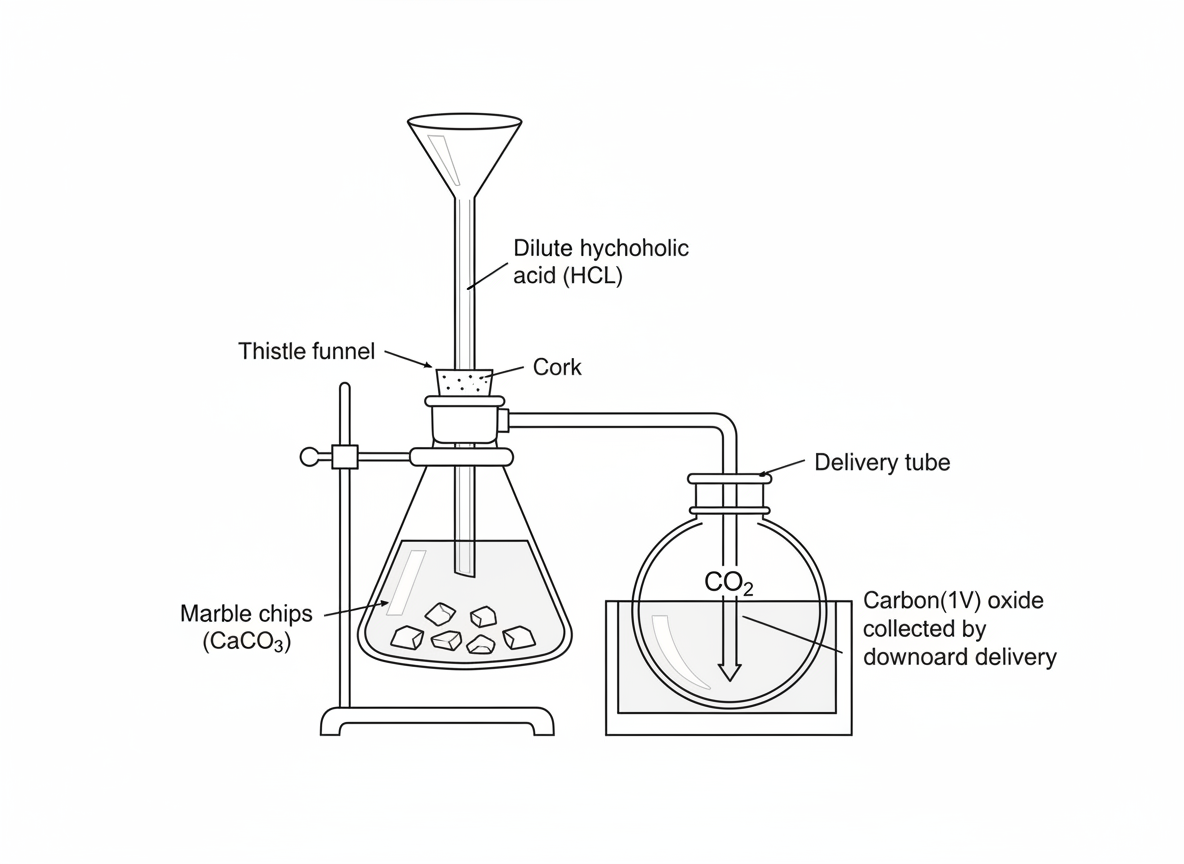
(5bi) Diagram & Equation for Laboratory Preparation of CO2
(5bii) Balanced Chemical Equation
CaCO3(s) + 2HCl(aq) → CaCl2(aq) + CO2(g) + H2O(l).
(5biii) Uses of Carbon(IV) Oxide (Any Two)
- Used in fire extinguishers.
- Used in manufacture of carbonated drinks.
- Used by green plants during photosynthesis.
- Used as a refrigerant (dry ice).
- Used in greenhouses to promote plant growth.
(5c)
(5ci) Vulcanization
Vulcanization is the process of heating natural rubber with sulphur to improve its strength, elasticity and durability.
(5cii) Examples of Natural and Synthetic Rubber
- Natural rubber example: Latex / Smoked sheet rubber / Crepe rubber.
- Synthetic rubber example: Neoprene / Buna-S (SBR) / Buna-N (NBR) / Butyl rubber / Silicone rubber.
(5ciii) Solubility Calculation
Solubility of NaCl at 100 °C = 39.8 g per 100 g water; at 15 °C = 35.9 g per 100 g water; mass of water = 80 g.
- At 100 °C: (39.8/100) × 80 = 31.84 g.
- At 15 °C: (35.9/100) × 80 = 28.72 g.
- Mass precipitated = 31.84 − 28.72 = 3.12 g.
- ∴ Mass of NaCl precipitated = 3.12 g.
QUESTION 6
(6a)
(6ai) Peroxide
A peroxide is a compound that contains the peroxide ion (O22−), in which two oxygen atoms are joined by a single covalent bond.
(6aii) Examples and Properties
- Examples of peroxides: Hydrogen peroxide (H2O2), Sodium peroxide (Na2O2), Barium peroxide (BaO2).
- Examples of oxides: Hydrochloric acid (HCl), Nitric acid (HNO3), Hydrofluoric acid (HF).
- Properties of acids (Any two): Sour taste; turn blue litmus red; pH less than 7; conduct electricity in solution; corrosive in concentrated form.
(6aiii) Strong Electrolyte
A strong electrolyte is a substance that completely ionizes into ions when dissolved in water, thereby conducting electricity efficiently.
(6aiv) Example of Strong Acid
Hydrochloric acid (HCl).
(6b)
(6bi) pH
pH is the negative logarithm of the hydrogen ion concentration in a solution. It measures the acidity or alkalinity of a solution.
(6bii) Comparing pH of Solutions
- Most acidic: A.
- Most basic: E.
- Neutral: C.
(6biii) Deliquescent and Efflorescent Compounds (Any One Difference)
- Deliquescent compounds absorb moisture from the atmosphere; efflorescent compounds lose water of crystallization to the atmosphere.
- Deliquescent compounds become wet/dissolve; efflorescent compounds become dry and powdery.
- Deliquescent compounds gain mass on exposure to air; efflorescent compounds lose mass on exposure to air.
(6biv) Examples of Deliquescent and Efflorescent Compounds
- Deliquescent compound: Calcium chloride (CaCl2).
- Efflorescent compound: Washing soda (Na2CO3·10H2O).
(6c)
(6ci) Properties of Water (Any Two)
- Water is colourless.
- Water is odourless.
- Water is tasteless.
- Water is a universal solvent.
- Water has a high specific heat capacity.
(6cii) Relative Molecular Mass of Gas X
Mass of gas X = 28.92 − 26.42 = 2.50 g; mass of hydrogen = 0.31 g.
Mr = (Mass of gas X / Mass of H2) × 2 = (2.50 / 0.31) × 2 = 16.
∴ Relative molecular mass of gas X = 16.
 Examsmooth
Leave a comment