
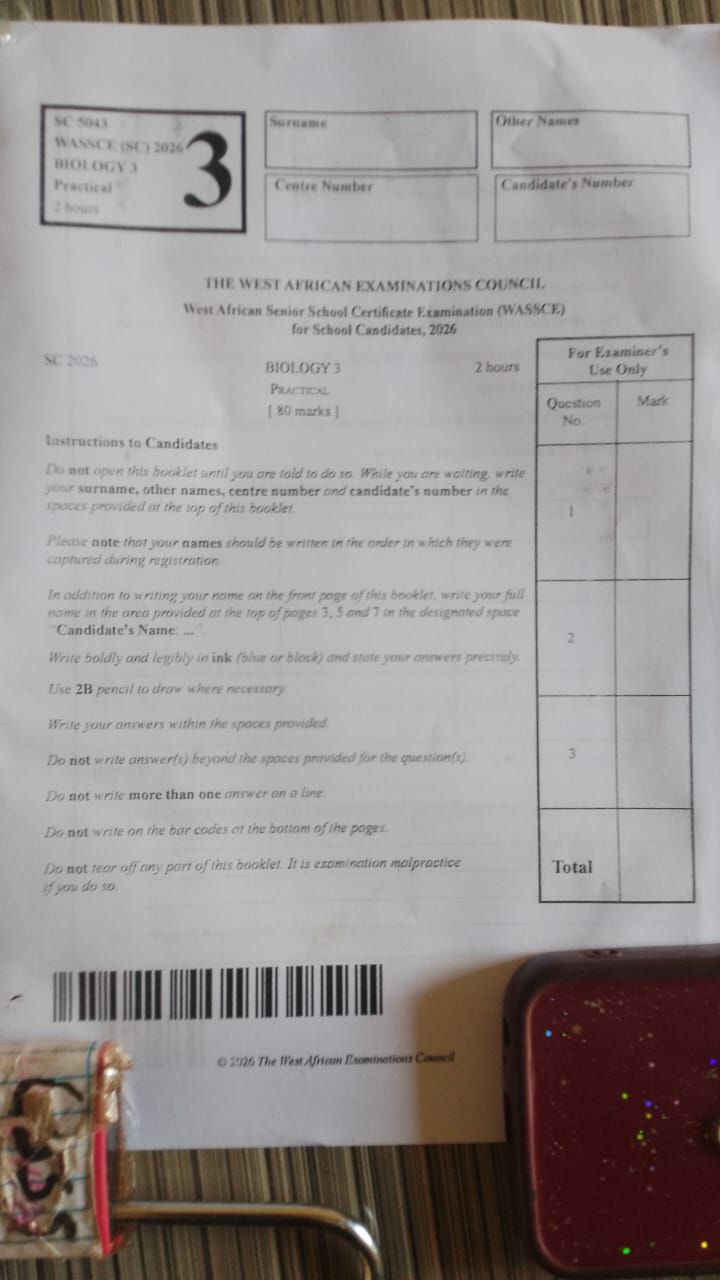
This page contains the WAEC 2026 Biology 3 Practical questions and answers. Scroll down for the official question paper images and full answers.
📌 INSTRUCTION: Please kindly trace and check the question numbering before copying to avoid errors. We solved with the 1st Set. If your centre is doing the 2nd Set, please check the questions, compare and re-number in your booklet before answering.
WAEC 2026 Biology 3 Practical Question Paper

WAEC 2026 Biology 3 Practical — Answers ✅
NUMBER ONE
1(a) Food Test Table
| TEST | OBSERVATION | INFERENCE |
|---|---|---|
| (i) Filter paper / light test | No blue-black coloration; remains brown/yellow | Starch is absent |
| (ii) Biuret test (NaOH + CuSO₄) | Purple/violet coloration appears | Protein is present |
| (iii) Filter paper / light test | Translucent/greasy spot visible on filter paper | Fat/oil is present |
1(b) Nutritional Importance of Specimen A to a Growing Child
- It is rich in protein needed for growth and tissue repair
- It contains fats/oils which provide energy for metabolic activities
- It is a good source of minerals (e.g. calcium, phosphorus) for bone development
- It contains vitamins essential for healthy development
- It provides energy needed for the child’s physical activities
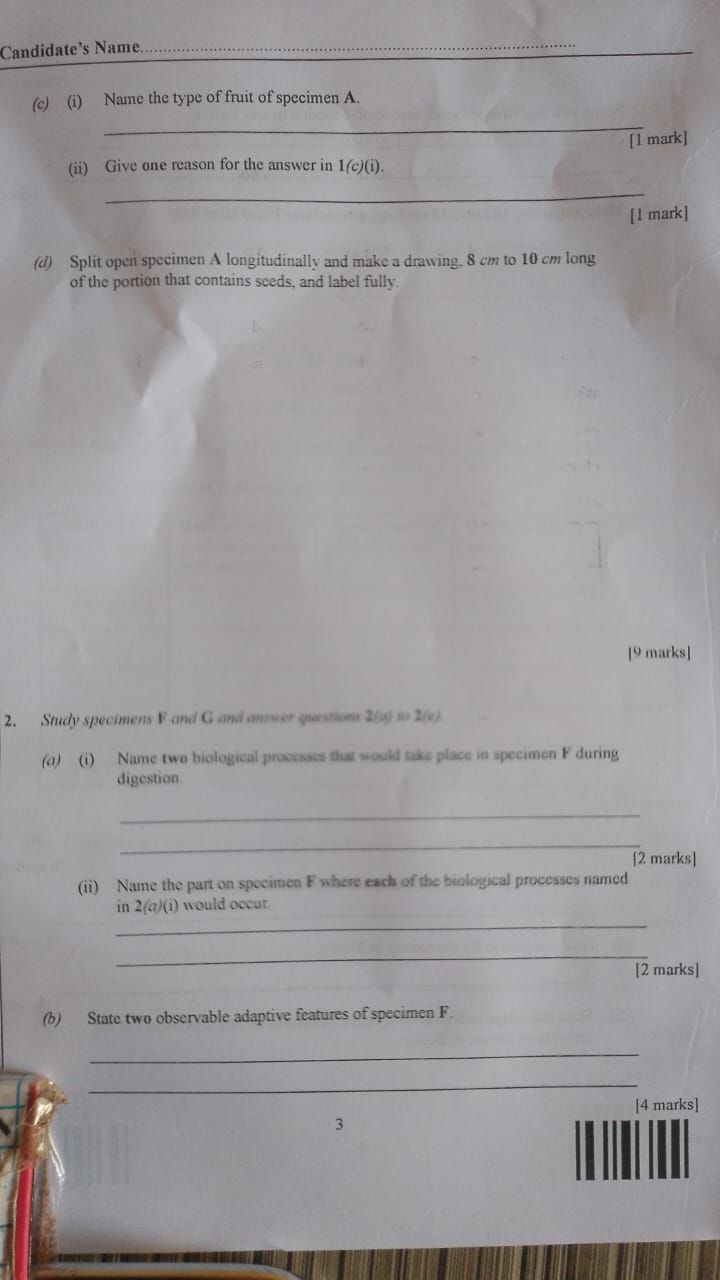
1(c)(i) Type of Fruit
Legume/Pod (a dry dehiscent fruit)
1(c)(ii) How the Fruit Develops
It develops from a single carpel and splits along two sides (sutures) when ripe to release seeds.
1(d) Diagram — Coming Soon
Diagram will be updated shortly.
NUMBER TWO
2(a)(i) Processes Illustrated
- Digestion
- Peristalsis
2(a)(ii) Parts of the Alimentary Canal Where Each Process Occurs
- Digestion — Stomach
- Peristalsis — Oesophagus
2(b) Structural Adaptations of Specimen F (Stomach)
- Thick muscular walls for churning food
- Presence of gastric glands for secretion of digestive juices
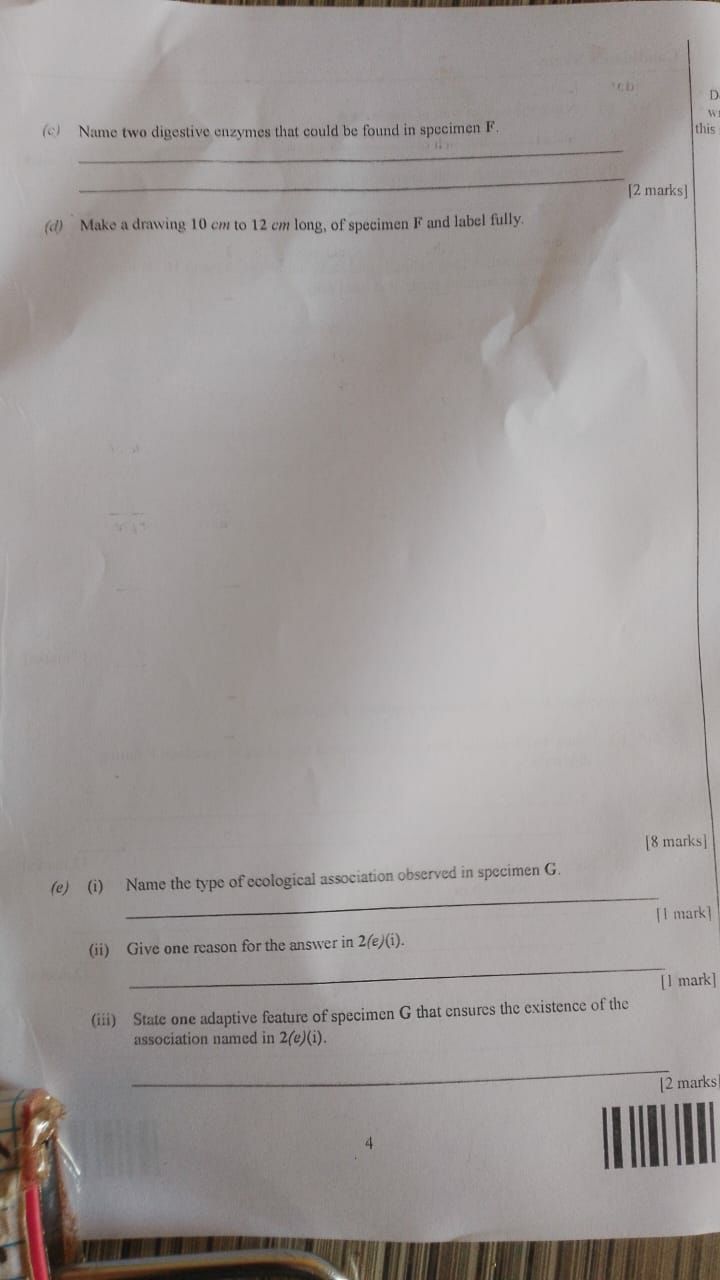
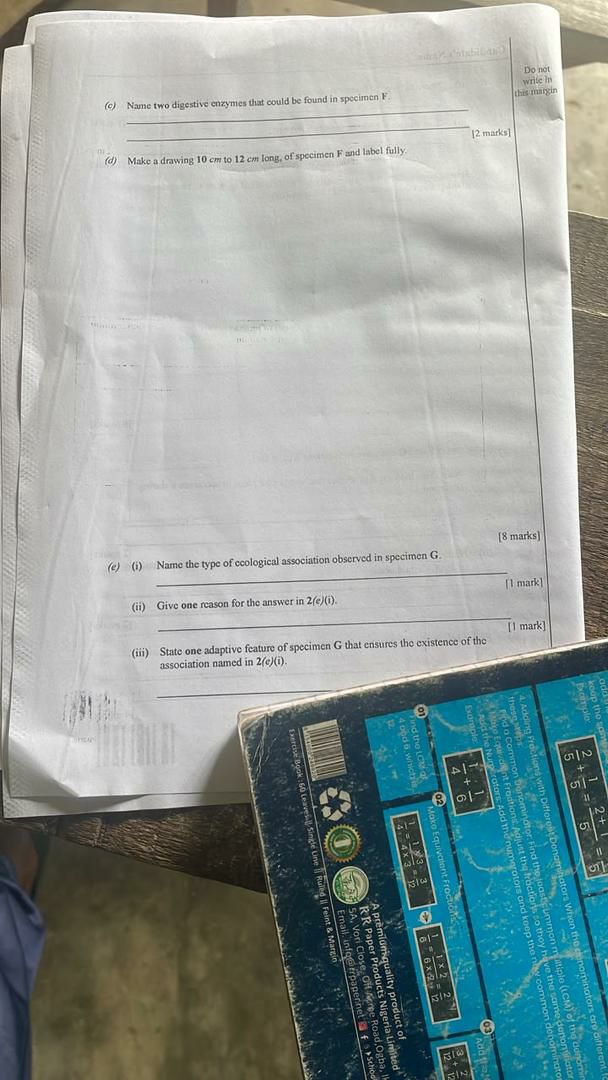
2(c) Enzymes Secreted by Specimen F (Stomach)
- Pepsin
- Rennin (or Gastric lipase)
2(e)(i) Type of Relationship
Parasitism
2(e)(ii) How the Relationship is Exhibited
The mistletoe obtains water and nutrients from the host plant while the host is harmed.
2(e)(iii) Structural Adaptation of Specimen G (Mistletoe)
Possession of haustoria (sucking roots) that penetrate the host tissues and absorb nutrients.
2(e)(iv) Effects on the Host Plant
- Reduces growth and vigour of the host twig/branch
- May cause drying, weakening or death of the infected branch
2(e)(v) Another Example of this Type of Relationship
Dodder (Cuscuta) growing on another plant.
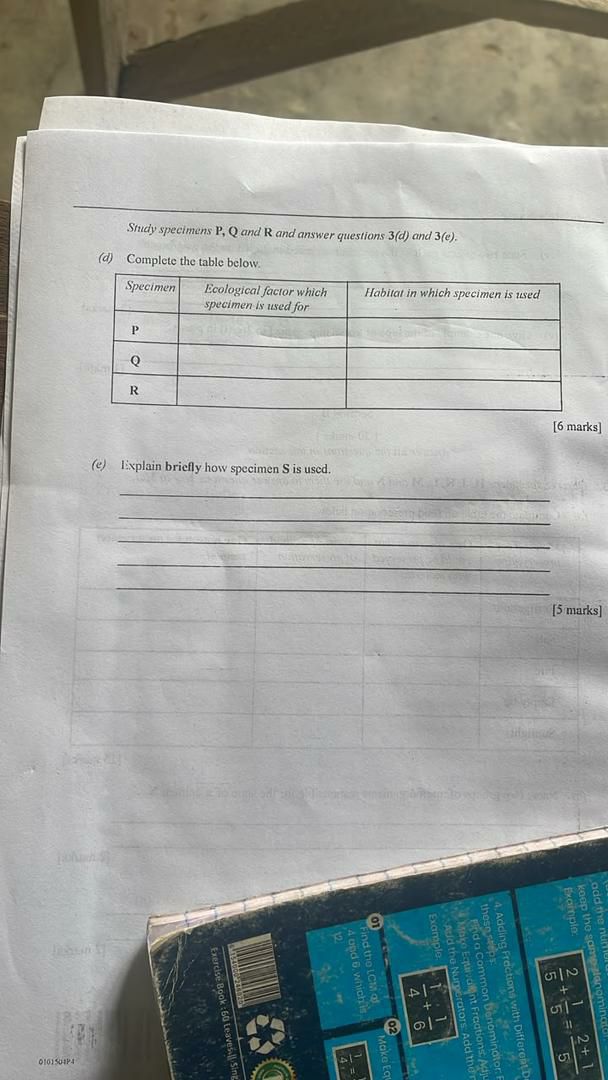
Question 3 answers will be updated shortly. Keep refreshing or join our channels below.
Join Our Exam Update Channels
Get fast updates, exam tips and more past questions and answers for WAEC, NECO and NABTEB.
 Examsmooth
Leave a comment