
2026 IJMB Literature in English Paper III Questions and Answers
Welcome to your IJMB 2026 Literature-in-English Paper III questions hub. You’ll find the question paper and, as they are confirmed, the official answers updated right here on this page.
IJMB 2026 Literature-in-English Paper III Question Paper
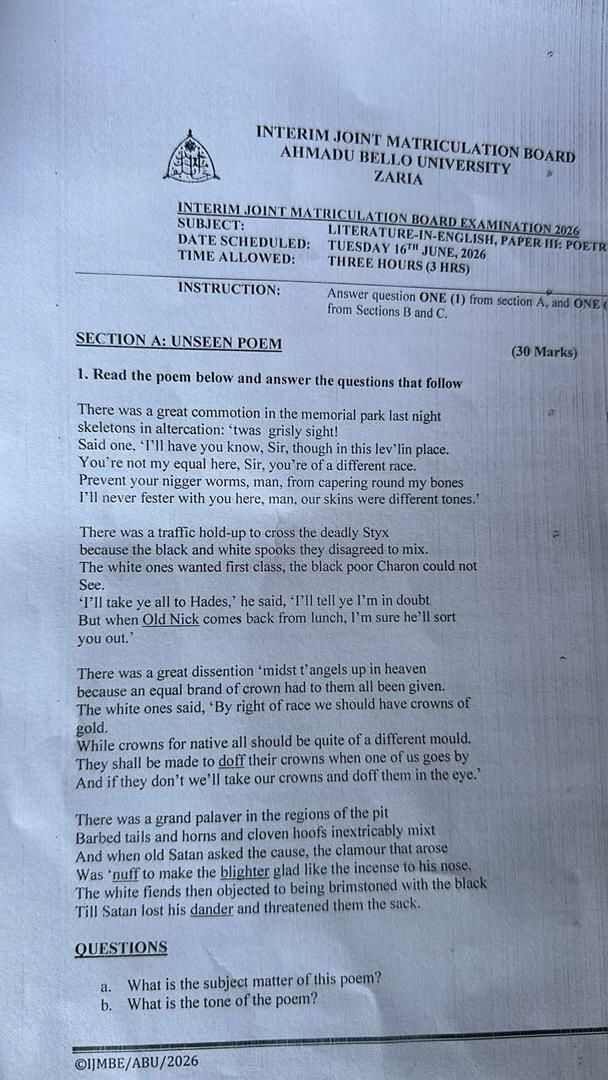
IJMB 2026 Literature-in-English Paper III Answers
Section A: Unseen Poem
Question (a): Subject Matter
The poem satirises racial prejudice by imagining that even after death, in heaven and hell, white and black people still quarrel over race and refuse to mix. By presenting skeletons, ghosts, angels and devils who continue to insist on racial superiority, the poet exposes the absurdity and persistence of racism. The poem suggests that racism is so deeply rooted that it survives the grave, delays judgement, disturbs the peace of heaven and even causes trouble in hell. In doing so, the poet condemns racial discrimination as irrational, divisive and ultimately ridiculous.
Question (b): Tone
The overall tone of the poem is satirical and ironic, with strong elements of humour and mockery. The poet uses playful, comic situations — skeletons quarrelling, ghosts causing a “traffic hold-up” on the Styx, angels fighting over crowns, devils nearly being “sacked” — to ridicule the seriousness with which racists cling to their prejudices. At the same time, beneath the humour, there is a bitter and critical undertone. The poet is angry at the stubbornness of racism and uses sarcasm to expose how morally bankrupt it is. Thus, the tone blends mockery and moral indignation.
Question (c): Meanings of Key Words
i. Spooks: In the context of the poem, “spooks” means ghosts or spirits of the dead. It is an informal word for supernatural beings who haunt or appear after death.
ii. Old Nick: “Old Nick” is a colloquial name for the Devil or Satan. It personifies the ruler of hell, presented here almost like a familiar, human character who goes for lunch and settles quarrels.
iii. To doff: “To doff” means to take off or remove, especially an item of clothing like a hat or crown, usually as a sign of respect or greeting. In the poem, the white angels want the black angels to remove their crowns whenever they pass.
iv. Nuff (“’nuff”): This is a colloquial, shortened form of “enough.” It suggests that the noise and clamour were so great that they were sufficient to please Satan, like incense to his nose.
v. Blighter: “Blighter” is an informal, slightly insulting term for a person, roughly meaning “fellow” or “wretch.” Here it is used for Satan, making him sound like a rough or mischievous character rather than a solemn figure.
vi. Dander: “Dander” is an informal word meaning temper or anger. To “lose one’s dander” means to become very angry. The phrase shows that Satan himself becomes irritated by racist quarrels.
Question (d): The Four Scenes
Each stanza is set in a different imaginary scene beyond the grave, and each scene is used to show how racism invades every realm:
First stanza — Memorial park / graveyard: The “memorial park” is a cemetery where skeletons rise and argue. The graveyard, which should be a place of rest and equality in death, becomes a battlefield of racial abuse as a white skeleton refuses to share the same worms and soil with a black skeleton.
Second stanza — The River Styx (crossing to Hades): The second scene is at the mythical River Styx, the boundary between the world of the living and the dead. The “traffic hold-up” happens because the white and black ghosts, or “spooks,” refuse to travel together in Charon’s boat. Hell’s journey is delayed by racial quarrels.
Third stanza — Heaven: The third stanza moves to heaven, where angels are all given equal crowns. The white angels protest, demanding better, golden crowns and insisting that the “natives” must have different, inferior crowns and remove them as a sign of subservience. Even paradise is poisoned by racist ideas of hierarchy.
Fourth stanza — Hell (the pit): The final stanza is set in hell, the “regions of the pit,” where devils with barbed tails and cloven hooves are “inextricably mixt.” Yet, even in this place of punishment, white fiends do not want to share the same brimstone with black fiends. Their quarrel becomes so noisy that Satan himself threatens to dismiss them. Hell thus mirrors earthly racism.
Question (e): Style of the Poem
First, the poet makes extensive use of satire and irony. By placing racial conflict in ridiculous supernatural settings — skeletons, ghosts, angels and devils quarrelling — the poet exaggerates the situation to show how foolish racism is. The idea that even the dead and the damned still cling to skin colour is an ironic comment on how deep and senseless such prejudice can be.
Secondly, the poem employs a narrative ballad-like form with regular stanzas that each tell a mini-story in a different setting. The rhythm is lively and often humorous, helped by rhyme and internal rhythm (for example, “Barbed tails and horns and cloven hoofs inextricably mixt”). This almost sing-song quality contrasts with the seriousness of the subject, reinforcing the satirical effect.
Thirdly, the poet’s language is colloquial and playful. Words such as “spooks,” “Old Nick,” “blighter” and “dander” are informal and conversational, which makes the poem accessible and creates a comic tone. The use of eye-dialect and shortened forms like “’nuff” and “t’angels” suggests spoken, non-standard English that adds humour and character.
Furthermore, the poem makes frequent use of personification and visual imagery. Abstract ideas like racial prejudice are turned into vivid scenes: skeletons speaking, crowns being “doffed,” devils threatening to strike. These images help the reader to see racism as something concrete and ugly, not just an abstract idea.
Overall, the style is simple in diction but rich in irony. The poet avoids complex philosophical argument and instead uses comic narrative, contrast and exaggeration to attack racism, making the poem memorable, entertaining and thought-provoking.
Question (f): Suggested Title
An appropriate title for this poem is “Racism Beyond the Grave”. This title captures the central idea that racial prejudice is carried by human beings even after death into the graveyard, across the Styx, into heaven and down to hell. It also hints at the poet’s criticism that racism is a haunting, destructive force that refuses to die, no matter how irrational it is.
Other possible titles could include “Colour in Heaven and Hell” or “The Dead and Their Colours”, both of which underline the irony that the dead still cling to colour differences. Whatever the exact wording, a suitable title must show that the poem deals with racism projected into the afterlife in a satirical, imaginary way.
Section B: Non-African Poetry — Gerard Manley Hopkins
Question 2: Hopkins as a Forerunner of Modernist Poetry
Although Hopkins wrote in the Victorian period, his poems anticipate many features of twentieth-century Modernist poetry: experimental rhythm, fractured syntax, intense subjectivity, and a fresh way of seeing reality. His use of “sprung rhythm,” dense sound patterns, and daring imagery breaks away from regular metrical patterns and smooth, ornamental diction typical of much nineteenth-century verse. In poems such as “God’s Grandeur,” “Pied Beauty,” “The Windhover” and “Carrion Comfort,” we see him challenging conventional poetic form and language in ways that foreshadow the Modernists.
In “God’s Grandeur”, Hopkins’ experimental form is immediately noticeable. The sonnet uses sprung rhythm and heavy alliteration to capture the pulsing energy of God’s presence in the world: “The world is charged with the grandeur of God.” The word “charged” suggests electricity, not the calm, static images common in earlier religious poetry. The syntax is condensed and sometimes inverted, forcing the reader to work actively with the lines, a feature later common in Modernist poetry. The octave also offers a bleak, almost industrial view of humanity — “Generations have trod, have trod, have trod” — foreshadowing the alienation and spiritual crisis that Modernists would explore.
“Pied Beauty” also reveals Hopkins as a precursor of Modernism in its celebration of oddity and fragmentation. Rather than praise classical harmony or ideal beauty, he praises “dappled things” — “skies of couple-colour,” “rose-moles all in stipple upon trout,” and “all trades, their gear and tackle and trim.” The catalogue of concrete, “pied” images and the vigorous, broken rhythms anticipate the Modernist fascination with the ordinary and the “ugly” as worthy of art. Hopkins’ emphasis on particularity (“thisness” or “inscape”) parallels Modernist attempts to present the thing itself, not abstract moralising.
In “The Windhover”, Hopkins develops an intensely subjective and psychological mode that anticipates Modernist interiority. The poem begins as a meditation on the beauty of a falcon in flight, but quickly becomes a complex exploration of the speaker’s own spiritual response. The syntax is broken, full of exclamations and compound words (“valor, act, oh, air, pride, plume”), mimicking a mind struggling to articulate an overwhelming experience. This fractured, highly personal voice, which allows the reader to feel the pressure of consciousness itself, resembles the stream-of-consciousness and psychological depth of later poets.
“Carrion Comfort” further shows Hopkins’ modernity through its raw exploration of despair. Unlike traditional religious verse that calmly affirms faith, Hopkins here addresses God in near-accusatory tones: “Not, I’ll not, carrion comfort, Despair, not feast on thee.” The sonnet is filled with violent metaphors of wrestling, crushing and being “wrung.” This psychological nakedness and willingness to dramatise inner conflict foreshadow the confessional intensity of many twentieth-century poets. The poem’s broken phrases, enjambments and unusual word order reflect the speaker’s emotional turbulence rather than follow a smooth decorative pattern.
Across these four poems, Hopkins appears “modern” because he breaks regular metre with sprung rhythm, condenses syntax into highly charged phrases, experiments with sound and image, and centres the unstable, questioning mind of the speaker. These features anticipate the Modernist desire to renew poetic language and to express the complexity and fragmentation of modern spiritual and psychological life.
Question 3: Distinctive Style of Hopkins
Hopkins’ style is distinctive for several interrelated features: sprung rhythm, dense sound devices, the concepts of inscape and instress, and intense religious imagery. These can be clearly seen in poems such as “Pied Beauty,” “God’s Grandeur,” “The Windhover” and “Spring and Fall.”
First, Hopkins’ use of sprung rhythm marks him out. Instead of the even, counted syllables of traditional metres, sprung rhythm counts only stressed syllables, allowing a more speech-like, energetic movement. In “Pied Beauty”, lines such as “Glory be to God for dappled things” leap with stressed beats and compressed syllables, making the verse vigorous and muscular. Similarly, in “God’s Grandeur”, the line “Generations have trod, have trod, have trod” uses repeated stresses to convey the monotonous trampling of human history.
Secondly, Hopkins is famous for alliteration, assonance and internal rhyme. In “The Windhover”, for example, we hear a dense pattern of p and b sounds in “the rolling level underneath him steady air, and striding high there” and “the achieve of, the mastery of the thing.” These sound patterns do more than decorate; they help to enact the movement and power of the bird in flight. In “God’s Grandeur,” the assonance in “ooze of oil / Crushed” and the alliteration in “shook foil” give the poem a tactile, almost physical quality.
Thirdly, Hopkins’ idea of inscape — the unique inner pattern or “thisness” of each created thing — shapes his diction and imagery. In “Pied Beauty,” he does not speak abstractly about beauty but lists specific, peculiar details: “fresh-firecoal chestnut-falls,” “plotted and pieced—fold, fallow, and plough.” In “Spring and Fall,” the individuality of the little girl, Margaret, and the autumn leaves combine to express an inscape of mortality that is both personal and universal. This focus on specific, concrete particulars sets his style apart from more generalised Victorian moralising.
Another hallmark of his style is the compression of language. Hopkins often forges compound words, unusual hyphenations and compressed metaphors. In “The Windhover,” phrases like “dapple-dawn-drawn Falcon” and “blue-bleak embers” pack several layers of meaning and sensation into short, dense clusters. In “God’s Grandeur,” the comparison of God’s presence to “shook foil” is startlingly original, at once visual and kinetic.
Finally, Hopkins’ religious intensity and emotional candour stand out. In “God’s Grandeur,” he laments human sin and environmental destruction but ends triumphantly with the Holy Ghost brooding over the world “with warm breast and with ah! bright wings.” In contrast, “Spring and Fall” quietly confronts the inevitability of death, telling the child Margaret that her sorrow for the falling leaves is really sorrow for her own mortality. Hopkins’ style thus combines technical experimentation with deep spiritual feeling, making his poems immediately recognisable.
Section B: Non-African Poetry — Ezra Pound
Question 4: Pound’s Views on Replacement
Ezra Pound is deeply concerned with replacement in several senses: replacing worn-out poetic forms with new ones, replacing sentimental language with precise images, and replacing corrupt social and economic systems with juster alternatives. Across his Selected Poems, we see him advocating the removal of what he calls “dullness” and “verbose” traditions in order to create a hard, clear, modern poetry. At the same time, his poems look back to classical and Eastern cultures, suggesting that the modern world should replace its materialism with the wisdom of older civilisations.
In “In a Station of the Metro,” Pound replaces elaborate description with a single compressed image: “The apparition of these faces in the crowd; / Petals on a wet, black bough.” Here, he rejects the Victorian habit of explaining feelings at length and instead substitutes an image that fuses two moments into one. The poem itself is a replacement of narrative with pure imagism, showing his belief that poetry should present, not comment. The old discursive style gives way to a new, stripped-down form that influenced much twentieth-century verse.
In “A Pact,” Pound addresses Walt Whitman and dramatizes a generational replacement. He admits that he once hated Whitman but now recognises him as a necessary precursor: “Let there be commerce between us.” Pound describes Whitman as the one who “broke the new wood,” while he, Pound, wants to “carve it” more finely. Here, he suggests that while Whitman replaced older European models with a new American voice, Pound in turn seeks to refine and replace even Whitman’s looseness with greater economy and structure. Replacement is thus seen as a continuous artistic process, each generation renewing and correcting the previous one.
In the early Cantos, particularly “Canto I”, Pound rewrites and replaces classical texts. He adapts the story of Odysseus’s descent into the underworld from Homer and the Latin translation by Andreas Divus. By re-voicing this ancient journey in a fragmented, modern style, Pound symbolically replaces passive imitation of the classics with active re-creation. The past is not to be copied but to be transformed into something new that speaks to the present. Replacement here means creative translation and reconfiguration rather than mere repetition.
In social and economic terms, poems that attack usury and financial corruption (for example, the “Usura” passages in the Cantos) show Pound’s desire to replace exploitative monetary systems with ones that respect labour, art and nature. He blames “usura” for the decay of culture and calls for a return to more humane economic practices inspired by older civilisations. Even though his prescriptions are controversial, the poems clearly show his belief that a rotten order must be replaced if civilisation is to survive.
Overall, Pound’s Selected Poems present replacement as both an aesthetic and a moral necessity: old forms, old diction and corrupt structures must give way to a new, precise, disciplined art and a reformed society.
Question 5: Pound’s Projection of Life in the 20th Century
Pound’s poetry offers a complex projection of twentieth-century life: it is presented as fast, fragmented, cosmopolitan, spiritually exhausted yet still capable of renewal. Through poems such as “In a Station of the Metro,” “The River-Merchant’s Wife: A Letter,” “Hugh Selwyn Mauberley” and sections of the Cantos, Pound depicts a world of crowded cities, fleeting impressions, cultural confusion and political decay.
“In a Station of the Metro” captures the speed and impersonality of urban life in just two lines. The faces in the Paris metro appear briefly and vanish, like petals on a dark branch. The image suggests that in the modern city, individuals are reduced to passing impressions, easily lost in the crowd. The poem also shows how twentieth-century life is dominated by machines (the underground train) and artificial light, yet within that setting there is still a fragile beauty.
In “The River-Merchant’s Wife: A Letter,” Pound translates and recreates an ancient Chinese poem, but it speaks powerfully to modern experiences of distance, separation and emotional isolation. The wife’s loneliness as her husband travels reflects the instability of relationships in an age of global movement and trade. By making a foreign, classical situation feel immediate and intimate, Pound suggests that twentieth-century life is increasingly international and that emotions must find expression across cultures and distances.
“Hugh Selwyn Mauberley” offers a more direct critique of life in the early twentieth century, especially after the First World War. Pound portrays a society that has sacrificed a generation of young men for a “botched civilization.” Mass culture, commercialism and shallow newspapers have replaced deep artistic values. Mauberley, the central figure, is an artist who cannot fit into this world; he is “out of key with his time.” Through him, Pound projects the twentieth century as a period of cultural decline and disillusionment, in which genuine art is marginalised.
In the Cantos, Pound’s fragmented style itself mirrors the discontinuous, overloaded experience of twentieth-century existence. Snatches of different languages, historical episodes, financial debates and personal memories collide in the same poem. This collage technique reflects a world flooded with information, where coherence is difficult to achieve. At the same time, Pound’s search for order in the chaos — through references to Confucian ethics, classical myths and just economic systems — suggests that modern life still has the possibility of moral and cultural renewal.
Thus, Pound’s projection of twentieth-century life is double-edged: it is a time of crowding, speed, war and spiritual emptiness, but also a period in which new forms of art and cross-cultural understanding can emerge.
Section C: African Poetry — Isidore Diala, The Lure of Ash
Question 6: Diala’s Distinguishing Stylistic Features
Isidore Diala’s The Lure of Ash is stylistically distinctive for its symbolism of ash, its frequent use of historical and political allusion, its mixing of lyrical and narrative voices, and its fusion of European and African literary traditions. Across the collection, Diala’s style is marked by a serious, reflective tone and a sculpted, sometimes dense, poetic language that invites careful reading.
One key stylistic feature is his central controlling metaphor of “ash”. In many poems, ash symbolises the remains of war, dictatorship, colonialism and personal loss. The titles of the three phases — The Hues of Ash, The Swell of Ash and The Trail of Ash — already signal that ash will be used to explore change over time. In poems that recall civil war or military rule, Diala often describes landscapes, cities and memories as covered in ash, suggesting both destruction and the possibility of renewal, since ash can also fertilise the soil. This extended metaphor unifies the collection and gives his style a philosophical depth.
Diala also relies heavily on historical and political references. He names or alludes to past Nigerian leaders, coups, civil conflict, and the disappointments of independence. These references are often woven subtly into his imagery rather than stated didactically. For example, a poem may mention “the general in dark glasses” or “broadcasts at dawn” to evoke an era of military rule without naming it directly. This technique allows his poems to criticise oppression while remaining artistically suggestive.
Another feature is Diala’s interplay of lyric and narrative modes. Some poems employ a first-person, confessional voice that meditates on trauma and memory; others narrate scenes from history or communal experience through a more detached third-person perspective. In one poem the speaker may recall childhood experiences during conflict; in another, he may reconstruct the public scene of executions or propaganda speeches. This movement between the personal and the historical broadens the scope of the collection and is a key aspect of his style.
Diala’s diction blends elevated, sometimes academic English with colloquial expressions and indigenous references. Names of local places, gods, customs and proverbs sit alongside references to European philosophers or classical myths. This fusion reflects the double heritage of the African intellectual who has been educated in Western traditions but remains rooted in African history and culture. The result is a richly textured language that requires the reader to navigate different cultural registers.
Finally, Diala makes skillful use of imagery of bodies and landscapes scarred by violence. He describes cities as burnt-out shells, rivers as carrying the memory of blood, and human bodies as archives of pain. Such images give concrete shape to abstract themes like trauma, guilt and mourning. Through these stylistic choices, The Lure of Ash achieves a distinctive voice among contemporary African poetic works.
Question 7: Major Preoccupation in the Three Phases
Diala structures The Lure of Ash into three phases — The Hues of Ash, The Swell of Ash and The Trail of Ash — and this structure reflects his major preoccupation with how societies remember, live through and live after catastrophe. Across the three sections, he is concerned with war and dictatorship, collective memory, moral responsibility and the difficult hope of reconstruction.
In The Hues of Ash, the focus is on naming and recognising the many forms of historical ruin. Here ash has “hues” because Diala explores different shades of suffering: colonial violence, civil war, ethnic tension and the betrayal of independence. Poems in this phase often look backward, describing scenes of burning, executions or displacements. The speaker tries to fix in words the colours of loss so that they will not be forgotten. The preoccupation is with memory and testimony: to bear witness to what has happened.
In The Swell of Ash, Diala is preoccupied with the present, ongoing consequences of past violence. The “swell” suggests both a rising wave and the way wounds swell after injury. Poems in this phase show how the effects of war and dictatorship persist in everyday life: corrupt institutions, fear, silence, poverty and mistrust. The speaker often moves between private memory and public events to show that the past continues to “swell” in the bodies and minds of survivors. Diala examines guilt, complicity and the difficulty of healing in a society that has not fully confronted its past.
In The Trail of Ash, Diala turns towards legacy and the future. The “trail” of ash is what remains as people move on: the stories, scars and moral lessons left behind. Here his preoccupation is with how to live responsibly after catastrophe. Some poems ask whether the younger generation understands the cost of their current freedoms, while others question whether the leaders have learned anything from history. Ash becomes a trail that may either guide people away from repeating mistakes or, if ignored, lead them back into disaster.
Across the three phases, therefore, Diala’s major concern is how an African society marked by war, dictatorship and betrayal can remember truthfully, suffer honestly and yet still seek moral renewal. The progression from hues to swell to trail shows a movement from recognition, through endurance, to reflection and responsibility.
Section C: African Poetry — Antjie Krog, Body Bereft
Question 8: Preoccupation of Antjie Krog in Body Bereft
In Body Bereft, Antjie Krog is primarily preoccupied with the ageing female body, the legacy of apartheid violence, guilt and complicity, and the struggle to find language adequate to pain. The collection examines how personal, bodily experience and national history are inseparably linked. As Krog writes about menopause, sagging flesh and physical decay, she also confronts the moral scars left by South Africa’s apartheid past and by the Truth and Reconciliation Commission (TRC), in which she was deeply involved as a journalist.
One central concern is the loss and transformation of the female body. In several poems, the speaker describes her breasts, skin and womb in stark, sometimes shocking images that reject polite euphemism. Ageing is presented not as graceful decline but as a violent, almost humiliating process in which the body becomes “bereft,” deprived of its former attractiveness and fertility. Yet this honesty also becomes a form of liberation, as the poet claims a new voice that is not defined by male desire.
Another preoccupation is memory, trauma and national guilt. Krog frequently recalls testimonies from the TRC and images of torture, disappearance and racial oppression. These public memories disturb her private life and dreams, leaving the body itself as an archive of horror. The poems ask how a white Afrikaner woman can live ethically after benefiting from a racist system. Feelings of shame, complicity and the desire for forgiveness run through the collection.
Krog is also concerned with the limitations and possibilities of language. She writes in a multilingual context — Afrikaans, English and African languages — and often questions whether words can truly convey pain. Some poems break syntax, repeat phrases or switch languages to suggest that ordinary speech has been corrupted by propaganda and lies. The poet searches for a new, broken but truthful language that can speak of both body and history.
Finally, Body Bereft is preoccupied with love, care and fragile hope in the midst of decay. Images of family, children and intimate relationships appear alongside images of death and violence. Even as the body ages and the nation struggles with its past, the poems often end on moments of tenderness or tentative reconciliation. Krog’s overall concern, therefore, is how to live honestly in a damaged body and a damaged country, without denying pain but also without surrendering to despair.
Question 9: Krog’s Style in Body Bereft
Krog’s style in Body Bereft is distinctive for its raw, unflinching imagery, its fragmented, experimental form, its multilingual texture, and its fusion of the personal and the political. She refuses decorative language, opting instead for stark, sometimes brutal metaphors that force the reader to confront physical and moral pain.
First, her imagery of the body is unusually direct. Rather than idealising the female form, she describes sagging breasts, wrinkled skin and internal organs in clinical or even grotesque terms. This stylistic choice breaks taboos around ageing and women’s bodies, and it matches the brutal realities of political violence described elsewhere in the collection. The same plainness that names torture also names menopause; in this way, style unites the two spheres.
Secondly, Krog often uses a fragmented and open form. Lines may be short, abruptly broken, or scattered across the page. Sentences are sometimes incomplete, with silences and gaps suggesting what cannot easily be spoken. This fragmented style reflects both the brokenness of traumatised bodies and the fractured history of South Africa. It also invites the reader to participate in completing the meaning.
A further stylistic feature is her mixing of languages and registers. Krog draws on Afrikaans, English and African languages, as well as on Biblical echoes and everyday speech. She may shift from intimate, almost whispered confessions to harsh, documentary-style accounts within the same poem. The changes in language and tone mirror the multiple identities she holds: woman, mother, journalist, Afrikaner, South African.
Krog also makes prominent use of repetition and refrain. Certain words or phrases recur, building an incantatory rhythm that suggests both obsession and prayer. This is especially evident in poems that recall the TRC testimonies, where repeated cries or statements echo the repetitiveness of trauma. The repeated structures give emotional weight while also formally organising otherwise chaotic material.
Finally, her style constantly weaves the intimate with the historical. A line about a hot flush or sleepless night may immediately be followed by an image of a burned village or a mass grave. This juxtaposition is not accidental; it is the central technique of the book. By writing in this way, Krog insists that the ageing female body and the wounded national body belong in the same poem. Her style in Body Bereft is therefore both confessional and public, lyrical and documentary, making the collection a powerful example of contemporary African poetry.
Bookmark this page and check back regularly so you don’t miss the updated answers. If you find this helpful, please share it with your friends and classmates preparing for IJMB 2026!
 Examsmooth
Leave a comment