
Paper 1 — Objective Question Paper
See the question paper images below, then scroll down for the answers.
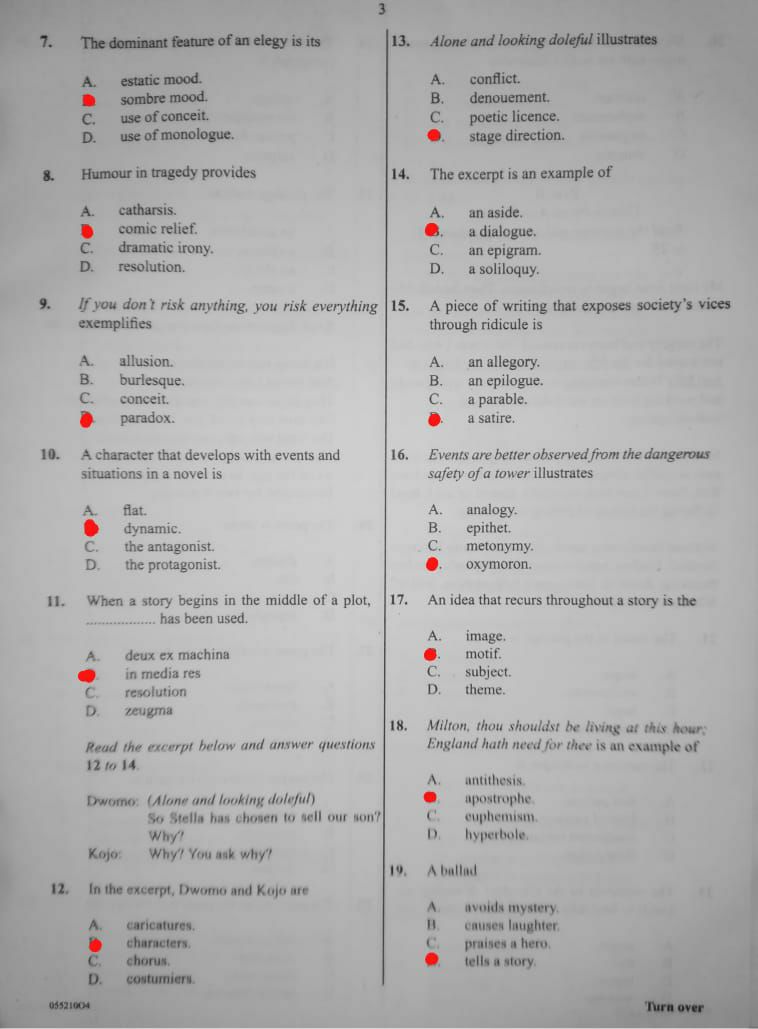

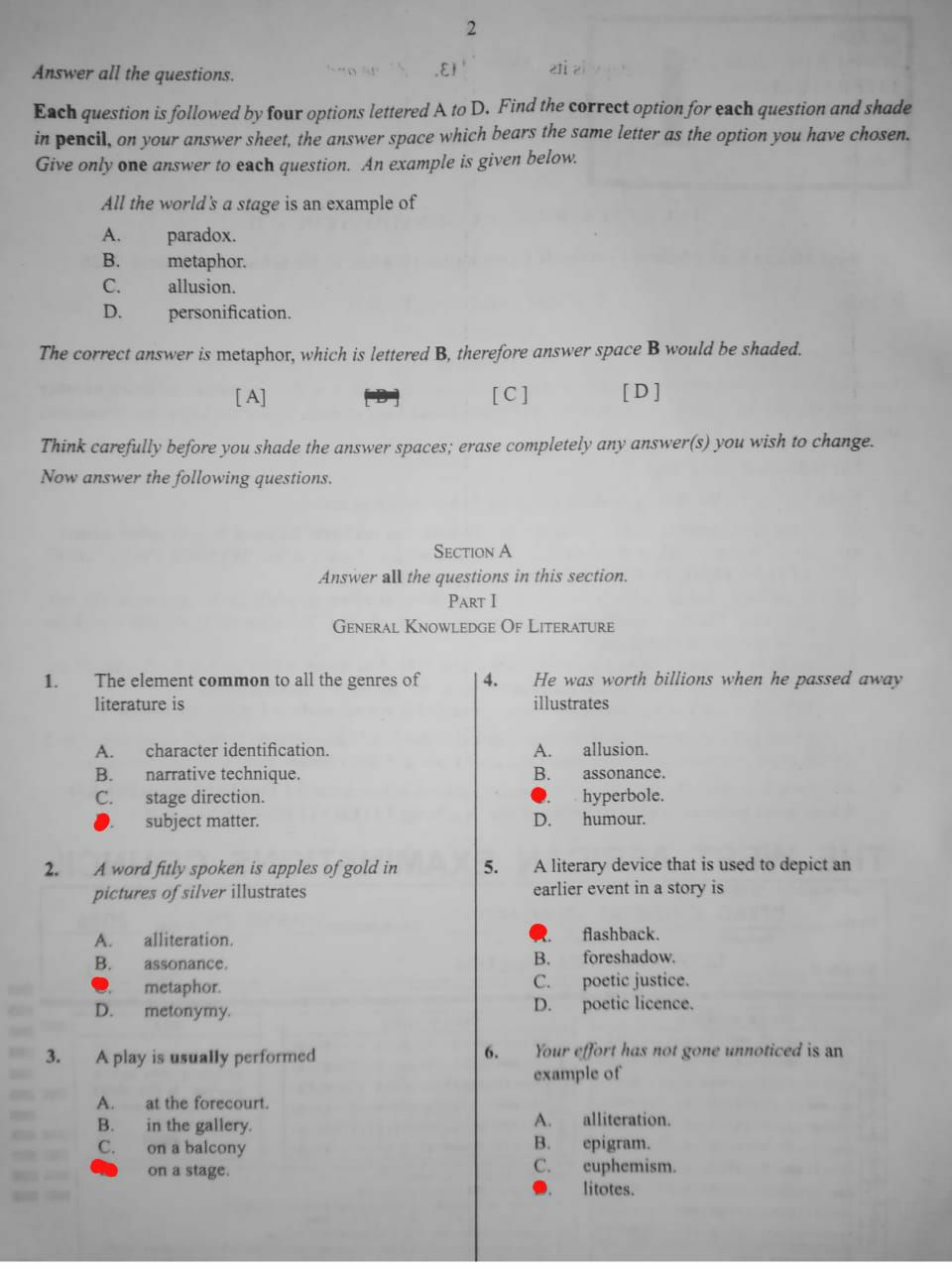
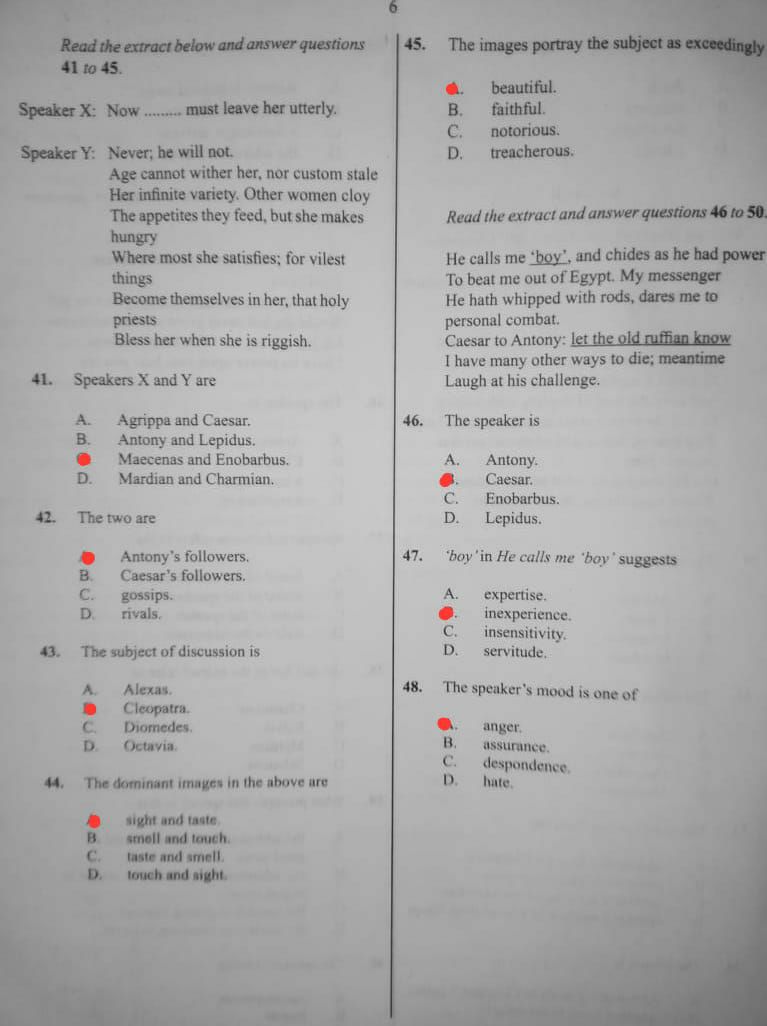
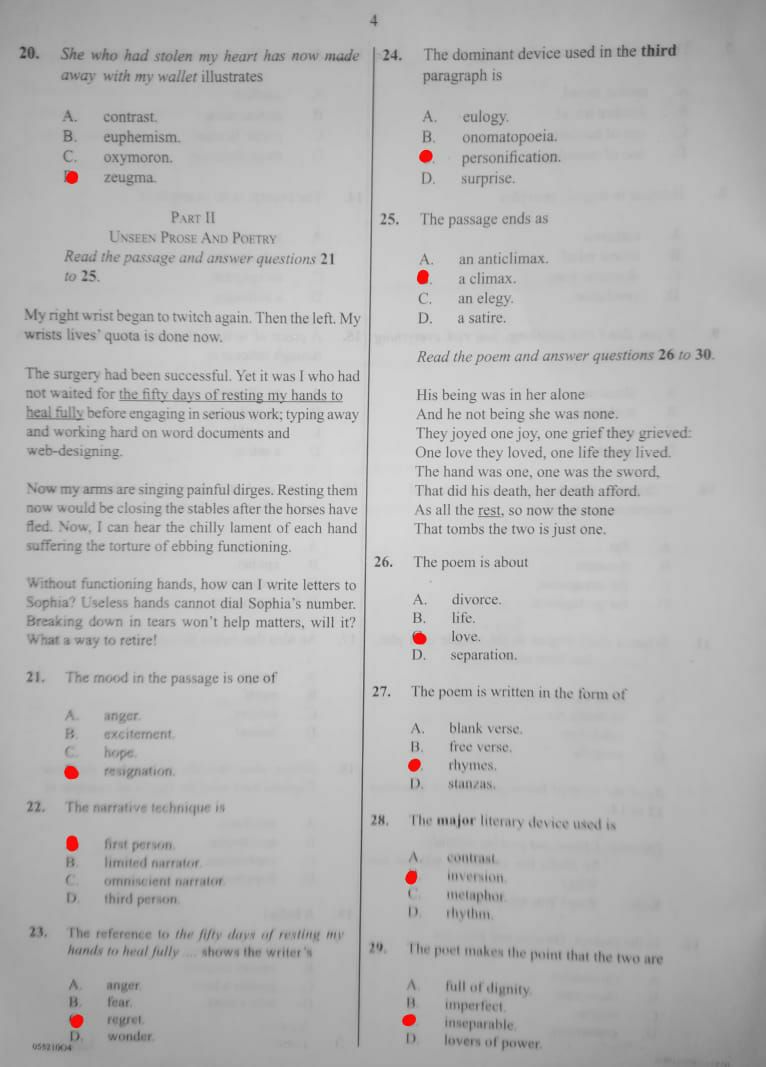
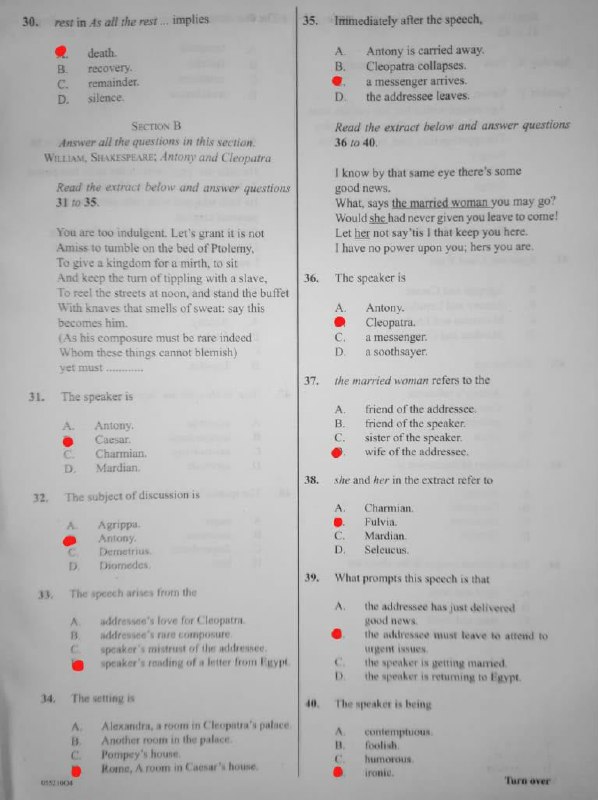
Paper 1 — Objective (OBJ) Answers
Answer Key:
1–10: D C D C A D B B D B
11–20: B B D B D A D B D C
21–30: D A C C B C C C C A
31–40: B B D D C B D B B D
41–50: C B C A A A B A D D
NOTE: If your paper is reshuffled, use the explanations below to match your answers.
- 1. D – Subject matter is common to all genres (literature, drama, poetry all have a subject).
- 2. C – "A word fitly spoken is apples of gold…" is a metaphor.
- 3. D – A play is usually performed on a stage.
- 4. C – "Worth billions" is hyperbole (exaggeration).
- 5. A – Flashback depicts earlier events.
- 6. D – "Your effort has not gone unnoticed".
- 7. B – Elegy has a sombre (sad, mournful) mood.
- 8. B – Humour in tragedy provides comic relief.
- 9. D – "If you don’t risk anything, you risk everything" is a paradox.
- 10. B – Dynamic character develops with events.
- 11. B – In media res = starting in the middle of the action.
- 12. B – Dwormo and Kojo are characters.
- 13. D – "Alone and looking doleful" is a stage direction.
- 14. B – Dwormo speaking alone on stage is a dialogue.
- 15. D – Satire exposes vices through ridicule.
- 16. A – "Dangerous safety of a tower" is an analogy/comparison.
- 17. D – Theme = recurring idea.
- 18. B – Addressing the absent Milton = apostrophe.
- 19. D – A ballad tells a story.
- 20. C – "She stole my heart…"
- 21. D – Mood = resignation.
- 22. A – First person narrative (I, my).
- 23. C – Regret (not waiting to heal).
- 24. C – Personification ("arms singing dirges").
- 25. B – Ends as a climax.
- 26. C – About love.
- 27. C – Rhymes (AA BB CC DD).
- 28. C – Metaphor (they are one stone, one sword, etc.).
- 29. C – They are inseparable.
- 30. A – "Rest in… all the rest" implies death.
- 31. B – Speaker is Caesar.
- 32. B – Subject is Antony.
- 33. D – Arises from the speaker’s reading of a letter from Egypt.
- 34. D – Setting: Rome, Caesar’s house.
- 35. C – Immediately after, a messenger arrives.
- 36. B – Speaker is Cleopatra.
- 37. D – "The married woman" = wife of addressee (Fulvia, Antony’s wife).
- 38. B – She/her refer to Fulvia.
- 39. B – The addressee must leave to attend to urgent issues.
- 40. D – Ironic tone.
- 41. C – "Let the old ruffian know" is sarcastic.
- 42–50: C B C A A A B A D D (explanations coming soon).
2026 WAEC Literature in English – Live Exam Updates
2026 WAEC Literature in English Questions and Answers
Answers are currently loading. Bookmark this page and keep refreshing during the exam for verified WAEC Literature in English 2026 OBJ and Essay answers as Examsmooth updates in real time.
Get instant alerts when we drop the 2026 WAEC Literature in English answers. Limited slots – join the official Examsmooth WhatsApp channel now.
WAEC Literature in English 2026 OBJ Answers
We are working on the complete and correct WAEC Literature in English 2026 objective (OBJ) answers. Stay on this page and keep refreshing as the exam starts. The section below will update automatically once our exam team verifies each number.
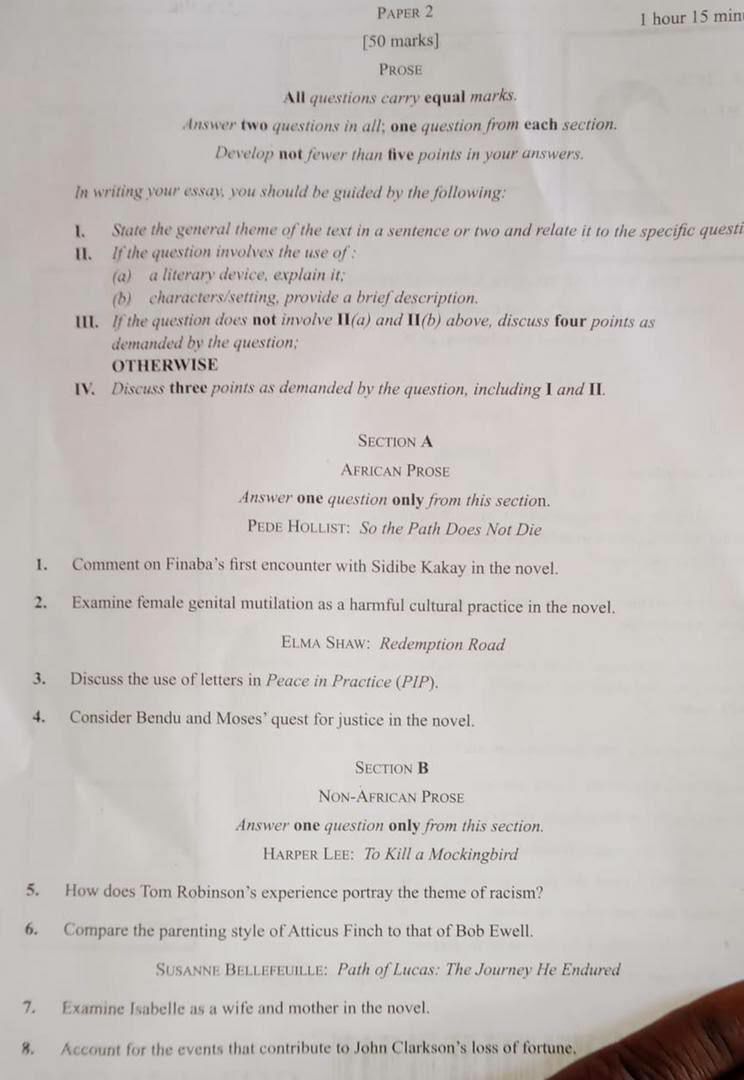
WAEC 2026 Literature in English — Paper 2 (Prose) Question Paper
WAEC Literature in English 2026 Essay / Theory Answers
This section is for full, well-explained answers to the theory and essay questions for WAEC Literature in English 2026. As soon as each question is confirmed, our tutors will upload complete solutions here with clear points and marking scheme guidance.
Question 1 — So the Path Does Not Die: Finaba’s First Encounter with Sidibe Kakay
The general theme of So the Path Does Not Die is the conflict between tradition and modernity, especially as it affects women’s rights and personal freedom. Finaba’s first encounter with Sidibe Kakay clearly reflects this theme, as it introduces her to new ideas that challenge the rigid cultural practices she has grown up with.
Finaba’s first meeting with Sidibe Kakay is significant because it is not merely a casual interaction but one that exposes her to a different worldview. Sidibe Kakay comes across as confident, educated, and enlightened, which sharply contrasts with the conservative and tradition-bound society Finaba is familiar with. His presence immediately creates a sense of difference and curiosity.
Sidibe Kakay is portrayed as a progressive character who questions harmful cultural practices and supports change. His boldness and intelligence distinguish him from other men in the society, making him an important figure in the novel. Through his speech and behavior, he represents modern values and a break from oppressive traditions.
During the encounter, Finaba reacts with a mixture of curiosity and admiration. She is intrigued by Sidibe Kakay’s ideas and begins to see things from a new perspective. This moment is important because it marks the beginning of her questioning of long-held beliefs that she once accepted without doubt.
The meeting also introduces an internal conflict within Finaba. She begins to struggle between remaining loyal to her traditional upbringing and embracing the new ideas presented by Sidibe Kakay. This conflict becomes central to her development throughout the novel.
Furthermore, the encounter is symbolic because it represents the beginning of Finaba’s transformation. It marks the point at which she becomes aware of the possibility of change and starts to resist harmful practices such as female genital mutilation.
Finally, this first meeting foreshadows future events in the novel. The influence of Sidibe Kakay continues to shape Finaba’s thoughts and decisions, guiding her towards self-awareness and independence.
In conclusion, Finaba’s first encounter with Sidibe Kakay is a crucial moment in the novel as it introduces key themes, develops character, and sets the foundation for Finaba’s personal growth and the conflicts that follow.
Question 2 — So the Path Does Not Die: Female Genital Mutilation as a Harmful Cultural Practice
Pede Hollist's So the Path Does Not Die is a novel that examines the experiences of African women and the conflict between harmful traditions and modern values. One of the major issues discussed in the novel is Female Genital Mutilation (FGM), which the author presents as a harmful cultural practice that causes suffering to women and girls.
Female Genital Mutilation is a traditional practice in which part or all of a girl's external genital organs are cut off. In the novel, the practice is carried out as a cultural requirement for girls before they are accepted as mature members of society. However, the author clearly shows that the practice has serious negative effects on its victims.
One harmful effect of FGM is the severe physical pain it causes. The girls who undergo the procedure experience intense suffering because it is often performed without proper medical care. In some cases, victims suffer excessive bleeding, infections and other health complications that may affect them throughout their lives.
Another reason the practice is harmful is that it causes emotional and psychological trauma. Many girls live in fear of the initiation ceremony and continue to suffer painful memories after the operation. The experience often leaves them emotionally distressed and affects their confidence and well-being.
Furthermore, FGM violates the rights and freedom of women. Young girls are usually forced into the practice without their consent because of societal expectations and pressure from family members. The novel presents this as an injustice against women and a denial of their right to make decisions about their own bodies.
The practice also promotes gender inequality. While women are expected to undergo painful initiation rituals, men are not subjected to similar treatment. This reflects the unequal position of women in a society that values tradition above their welfare and happiness.
Through Finaba's experiences and the experiences of other women, the author condemns Female Genital Mutilation and advocates social change. The novel suggests that education and awareness are necessary to eliminate harmful cultural practices and protect the rights of women.
In conclusion, Female Genital Mutilation is portrayed in the novel as a harmful cultural practice because it causes physical pain, emotional trauma, violates human rights and promotes gender inequality. Through this portrayal, Pede Hollist encourages society to reject traditions that endanger the lives and well-being of women.
Question 3 — Redemption Road: Use of Letters in Peace in Practice (PIP)
Redemption Road is a novel that examines the effects of the Sierra Leone civil war and the struggle for healing, justice and reconciliation. One important literary device used in the novel is the use of letters in the programme known as Peace in Practice (PIP). These letters play a significant role in the development of the plot and themes of the novel.
Peace in Practice (PIP) is a reconciliation programme designed to bring together victims and perpetrators of the civil war. Through the exchange of letters, former combatants are encouraged to communicate with those they harmed. The letters create a channel for dialogue and understanding between both parties.
The letters help to reveal hidden emotions and personal experiences. Many of the perpetrators use them to confess their crimes, express remorse and seek forgiveness. In the same way, victims use the letters to explain their pain, suffering and emotional wounds caused by the war.
Another importance of the letters is that they promote the theme of reconciliation. Through written communication, both victims and offenders begin the difficult process of rebuilding trust. The letters serve as a bridge between people who were once enemies.
The letters also advance the plot of the novel. They create opportunities for meetings and discussions between characters involved in the PIP programme. These interactions contribute to the growth and transformation of several characters in the story.
Furthermore, the letters provide insight into the psychological effects of war. They expose feelings of guilt, trauma, anger, fear and regret experienced by both victims and former fighters. Through these revelations, the author highlights the long-lasting consequences of violent conflict.
The use of letters also adds realism to the narrative. By presenting personal accounts directly from the characters, the author allows readers to understand their thoughts and feelings more deeply. This makes the experiences of the characters more believable and moving.
In conclusion, the letters used in Peace in Practice (PIP) are an important literary device in the novel. They promote communication, confession, forgiveness and reconciliation, reveal the emotional impact of war, develop the plot and reinforce the novel’s message of healing and national recovery.
Question 5 — To Kill a Mockingbird: Tom Robinson’s Experience and the Theme of Racism
In Harper Lee’s To Kill a Mockingbird, the central theme is the destructive nature of racial prejudice and injustice in a deeply divided society. When looking at how Tom Robinson’s experience portrays this theme of racism, it is clear that his entire storyline is the loudest and most tragic example of how blind hatred can completely destroy an innocent person’s life in 1930s Maycomb.
To really understand this, we have to look at who Tom Robinson is. He is a hardworking, kind-hearted, and completely innocent black family man. He is someone who actually went out of his way to help Mayella Ewell simply out of pity. But because of the deeply racist society they live in, his genuine kindness is twisted into a horrific, false accusation of rape.
The first major way his experience shows racism is the automatic assumption of his guilt by almost everyone in the town before the trial even starts. In Maycomb, the word of a white person, even a known liar and deadbeat like Bob Ewell, is automatically taken over the honest truth of a black man. The town immediately turns on Atticus Finch just for agreeing to defend him, which proves that Tom was already condemned by the colour of his skin before he ever stepped foot inside the courtroom.
The second point that really highlights the theme of racism is the trial itself and its incredibly unfair verdict. During the court case, Atticus proves beyond a reasonable doubt that Tom could not have committed the crime because his left arm is crippled. Atticus makes it painfully obvious that Bob Ewell was the one who beat his own daughter. Yet, despite having clear, undeniable evidence of Tom’s innocence right in front of their eyes, the all-white jury still finds him guilty. This shows that their racist beliefs were much stronger than actual truth or justice.
Finally, Tom’s tragic death perfectly captures the absolute hopelessness caused by this racism. He is shot seventeen times while trying to climb the fence to escape from prison. He did not run because he was guilty; he ran because he had completely lost faith in the law and knew that a racist justice system would never let a black man win an appeal. His death is the ultimate, heartbreaking proof that in such a prejudiced society, his life was not valued at all — it was exactly like the senseless killing of an innocent mockingbird.
In conclusion, Tom Robinson’s experience in To Kill a Mockingbird is a powerful portrayal of the theme of racism. Through his wrongful accusation, unjust trial, and tragic death, Harper Lee condemns racial prejudice and calls on society to recognise the humanity of every individual regardless of race.
Question 6 — To Kill a Mockingbird: Parenting Style of Atticus Finch vs Bob Ewell
To Kill a Mockingbird by Harper Lee explores the theme of moral integrity and racial injustice in the American South, and this is clearly seen in the contrasting ways Atticus Finch and Bob Ewell raise their children.
Atticus Finch is portrayed as a calm, wise, and principled single father who raises his children, Scout and Jem, with a strong moral compass. Bob Ewell, on the other hand, is presented as a bitter, irresponsible, and abusive man whose children are largely left to fend for themselves.
The first major difference between both fathers is the matter of moral guidance. Atticus constantly teaches Scout and Jem to see the world from other people’s perspectives. He famously tells Scout that you never really understand a person until you climb into their skin and walk around in it. Bob Ewell gives his children no such lessons. He models hatred, dishonesty and racial prejudice, which are values that destroy rather than build.
Another point of difference is the issue of education. Atticus encourages his children to read, think and question the world around them. He himself reads to Scout every night, which shows his involvement in their intellectual growth. Bob Ewell, however, barely ensures his children attend school. Mayella, his eldest daughter, is isolated and uneducated, which speaks to how little her father cares about her future.
Furthermore, their emotional treatment of their children differs greatly. Atticus is gentle and patient with Scout and Jem even when they misbehave. He corrects them with reason rather than anger, and this makes his children feel safe and loved. Bob Ewell is violent and emotionally abusive. It is strongly suggested in the novel that he assaulted Mayella himself, which shows a man who sees his children as burdens rather than human beings worthy of love and protection.
In conclusion, Harper Lee uses the contrast between Atticus and Bob Ewell to show that true parenting goes beyond providing food and shelter. It involves love, moral teaching and sacrifice. Atticus represents the father every child deserves, while Bob Ewell represents the kind of neglect and cruelty that breaks a child’s spirit. Through these two men, Lee reminds us that the home is where character is either built or destroyed.
Question 7 — Path of Lucas: Isabelle as a Wife and Mother
The novel explores themes of resilience, family struggle and personal sacrifice, and the character of Isabelle stands at the very centre of these themes as both a wife and a mother.
Isabelle as a character is portrayed as a woman who carries enormous emotional weight within her family. She is a devoted and deeply feeling woman whose identity is shaped largely by her love for the people around her, particularly her husband and her children.
As a wife, Isabelle shares a complex relationship with her husband. She is not simply a background figure but someone who actively participates in the emotional life of her marriage. She tries to hold things together even when circumstances threaten to pull everything apart. Her dedication to her husband shows a woman who understands commitment, even when it comes at a personal cost to herself.
As a mother, Isabelle is perhaps even more compelling. She is tender and protective toward her children and does everything within her power to shield them from pain. The struggles the family faces do not make her withdraw from her children but rather push her closer to them. Her motherhood is not perfect, but it is real and full of genuine sacrifice, which makes her one of the more emotionally honest characters in the novel.
What makes Isabelle particularly significant is the way she balances both roles without losing herself entirely. She represents the kind of woman who gives quietly and endures silently, yet her presence shapes every major event in the story.
In conclusion, Isabelle is one of the most layered characters in the novel. Through her, Bellefeuille shows that the roles of wife and mother are not simply domestic duties but acts of continuous love and endurance, and Isabelle performs both with a quiet strength that leaves a lasting impression on the reader.
Important notice: Examsmooth provides fast and reliable exam assistance, but you should still read through each answer and understand it before writing in your booklet. Do not rely on any unverified answers from random groups or channels.
 Examsmooth
Leave a comment