
Examsmooth is the ONLY place you’ll get accurate and real-time 2026 WAEC Livestock Farming Practical answers. Bookmark this page and keep refreshing! 🔥
LIVESTOCK FARMING PRACTICAL QUESTIONS (PHOTOS) 📸
LIVESTOCK FARMING PRACTICAL ANSWERS ✅
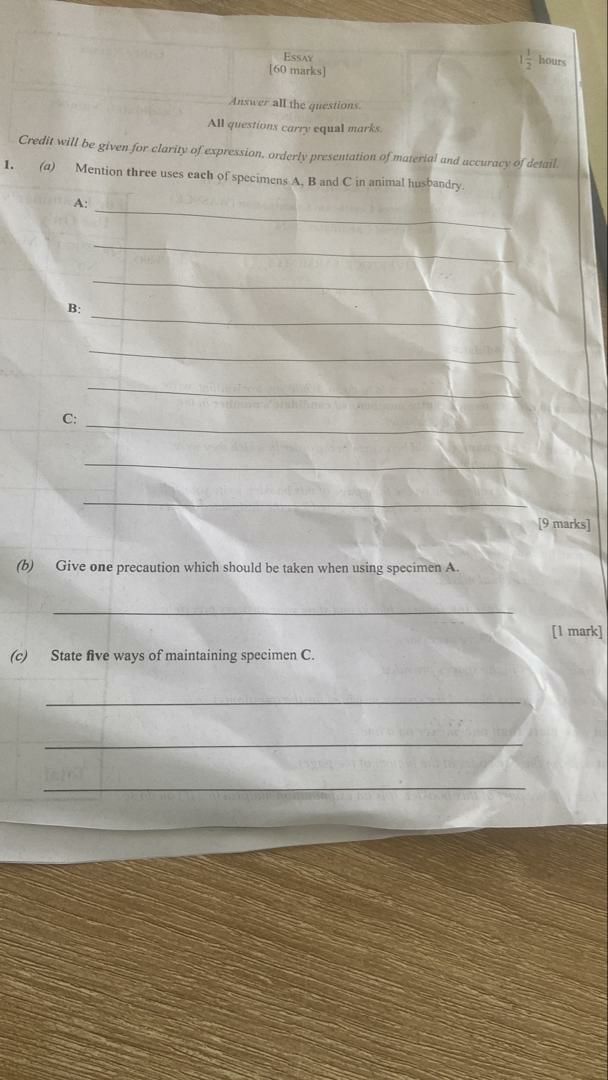
QUESTION 1
(1a) Three uses each of Specimens A, B and C in animal husbandry:
A (Cutlass):
- Clearing bushes/vegetation around animal pens.
- Cutting fodder/forage crops for feeding animals.
- Harvesting feed crops for animals.
B (Shovel):
- Removing dung/manure from animal pens.
- Digging/burying dead animals.
- Spreading manure onto farmland.
C (Wheelbarrow):
- Transporting feed/fodder to animals.
- Conveying manure from pens.
- Transporting farm tools and equipment around the farm.
(1b) One precaution when using Specimen A: Keep the blade away from the body to avoid injury and store safely when not in use.
(1c) Five ways of maintaining Specimen C:
- Oil/grease the wheel axle regularly.
- Inflate the tyre when flat.
- Clean thoroughly after use.
- Store in a dry place to prevent rusting.
- Paint metal parts to prevent corrosion.
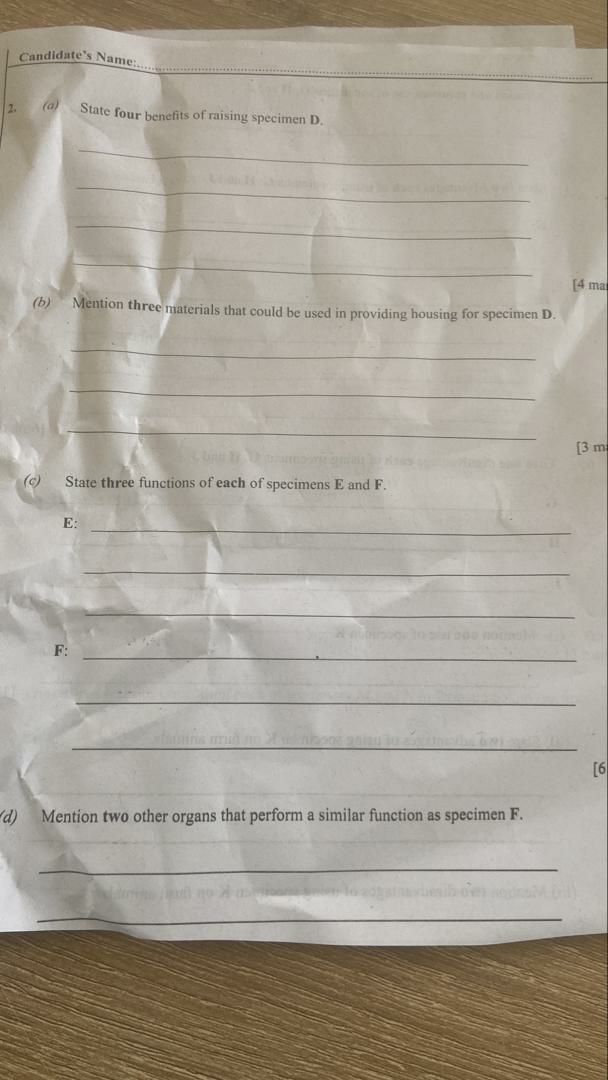
QUESTION 2
(2a) Four benefits of raising Specimen D (Rabbit):
- They reproduce rapidly with a short gestation period.
- They require little space for housing.
- They provide meat for human consumption.
- Their droppings serve as organic manure for crops.
(2b) Three materials for housing Specimen D:
- Wire mesh/netting.
- Wood/timber.
- Concrete blocks/iron sheets.
(2c) Three functions each of Specimens E and F:
E (Liver):
- Detoxifies harmful substances in the blood.
- Produces and secretes bile for fat digestion.
- Stores glycogen as an energy reserve.
F (Kidney):
- Filters blood to remove waste products (urea).
- Regulates water balance in the body.
- Maintains blood pH and electrolyte balance.
(2d) Two other organs that perform similar function as Specimen F:
- Skin — excretes salts and urea through sweat.
- Lungs — excretes carbon dioxide and water vapour.
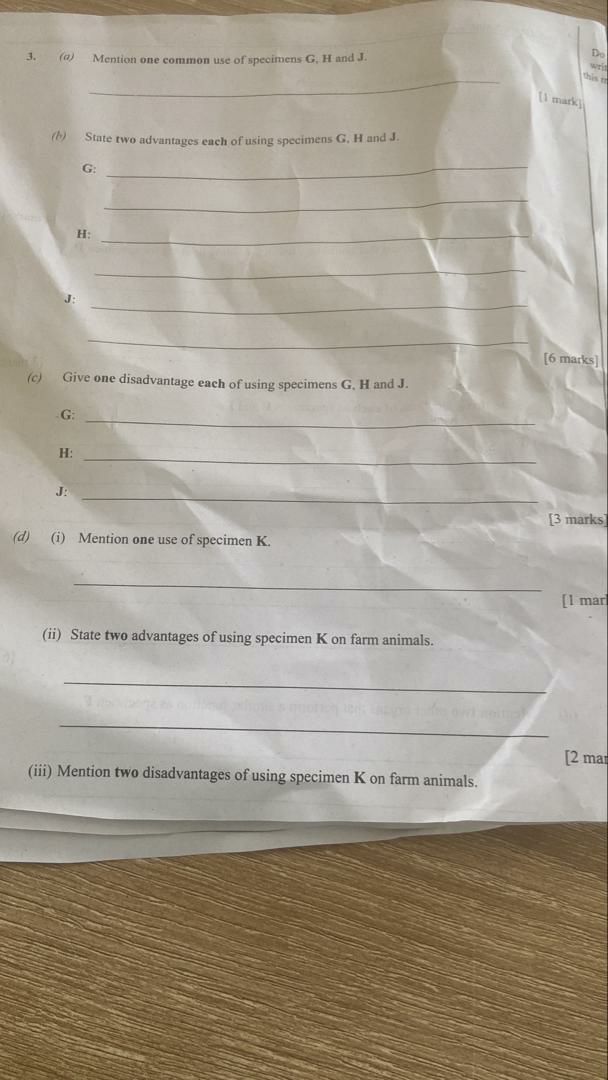
QUESTION 3
(3a) One common use of Specimens G, H and J: Identification/marking of farm animals.
(3b) Two advantages each of Specimens G, H and J:
G (Oil paint/Dye):
- Cheap and easily available.
- Painless and harmless to the animal.
H (Branding iron):
- Marking is permanent and long-lasting.
- Marks are clearly visible from a distance.
J (Tags):
- Can carry detailed information such as name, number and date of birth.
- Easy to read and update animal records.
(3c) One disadvantage each of Specimens G, H and J:
G: Not permanent — fades or washes off over time.
H: Painful and causes stress/injury to the animal.
J: Can fall off easily and may cause ear infections.
(3d)(i) One use of Specimen K (Burdizzo): Used for bloodless castration of male farm animals by crushing the spermatic cord.
(3d)(ii) Two advantages of using Specimen K:
- It is bloodless, so there is no risk of wound infection.
- Recovery is faster compared to surgical castration.
(3d)(iii) Two disadvantages of using Specimen K:
- May be ineffective if not applied correctly.
- Requires skill and expertise to use properly.
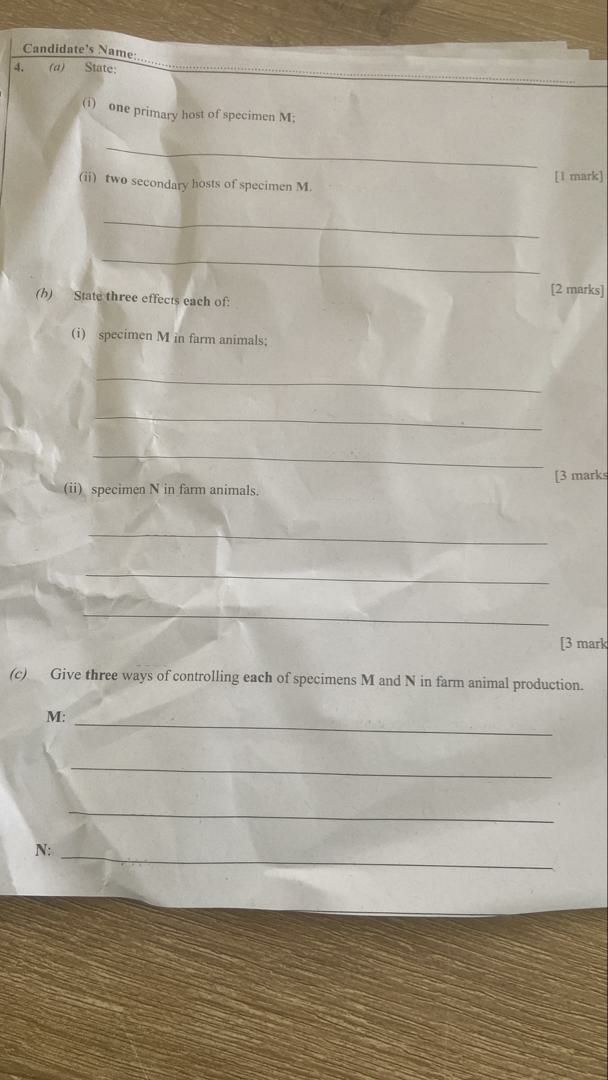
QUESTION 4
(4a)(i) One primary host of Specimen M (Tapeworm):
- Human.
(4a)(ii) Two secondary hosts of Specimen M:
- Cattle/Cow.
- Pig.
(4b)(i) Three effects of Specimen M (Tapeworm) in farm animals:
- Causes weight loss and emaciation.
- Reduces productivity.
- Causes digestive disorders such as diarrhoea and pot belly.
(4b)(ii) Three effects of Specimen N (Tick) in farm animals:
- Causes anaemia through constant blood-sucking.
- Transmits diseases such as East Coast Fever and Babesiosis.
- Damages the hide/skin, reducing its market value.
(4c) Three ways of controlling Specimens M and N:
M (Tapeworm):
- Regular deworming with anthelmintics.
- Proper disposal of animal faeces on the farm.
- Practising rotational grazing to break the life cycle.
N (Tick):
- Regular dipping or spraying of animals with acaricides.
- Rotational grazing — leaving pastures fallow to starve ticks.
- Clearing bushes around animal pens and paddocks.
📢 Share this page with your classmates now so everyone can get the 2026 WAEC Livestock Farming Practical questions and answers in one place. Copy the link and send it on WhatsApp, Telegram, and your school group chats!

 Examsmooth
Leave a comment