
UNIZIK JUPEB First Semester Chemistry Examination Questions and Answers
The Joint Universities Preliminary Examinations Board (JUPEB) is a one-year A-level programme that gives you direct entry admission into 200 level in universities like Nnamdi Azikiwe University (UNIZIK). Having access to reliable UNIZIK JUPEB Chemistry past questions is one of the best ways to prepare for your first semester exams. This guide brings together likely JUPEB First Semester Chemistry questions with answers, explanations, and tips to help you build confidence before entering the exam hall.
Section A: Objectives — JUPEB First Semester Chemistry Questions
The objective part of the UNIZIK JUPEB Chemistry past questions usually covers topics such as atomic structure, the periodic table, chemical bonding, stoichiometry, acids and bases, organic chemistry, electrochemistry, and thermochemistry. Practice these sample questions under exam conditions and then check the answers provided after the questions.
Multiple Choice Questions (Answer All Questions)
- 1. The atomic number of an element represents the:
A. Number of neutrons in the nucleus
B. Number of protons in the nucleus
C. Total number of nucleons
D. Number of electrons in the outermost shell - 2. Which of the following electronic configurations represents a noble gas?
A. 1s2 2s2 2p6
B. 1s2 2s2 2p5
C. 1s2 2s2 2p3
D. 1s2 2s1 2p6 - 3. Across a period in the periodic table, the general trend in atomic radius is that it:
A. Increases due to increase in nuclear charge
B. Decreases due to increase in nuclear charge
C. Increases due to decrease in screening effect
D. Remains constant because the number of shells is the same - 4. The bond formed between two chlorine atoms in a Cl2 molecule is best described as:
A. Ionic bond
B. Polar covalent bond
C. Non-polar covalent bond
D. Coordinate covalent bond - 5. Which of the following compounds contains both ionic and covalent bonds?
A. NaCl
B. HCl
C. NH4Cl
D. CH4 - 6. How many moles of oxygen gas are required for the complete combustion of 2.0 mol of methane according to the equation:
CH4 + 2O2 → CO2 + 2H2O ?
A. 1.0 mol
B. 2.0 mol
C. 3.0 mol
D. 4.0 mol - 7. A solution has a pH of 2. The concentration of hydrogen ions [H+] in the solution is:
A. 1 × 10⁻¹ mol dm−3
B. 1 × 10⁻² mol dm−3
C. 1 × 10⁻¹² mol dm−3
D. 1 × 10² mol dm−3 - 8. Which of the following is a weak acid?
A. HCl
B. HNO3
C. CH3COOH
D. H2SO4 - 9. The IUPAC name of CH3−CH2−CH3 is:
A. Methane
B. Ethane
C. Propane
D. Butane - 10. Which of the following statements is correct about oxidation and reduction?
A. Oxidation is loss of oxygen, reduction is gain of hydrogen
B. Oxidation is gain of electrons, reduction is loss of electrons
C. Oxidation is loss of electrons, reduction is gain of electrons
D. Oxidation and reduction always involve gain of electrons - 11. In an electrolytic cell, the electrode at which oxidation occurs is the:
A. Anode, which is positively charged
B. Cathode, which is negatively charged
C. Anode, which is negatively charged
D. Cathode, which is positively charged - 12. The heat change that occurs when one mole of a substance is completely burned in oxygen at constant pressure is called:
A. Enthalpy of formation
B. Enthalpy of combustion
C. Enthalpy of neutralisation
D. Enthalpy of solution - 13. Which of the following processes is exothermic?
A. Melting of ice
B. Evaporation of water
C. Dissolution of ammonium nitrate in water
D. Neutralisation of a strong acid by a strong base - 14. In the reaction:
2SO2(g) + O2(g) → 2SO3(g)
Which of the following changes will increase the yield of SO3?
A. Decreasing the pressure
B. Increasing the temperature
C. Adding a catalyst only
D. Increasing the pressure - 15. Which of the following functional groups is present in ethanol?
A. Carbonyl group
B. Carboxyl group
C. Hydroxyl group
D. Amino group
Answers to Section A (Objectives)
1. B 2. A 3. B 4. C 5. C 6. D 7. B 8. C 9. C 10. C 11. A 12. B 13. D 14. D 15. C
Exam Question Papers (Images)
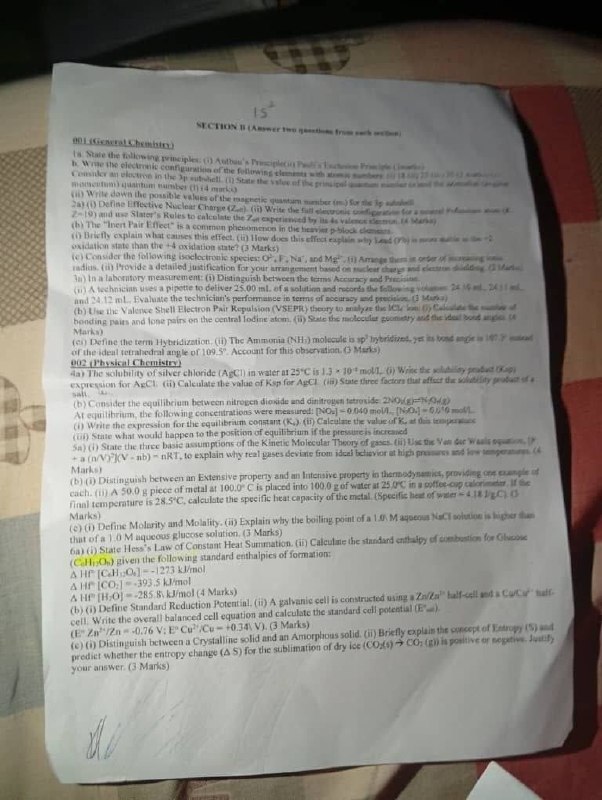
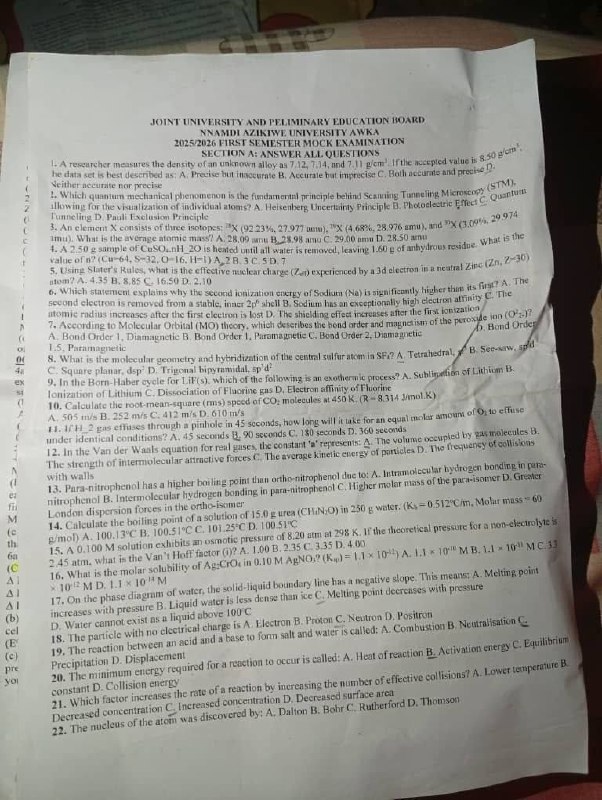
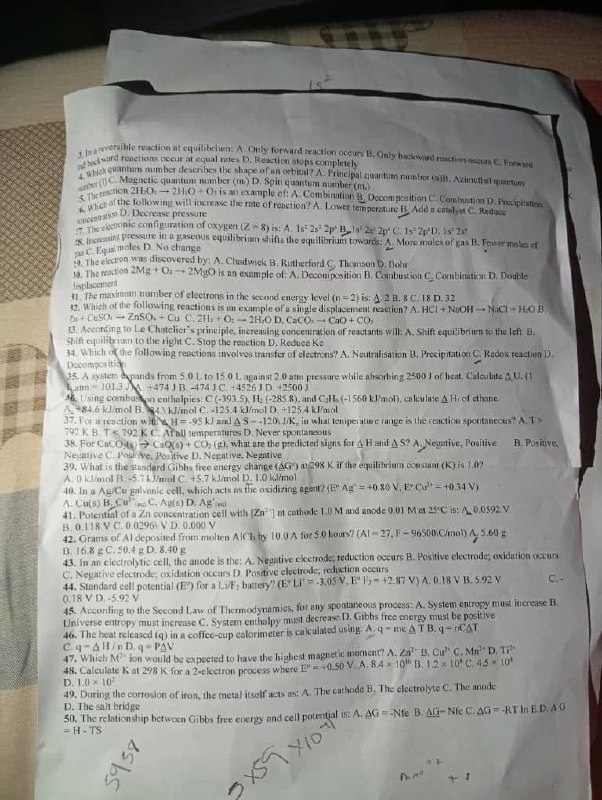
Section B: Theory — UNIZIK JUPEB Chemistry Past Questions
The theory part of JUPEB First Semester Chemistry questions requires clear explanations, balanced equations, and well-labelled diagrams where necessary. Use the following questions to practise how to organise your points and present your solutions logically.
Chemical Equilibrium
- 1. (a) Explain the term dynamic equilibrium as applied to a reversible reaction in a closed system.
(b) For the reaction:
N2(g) + 3H2(g) ⇌ 2NH3(g); ΔH = −92 kJ mol−1
(i) State and explain the effect of increasing pressure on the equilibrium position.
(ii) State and explain the effect of increasing temperature on the yield of ammonia.
(iii) Describe how a catalyst affects the rate and position of equilibrium for this reaction. - 2. Write the expression for the equilibrium constant Kc for the reaction:
CH3COOH(aq) + H2O(l) ⇌ CH3COO−(aq) + H3O+(aq)
Explain what the magnitude of Kc tells you about the strength of ethanoic acid.
Electrochemistry
- 3. (a) Define standard electrode potential, E°.
(b) Given the following standard electrode potentials:
Zn2+ + 2e− ⇌ Zn(s); E° = −0.76 V
Cu2+ + 2e− ⇌ Cu(s); E° = +0.34 V
(i) Draw a labelled diagram of the electrochemical cell formed from these half-cells.
(ii) Calculate the standard emf of the cell.
(iii) State the direction of electron flow when the cell is set up. - 4. Explain the differences between an electrolytic cell and a galvanic (voltaic) cell under the following headings:
(i) source of energy
(ii) direction of electron flow
(iii) sign of anode and cathode
(iv) typical examples.
Organic Chemistry Reactions
- 5. (a) Using equations, describe how ethanol can be prepared from:
(i) Ethene
(ii) Glucose (through fermentation).
(b) State two differences between addition polymerisation and condensation polymerisation with relevant examples. - 6. (a) What is meant by homologous series?
(b) Outline three general characteristics of members of a homologous series.
(c) Write the structural formula and IUPAC name of:
(i) An alcohol containing three carbon atoms
(ii) A carboxylic acid containing two carbon atoms.
Thermodynamics and Thermochemistry
- 7. (a) Define each of the following terms:
(i) Enthalpy change (ΔH)
(ii) Hess’s law.
(b) Given the following data:
C(s) + O2(g) → CO2(g); ΔH = −393 kJ mol−1
2CO(g) + O2(g) → 2CO2(g); ΔH = −566 kJ mol−1
Use Hess’s law to calculate the enthalpy change for:
2C(s) + O2(g) → 2CO(g). - 8. Explain briefly why many chemical reactions that are exothermic may still not occur spontaneously at room temperature. In your answer, refer to activation energy and collision theory.
Sample UNIZIK JUPEB Chemistry Exam Pages
The images below show sample pages from real UNIZIK JUPEB Chemistry past questions. Use them to familiarise yourself with the exam layout, instructions, and the way questions are structured on the answer booklet.
How to Pass JUPEB Chemistry (UNIZIK-Focused Tips)
To make the most of these UNIZIK JUPEB Chemistry past questions and secure a strong grade in first semester, apply the following strategies consistently from the beginning of the session.
- 1. Master the JUPEB syllabus early
Get the official JUPEB Chemistry syllabus and mark out key areas like atomic structure, periodic trends, stoichiometry, kinetics, equilibrium, electrochemistry, and introductory organic chemistry. Use the syllabus as a checklist when reading. - 2. Study with past questions in a timed way
Do not just skim through JUPEB First Semester Chemistry questions. Set a timer and attempt Section A and Section B as if you are in the exam. After marking your work, write short correction notes where you missed questions. - 3. Focus on understanding, not cramming
JUPEB examiners usually twist familiar questions. Instead of memorising answers, understand concepts such as mole calculations, redox processes, Le Chatelier’s principle, and organic reaction mechanisms so you can apply them to new problems. - 4. Build calculation speed and accuracy
Stoichiometry, thermochemistry, and electrochemistry questions often involve calculations. Practise with a scientific calculator, learn how to set up equations step by step, and always show working clearly the way JUPEB markers expect. - 5. Practise drawing clear, labelled diagrams
For topics like electrochemical cells, apparatus for preparation of gases, and titration set-ups, neat diagrams with correct labels can earn easy marks. Use a ruler and keep the diagrams simple but accurate. - 6. Form a serious study group
Study groups with committed JUPEB students can help you explain difficult topics to one another, exchange materials, and practise UNIZIK JUPEB Chemistry past questions together every week. - 7. Attend tutorials and consult your lecturers
If your centre or UNIZIK offers JUPEB tutorials, attend regularly and ask specific questions from the past questions you attempted. Lecturers can point out common mistakes and favourite question patterns. - 8. Train yourself to answer theory questions in points
For Section B theory, write in short, clear points and use correct chemical terms, equations, and units. Underline key terms and make sure each point answers the exact demand of the question. - 9. Revise regularly, not only before exams
Set a weekly revision schedule where you solve a mixed set of JUPEB Chemistry questions and answers from different topics. Constant revision helps you retain formulas and concepts till exam day. - 10. Take care of your health before the exam
Sleep well, eat light but balanced meals, and stay hydrated. Entering the exam hall with a clear mind will help you recall everything you have practised from these UNIZIK JUPEB Chemistry materials.
Final Thoughts
If you take time to practise these UNIZIK JUPEB Chemistry past questions, study the marking style, and apply the tips in this guide, you will be well prepared for your JUPEB First Semester Chemistry questions. Start early, be consistent, and use every past question as an opportunity to test and improve your understanding. With discipline and prayer, you can finish JUPEB Chemistry with a strong grade and move confidently into 200 level.
 Examsmooth
Leave a comment