
NABTEB May/June 2026 Timetable for Nigerian Students (Business & Technical)
The National Business and Technical Examinations Board (NABTEB) conducts the May/June examinations for senior secondary Business and Technical candidates across Nigeria. This guide breaks down the NABTEB May/June 2026 timetable in a simple, student-friendly format so you can plan your reading schedule and avoid missing any paper.
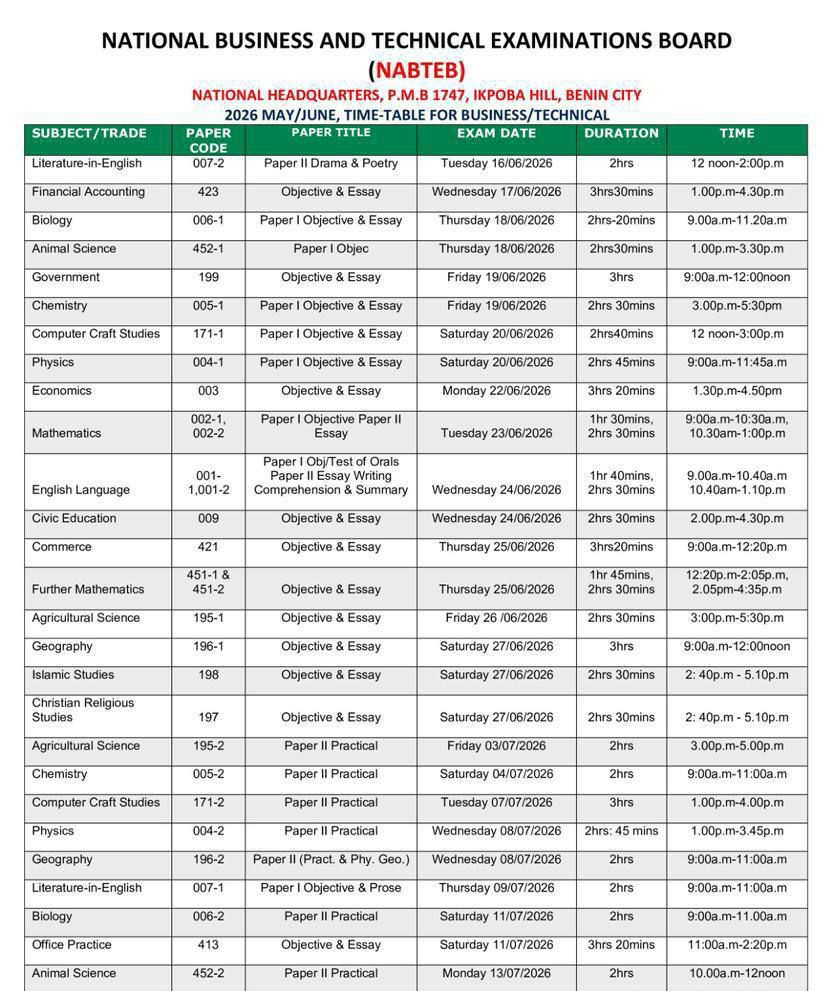
Key Exam Information (NABTEB May/June 2026)
- Exam body: National Business and Technical Examinations Board (NABTEB)
- Exam: May/June 2026
- Candidates: Business and Technical students in approved NABTEB centres
- Official site: nabteb.gov.ng
Detailed NABTEB May/June 2026 Timetable (Business & Technical)
The structured timetable below follows the official NABTEB May/June 2026 schedule pattern for Business and Technical candidates. Morning papers start by 9:30am, while afternoon papers begin by 2:00pm. Always confirm any last-minute adjustments from your school and the official NABTEB website.
| Date | Subject / Paper | Paper Code | Duration | Time |
|---|---|---|---|---|
| Monday, 18 May 2026 | ||||
| 18 May 2026 | Office Practice — Objective & Essay | 4301-1 | 2 hrs 30 mins | 9:30am – 12:00pm |
| 18 May 2026 | Bookkeeping & Accounting — Objective & Essay | 4302-1 | 2 hrs 30 mins | 2:00pm – 4:30pm |
| Tuesday, 19 May 2026 | ||||
| 19 May 2026 | Commerce — Objective & Essay | 4303-1 | 2 hrs 30 mins | 9:30am – 12:00pm |
| 19 May 2026 | Typewriting — Theory | 4304-1 | 2 hrs | 2:00pm – 4:00pm |
| Wednesday, 20 May 2026 | ||||
| 20 May 2026 | Typewriting — Practical | 4304-2 | 1 hr 30 mins | 9:30am – 11:00am |
| 20 May 2026 | Shorthand — Theory | 4305-1 | 2 hrs | 2:00pm – 4:00pm |
| Thursday, 21 May 2026 | ||||
| 21 May 2026 | Shorthand — Dictation & Transcription (Practical) | 4305-2 | 1 hr 30 mins | 9:30am – 11:00am |
| 21 May 2026 | Business Mathematics & Statistics | 4306-1 | 2 hrs 30 mins | 2:00pm – 4:30pm |
| Friday, 22 May 2026 | ||||
| 22 May 2026 | English Language — Objective & Essay (Business/Technical) | 4501-1 | 2 hrs 30 mins | 9:30am – 12:00pm |
| 22 May 2026 | Mathematics — Objective & Essay (Business/Technical) | 4502-1 | 2 hrs 30 mins | 2:00pm – 4:30pm |
| Monday, 25 May 2026 | ||||
| 25 May 2026 | Building Construction — Theory | 4401-1 | 3 hrs | 9:30am – 12:30pm |
| 25 May 2026 | Blocklaying, Bricklaying & Concreting — Practical | 4402-2 | 2 hrs | 2:00pm – 4:00pm |
| Tuesday, 26 May 2026 | ||||
| 26 May 2026 | Electrical Installation — Theory | 4403-1 | 3 hrs | 9:30am – 12:30pm |
| 26 May 2026 | Electrical Installation — Practical | 4403-2 | 2 hrs | 2:00pm – 4:00pm |
| Wednesday, 27 May 2026 | ||||
| 27 May 2026 | Auto Mechanics — Theory | 4404-1 | 3 hrs | 9:30am – 12:30pm |
| 27 May 2026 | Auto Mechanics — Practical | 4404-2 | 2 hrs | 2:00pm – 4:00pm |
| Thursday, 28 May 2026 | ||||
| 28 May 2026 | Metalwork Technology — Theory | 4405-1 | 3 hrs | 9:30am – 12:30pm |
| 28 May 2026 | Welding & Fabrication — Practical | 4406-2 | 2 hrs | 2:00pm – 4:00pm |
| Friday, 29 May 2026 | ||||
| 29 May 2026 | Computer Studies — Theory | 4307-1 | 2 hrs | 9:30am – 11:30am |
| 29 May 2026 | Computer Studies — Practical | 4307-2 | 1 hr 30 mins | 2:00pm – 3:30pm |
Important Notes for All NABTEB Candidates
- Candidates must arrive at least 30 minutes before exam time. This gives room for clearance, sitting arrangement and last-minute instructions from invigilators.
- Mobile phones and electronic devices are strictly prohibited inside the examination hall. Do not bring calculators or gadgets except those clearly allowed by NABTEB.
- Visit nabteb.gov.ng for the complete and most current timetable. If there is any conflict between this guide and the official timetable, always follow the official version.
How to Use the NABTEB Timetable for Effective Preparation
Do not wait until the week of your exam before looking at the NABTEB timetable. Use it now to plan how you will read and practice past questions.
- Create a personal study calendar: Copy out all your registered subjects, with their exact dates and times, into a notebook or digital calendar. Highlight the ones coming earlier.
- Group subjects by similarity: For example, read Office Practice together with Commerce and Bookkeeping, or group Building Construction with Blocklaying and other construction subjects. This helps you revise faster.
- Start with tough subjects: Any paper you find difficult (like Mathematics, Shorthand or some practicals) should get extra time weeks before the exam starts.
- Practice under timed conditions: Set a timer for 2–3 hours and answer past NABTEB questions as if you are in the real hall. This builds speed and confidence.
- Balance theory and practicals: Practical subjects like Typewriting, Electrical Installation, Auto Mechanics and Welding require hands-on practice. Schedule regular workshop or lab sessions, not just reading notes.
- Sleep well before each paper: Avoid overnight reading on the eve of your exam. A clear mind will help you recall what you have studied.
Exam Day Tips for NABTEB May/June 2026
- Pack your materials a day before: Ensure your exam slip, ID card, writing materials and approved calculator (if allowed) are ready.
- Know your centre and hall: Visit the centre ahead of time if possible, so you do not get confused on the exam day.
- Eat light but healthy: Take light food and water before leaving home so you do not feel weak during the paper.
- Follow all instructions: Listen carefully to invigilators and read the instructions printed on the question paper before you start writing.
- Manage your time: Divide the exam time by the number of questions to know how long you can spend on each section.
- Avoid examination malpractice: Any form of malpractice can lead to the cancellation of your paper or all your results. It is not worth the risk.
- Review your work: If you finish early, use the remaining time to check calculations, spelling and numbering of answers.
Join Exam Update Groups (WhatsApp & Telegram)
Stay updated with NABTEB May/June 2026 news, study materials and last-minute timetable notices by joining our free student communities.
 Examsmooth
Leave a comment